
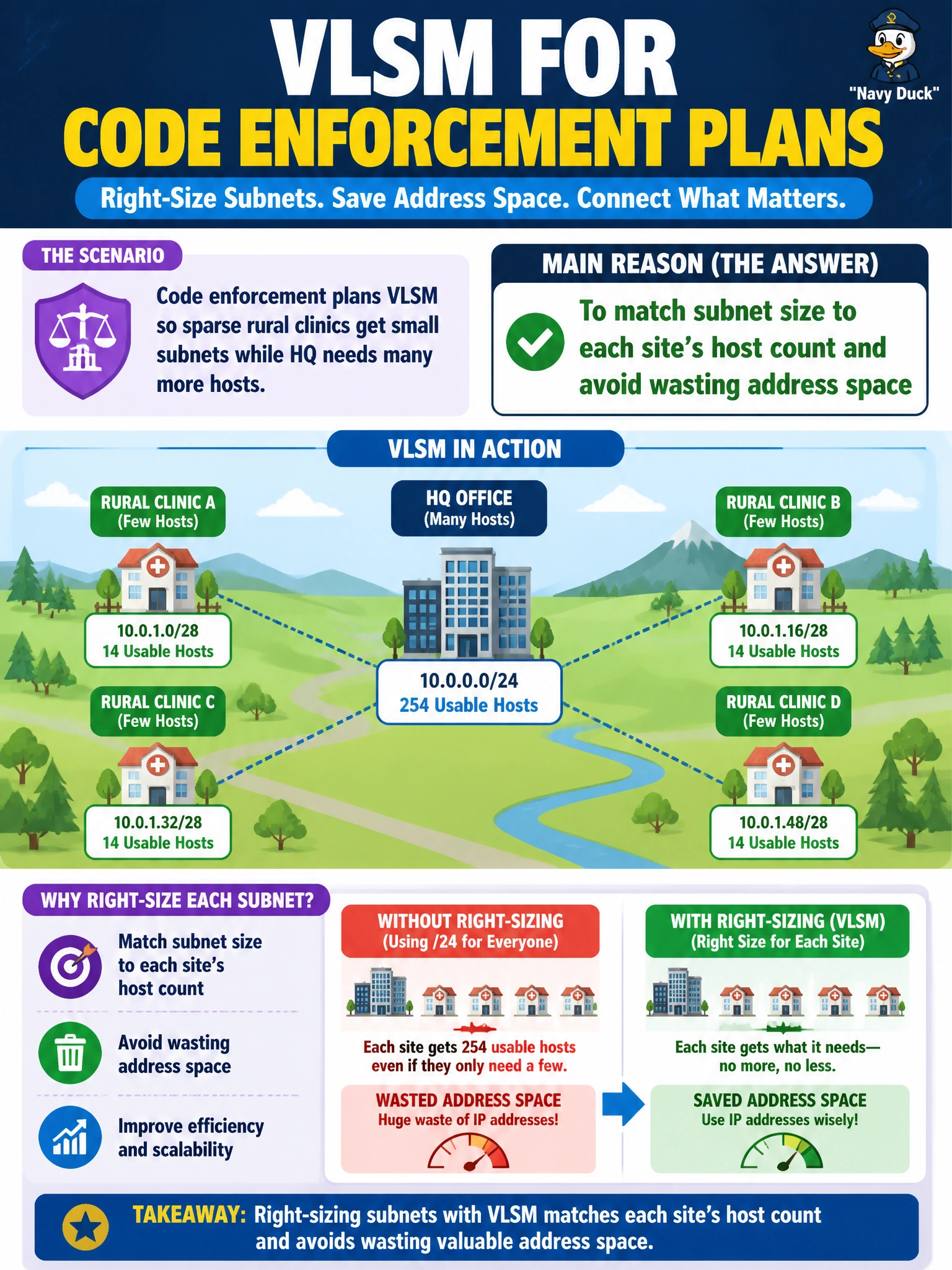
Code enforcement plans VLSM so sparse rural clinics get small subnets while HQ needs many more hosts. What is the main reason to right-size each subnet this way?
Select an answer to reveal the explanation.
Short Explanation
Think of parking lots sized for the cars you actually have — a tiny clinic does not need a stadium lot. VLSM lets you hand out smaller prefixes where demand is low and larger ones at HQ so addresses are not wasted.
Full Explanation
Code enforcement is planning VLSM so sparse rural clinics receive small subnets while headquarters needs far more hosts. The core purpose of variable-length subnet masking is to right-size each prefix to the actual host count at that site, which conserves scarce private (or public) address space and keeps routing summaries intentional. A clinic that needs a handful of endpoints can take a /28 or /27; HQ that needs hundreds can take a /24 or larger—without forcing every site onto the same wasteful mask.
Forcing every site onto the same /24 regardless of host count defeats VLSM and wastes addresses at small clinics. Replacing all private addressing with public Internet space is unrelated to VLSM sizing and is usually undesirable for internal desks. Disabling routing between clinics to force a flat Layer 2 campus is an architecture choice about L2 vs L3, not a reason to VLSM; VLSM assumes you still route between differently sized prefixes.
Exam caveat: VLSM answers focus on efficient allocation and matching prefix length to required host/subnet counts. Do not confuse VLSM with “use public space” or “eliminate routing.” Also remember that VLSM still requires careful non-overlapping assignment and consistent routing.
Operational check for the municipal plan: list each clinic and HQ host requirement, choose the smallest prefix that covers hosts plus growth and network/broadcast, ensure blocks do not overlap, and verify routing (or summarization) between those prefixes on the distribution/core devices. Spot-check with show ip route / addressing spreadsheets that a rural clinic /28 and the HQ /23 both appear as intended connected or static/dynamic routes.