
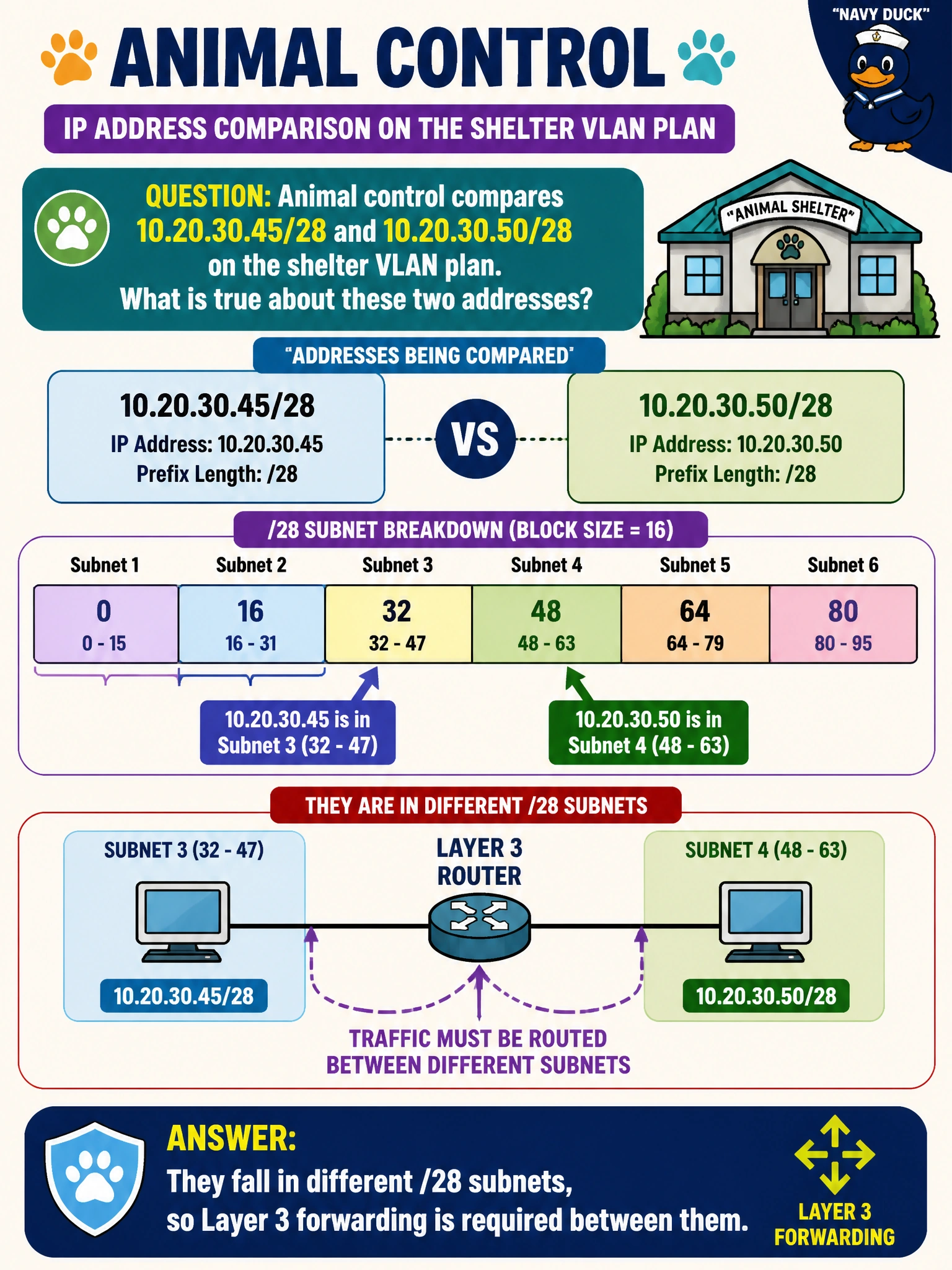
Animal control compares 10.20.30.45/28 and 10.20.30.50/28 on the shelter VLAN plan. What is true about these two addresses?
Select an answer to reveal the explanation.
Short Explanation
Picture cutting a street into 16-house blocks — .45 sits in the .32–.47 block and .50 sits in the .48–.63 block. Same /28 length does not mean same block. Those hosts need a router (or L3 switch) to talk.
Full Explanation
Animal control is comparing 10.20.30.45/28 and 10.20.30.50/28 on the shelter VLAN plan. A /28 mask creates fixed 16-address blocks, so subnet membership is determined by which block each host falls into, not merely by sharing the same prefix length. 10.20.30.45 sits in 10.20.30.32/28 (network .32, usable .33–.46, broadcast .47). 10.20.30.50 sits in 10.20.30.48/28 (network .48, usable .49–.62, broadcast .63). Because those are different Layer 3 networks, on-link ARP cannot bridge them; a router or Layer 3 switch must forward between the two /28s.
The option that claims both addresses belong to the same /28 and can communicate without a router fails the subnet-boundary check: same mask length is not the same as same network number. The claim that both addresses use a /24 mask is factually wrong—the plan states /28—and therefore cannot be used to decide membership. The claim that only the second address is a network address and the first is invalid misidentifies both hosts: neither .45 nor .50 is the network ID of its block (.32 and .48 respectively), and both are valid usable host addresses inside their own /28.
Exam caveat: CCNA items often tempt candidates to treat “same prefix length” as “same subnet.” Always compute the block start by zeroing host bits, then compare network IDs. Adjacent-looking decimals can still sit across a /28 boundary.
Operational check on the shelter VLAN: from a host at .45, confirm its configured gateway is inside 10.20.30.32/28; attempt ARP for .50 and expect failure on-link; verify that inter-host reachability succeeds only through the SVI or router that owns both subnets. Document both network IDs in the VLAN plan so future animal-control moves do not assume L2 adjacency across the cut.