
A public works yard documents the mask 255.255.255.192 for a new CCTV segment. Which prefix length matches that dotted-decimal mask?
Select an answer to reveal the explanation.
Short Explanation
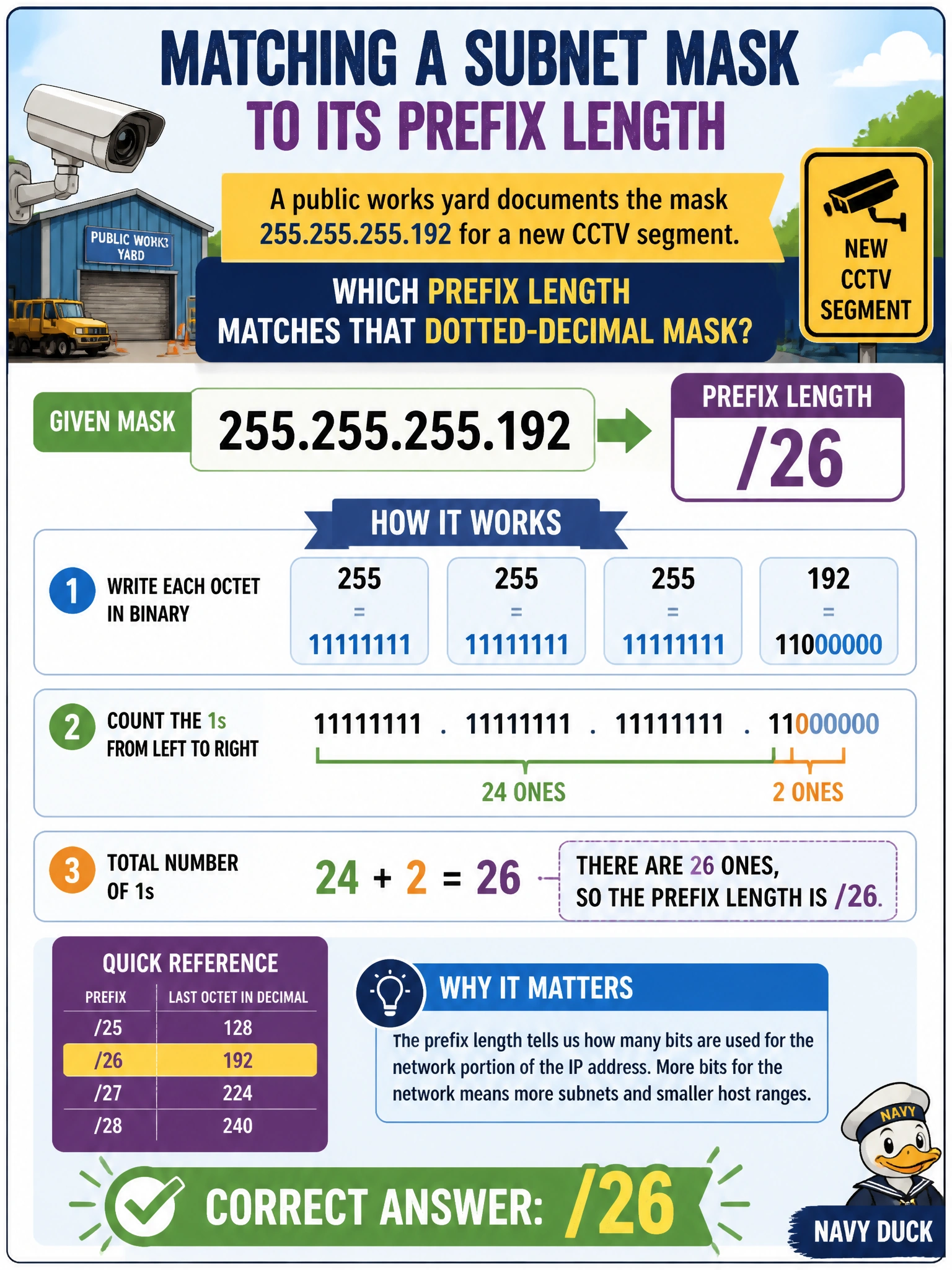
Count the ones: 255.255.255 is twenty-four ones, and .192 adds two more (11000000) for twenty-six total. So 255.255.255.192 is simply /26 — easy mask math for the ticket notes.
Full Explanation
A public works yard documents the mask 255.255.255.192 for a new CCTV segment and needs the matching prefix length. Convert dotted decimal to binary ones: 255.255.255 contributes 24 consecutive ones. The fourth octet 192 is 11000000 in binary, which adds two more ones, for a total of 26 ones. Therefore 255.255.255.192 equals /26. Equivalently, /26 yields 64 addresses per subnet (2^(32-26)), with 62 usable hosts after network and broadcast—consistent with a modest CCTV VLAN.
/24 would be 255.255.255.0 (twenty-four ones only), which is a larger subnet than .192 describes. /27 is 255.255.255.224 (twenty-seven ones), a smaller block than /26. /30 is 255.255.255.252, typically used for point-to-point links with only two usable hosts—not what .192 encodes.
Exam caveat: memorize common last-octet masks (/25=.128, /26=.192, /27=.224, /28=.240, /29=.248, /30=.252) or always count bits; do not confuse host-count tables with prefix notation under time pressure.
Operational check on the CCTV segment: configure or verify the interface/SVI mask as 255.255.255.192 or /26, confirm the network and broadcast for the chosen base address, and ensure camera DHCP pools or statics stay inside the usable range. A mismatch (for example documenting /26 but applying /24) will place hosts in the wrong on-link domain relative to the gateway.