
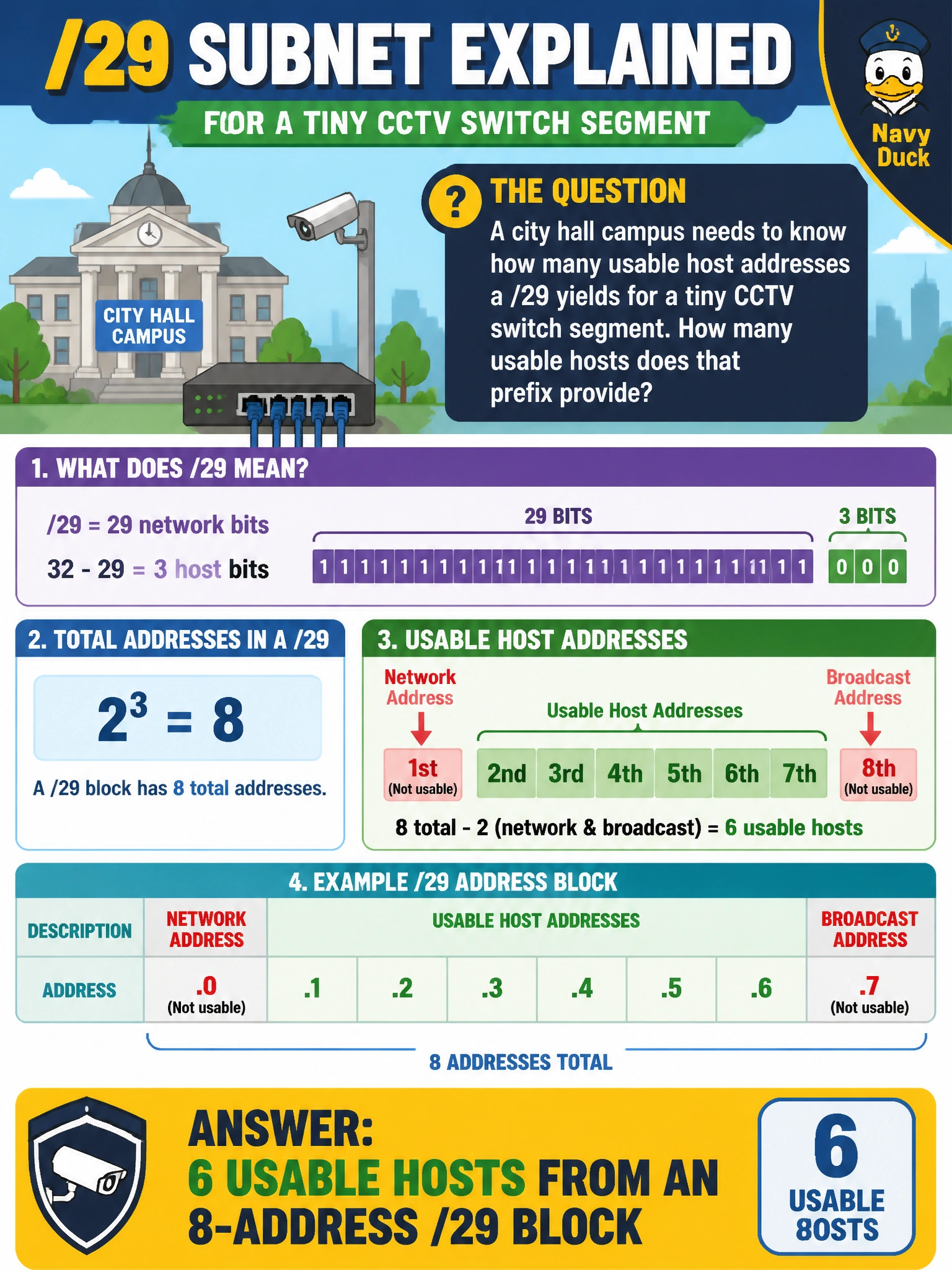
A city hall campus needs to know how many usable host addresses a /29 yields for a tiny CCTV switch segment. How many usable hosts does that prefix provide?
Select an answer to reveal the explanation.
Short Explanation
A /29 is a little 8-address parking lot: subtract the network and broadcast addresses and you have six usable spots for cameras and the gateway. You can keep the larger /28 and /27 blocks straight by remembering that /29 provides 6 usable hosts.
Full Explanation
A /29 contains 8 total addresses because 2^(32−29) = 8. Subtract the network and broadcast addresses, and 6 usable host addresses remain—enough for a tiny CCTV switch segment, such as a few cameras plus a gateway. Thus, 6 usable hosts from an 8-address /29 block gives the correct count. The claim of 14 usable hosts, as if the mask were /28, fails because /28 contains 16 total addresses and provides 14 usable hosts; it is a different, larger prefix. The claim of 30 usable hosts, matching a /27 allocation, also uses a different prefix: /27 contains 32 total addresses and provides 30 usable hosts. The claim of 2 usable hosts only if the prefix is treated as /30 confuses /29 with /30, which contains 4 total addresses and provides 2 usable hosts. An exam caveat is that these adjacent prefixes often appear as distractors, so memorize the sequence: /30 provides 2 usable hosts, /29 provides 6, /28 provides 14, and /27 provides 30. As a practical check, assign the CCTV segment a /29, place the gateway and up to five other hosts in its six usable addresses, and verify that the broadcast address is the last address in the 8-address block. If a plan calls for 14 cameras on that /29, it has confused the prefix with /28 and will run out of addresses; count usable hosts before ordering cameras so devices are not left without addresses.