
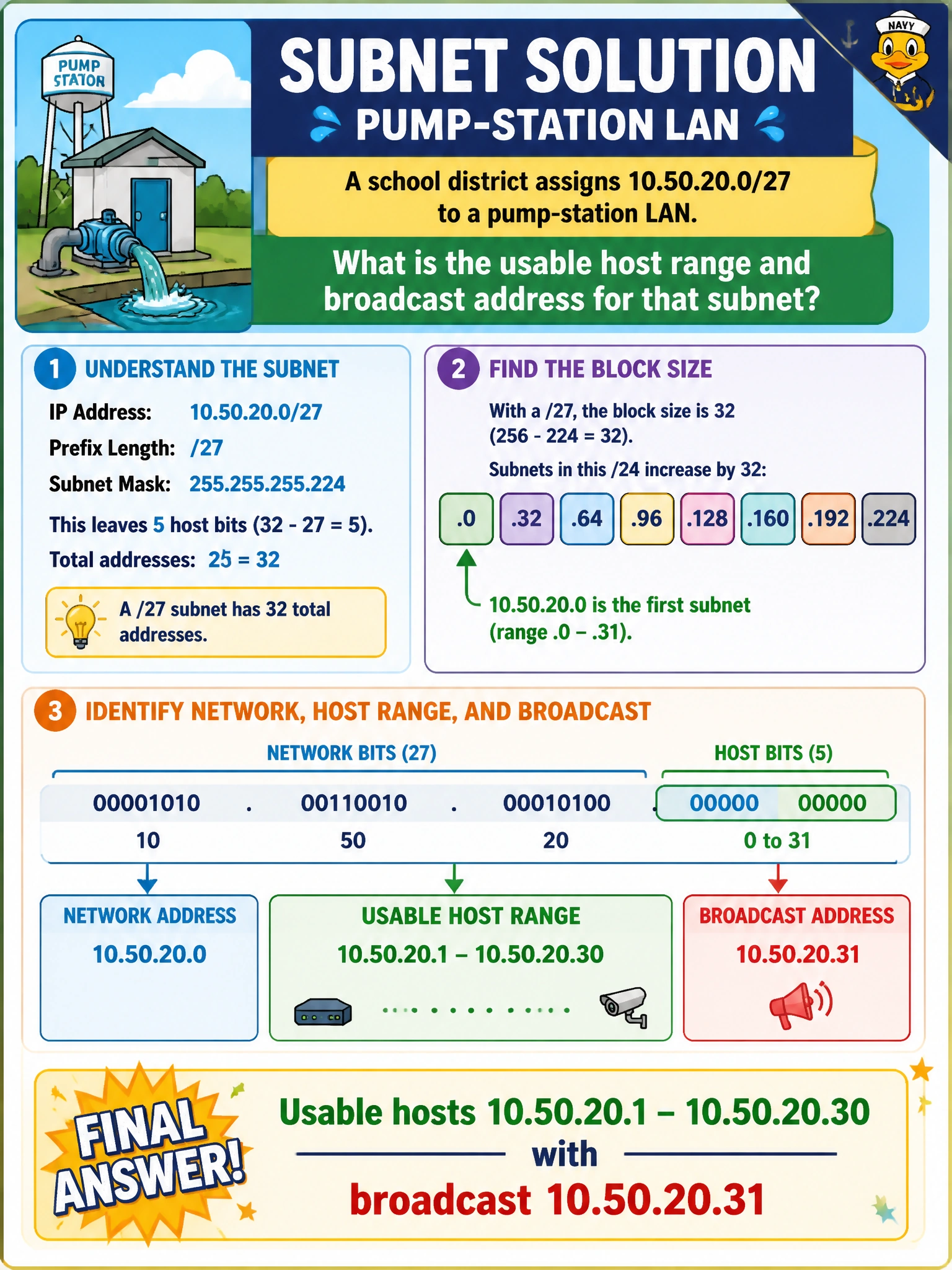
A school district assigns 10.50.20.0/27 to a pump-station LAN. What is the usable host range and broadcast address for that subnet?
Select an answer to reveal the explanation.
Short Explanation
A /27 is a 32-address block: network at .0, usable .1 through .30, broadcast .31. Don't hand out the network or broadcast as host IPs—that's the classic trap.
Full Explanation
A /27 provides 32 addresses total (2^(32-27) = 32). For 10.50.20.0/27, the network address is 10.50.20.0, the broadcast is 10.50.20.31, and the usable host range is 10.50.20.1 through 10.50.20.30. That is the correct usable range and broadcast for the school district's pump-station LAN allocation.
Usable hosts 10.50.20.0–10.50.20.31 with no reserved network address fails because .0 is the network identifier and .31 is broadcast—neither is a usable host address in ordinary IPv4 subnetting taught on CCNA. Usable hosts 10.50.20.1–10.50.20.62 with broadcast 10.50.20.63 fails by concept—that range describes a /26 (64 addresses), not a /27. Only one usable host at 10.50.20.0 with broadcast 10.50.20.255 fails because it misstates both the usable count and the broadcast for a /27.
Exam caveat: Usable hosts = total addresses − 2 (network and broadcast), except special cases like /31-/32 that the exam will call out explicitly. Know /27 → 32 total → 30 usable.
Operational check: Configure the pump-station gateway as 10.50.20.1/27 (or another address inside .1–.30), set hosts with matching mask, and ping within the range. Attempting to use .0 or .31 as a host IP, or using a /26-sized plan on a /27 wire, will produce addressing errors and troubleshooting noise.