
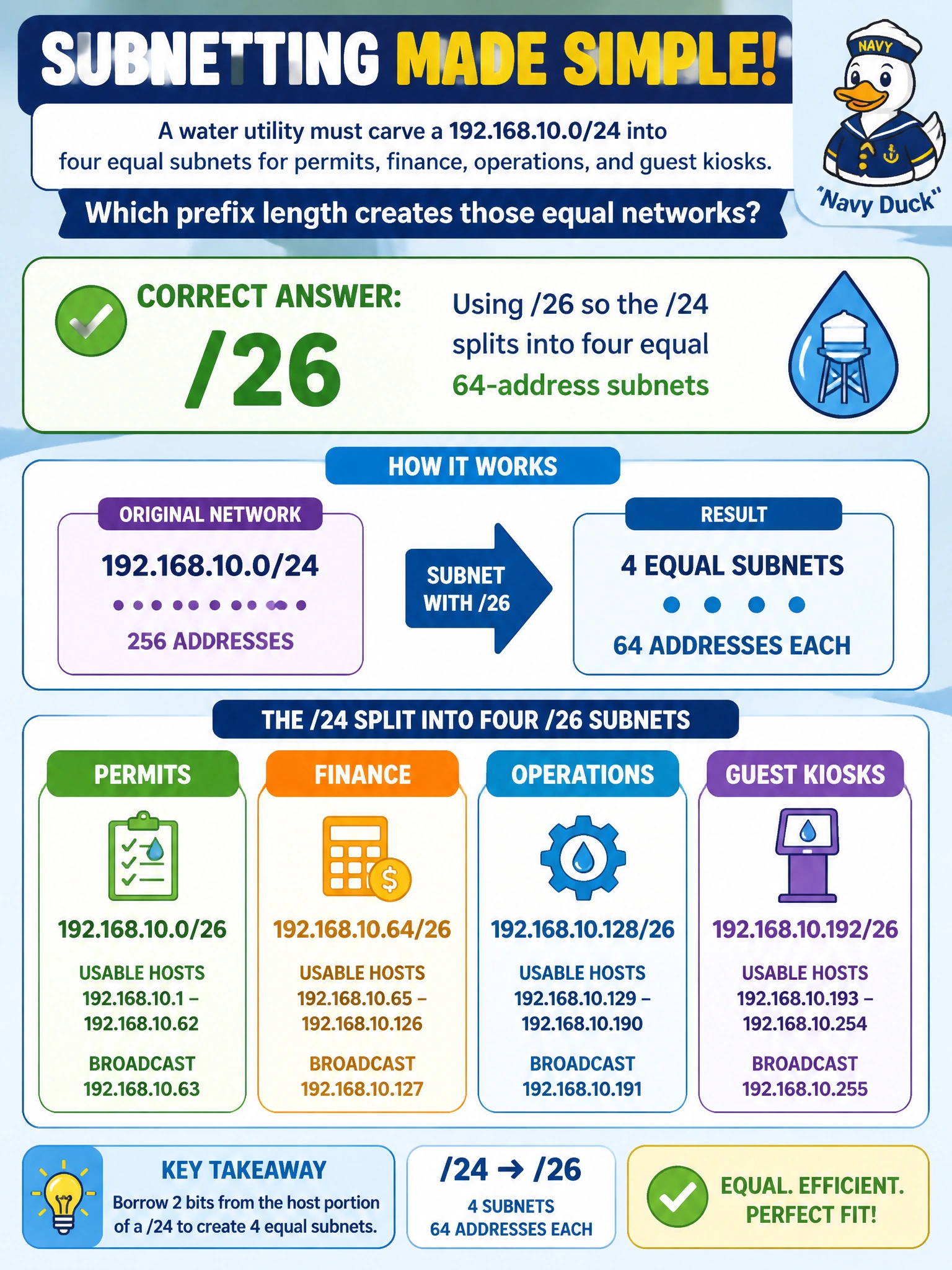
A water utility must carve a 192.168.10.0/24 into four equal subnets for permits, finance, operations, and guest kiosks. Which prefix length creates those equal networks?
Select an answer to reveal the explanation.
Short Explanation
A /24 is a pizza; /26 cuts it into four equal slices of 64 addresses each—perfect for four departments. Leaving /24 flat shares one big domain; /16 makes the pizza bigger, not more slices.
Full Explanation
Carving 192.168.10.0/24 into four equal subnets for permits, finance, operations, and guest kiosks requires borrowing two bits from the host portion (2^2 = 4 networks). That yields /26 prefixes: four subnets of 64 addresses each (62 usable hosts apiece), which cleanly maps one equal block per department. Using /26 is therefore the correct prefix length for equal four-way subdivision of the /24.
Keeping /24 unchanged so each department shares one flat broadcast domain fails because it does not create four networks—it leaves one. Using /30 only, which yields sixty-four equal department-sized subnets from a /24, fails by concept: /30 creates many tiny 4-address (2 usable) subnets, far more than four and far too small for department LANs. Using /16, which enlarges the space instead of subdividing the /24, fails because /16 is a larger supernet summary concept, not a subdivision of this /24 into four.
Exam caveat: Number of equal subnets = 2^(bits borrowed). Four subnets → +2 bits → /26 from a /24. Do not confuse "more subnets" (/30) with "four equal department subnets."
Operational check: Allocate 192.168.10.0/26, .64/26, .128/26, and .192/26 (or the equivalent four /26s), assign gateways, and verify each department's broadcast domain is separate. If all four departments still share 192.168.10.0/24 without mask changes, inter-department broadcast isolation and the requested equal split have not been implemented.