
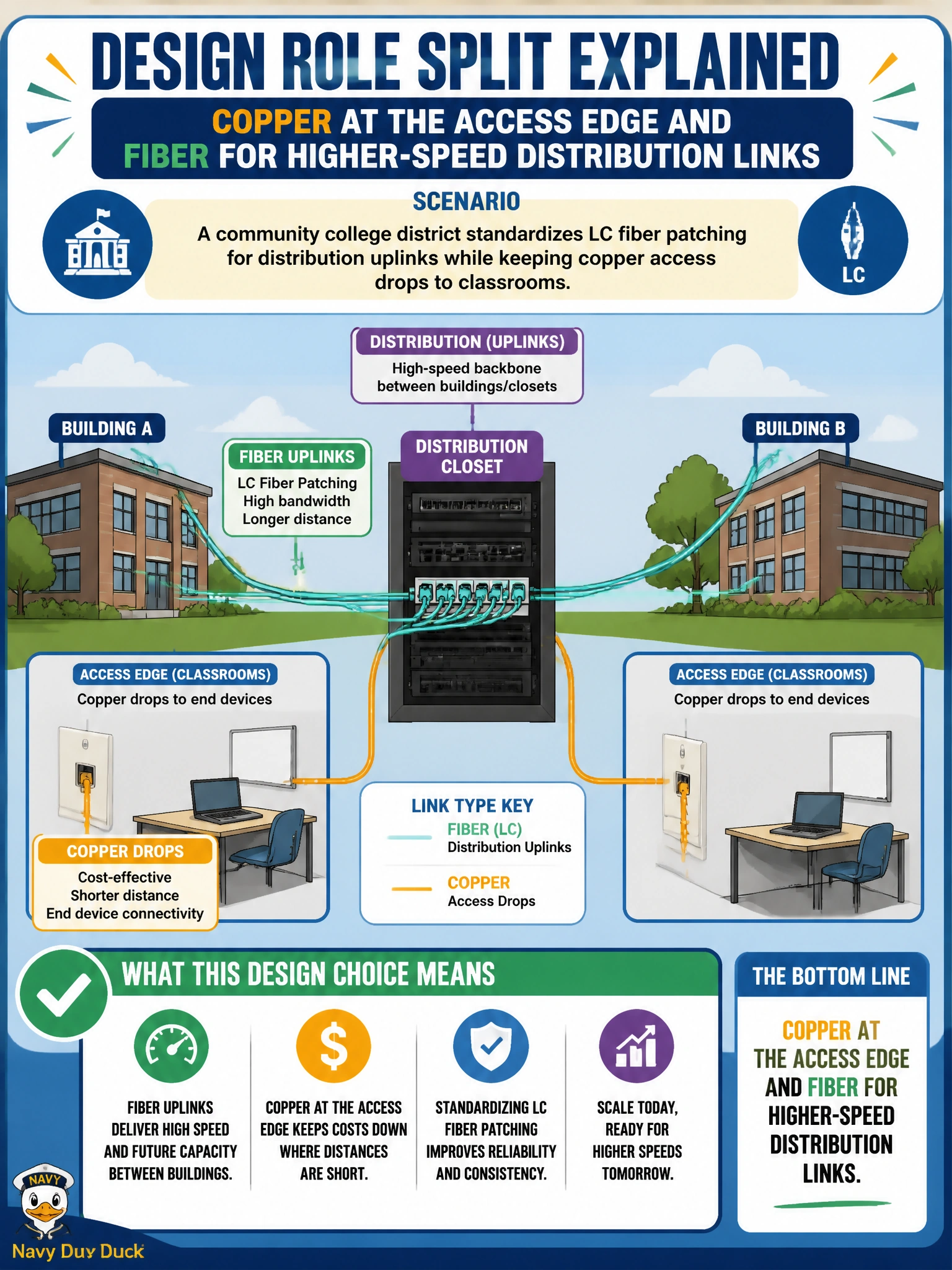
A community college district standardizes LC fiber patching for distribution uplinks while keeping copper access drops to classrooms. Which design role split does that reflect?
Select an answer to reveal the explanation.
Short Explanation
Classrooms get copper drops like regular wall jacks; the closet-to-closet muscle uses fiber LC patches. Flip that and you overbuild desks and underbuild the backbone.
Full Explanation
A community college district that standardizes LC fiber patching for distribution uplinks while keeping copper access drops to classrooms is splitting roles by layer: copper at the access edge for cost-effective desk/classroom connectivity (and PoE where needed), and fiber for higher-speed, longer, or cleaner distribution links between closets and buildings. That access-versus-distribution media split is a standard campus design pattern.
Fiber access to every desk and copper-only distribution between buildings fails because it inverts the usual economics and operations—fiber-to-every-desk is uncommon for ordinary classrooms when copper suffices, and copper-only building distribution often loses to fiber on distance/EMI/speed. Wireless-only distribution with no wired closet uplinks at all fails by concept: distribution uplinks are wired fiber/copper plant, not "wireless-only." Serial console cabling as the primary student data path fails because console cables are for device management, not student data forwarding.
Exam caveat: Access edge ≈ copper drops; distribution/core uplinks ≈ fiber (LC common for patching). Do not flip that split unless the stem explicitly requires fiber to the desk.
Operational check: Confirm classroom wall jacks are copper to access switches, and that distribution uplinks use LC fiber with matching optics. If distribution between buildings is still copper past distance limits, or if every desk was fiber-homed without requirement, the implemented plant does not match the standardized role split.