
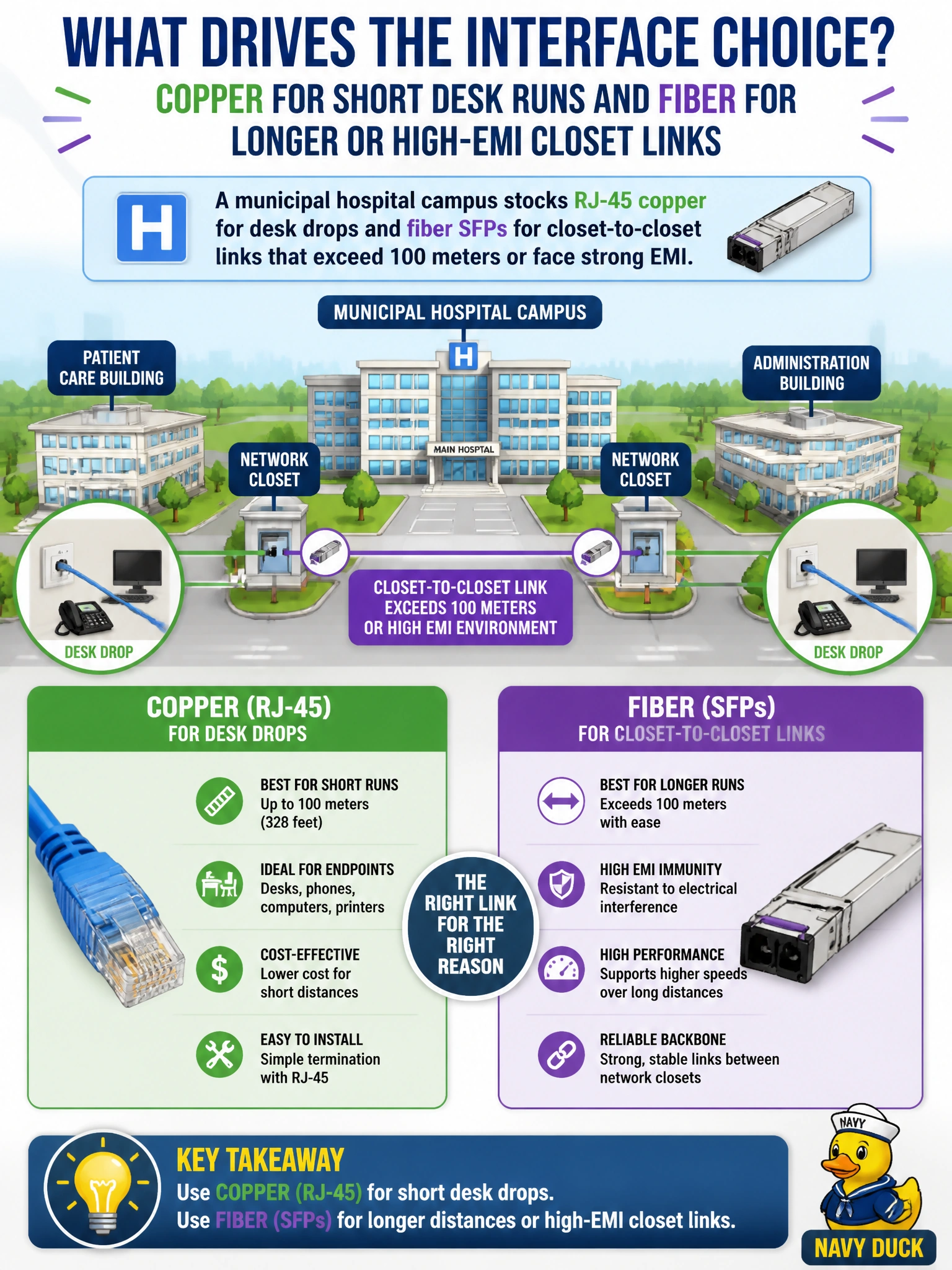
A municipal hospital campus stocks RJ-45 copper for desk drops and fiber SFPs for closet-to-closet links that exceed 100 meters or face strong EMI. What drives that interface choice?
Select an answer to reveal the explanation.
Short Explanation
Desks like short copper; long or noisy closet hops like fiber. It's distance and interference—not cable color myths or putting SFPs on every handset.
Full Explanation
A municipal hospital that stocks RJ-45 copper for desk drops and fiber SFPs for closet-to-closet links that exceed about 100 meters or face strong EMI is choosing interfaces by distance and interference. Copper twisted pair is appropriate for short horizontal desk runs within copper distance limits and for PoE endpoints; fiber is preferred when the run is longer than copper comfortably supports or when electromagnetic interference would degrade copper. That distance-and-EMI driver is what justifies the dual inventory.
Copper always supports unlimited distance if the patch cord is blue fails because copper has strict channel-length limits regardless of jacket color. Fiber SFPs are required for every phone handset in patient rooms fails by concept—phones use copper Ethernet (often with PoE), not per-handset fiber SFPs. RJ-45 copper is mandatory for all backbone links over one kilometer fails because kilometer-scale backbones are fiber territory, not mandatory copper.
Exam caveat: Remember approximate copper horizontal limits (~100 m for twisted-pair Ethernet channels) and that fiber immunity to EMI plus longer reach drive backbone choices. Cable color is not a technical distance extender.
Operational check: Measure closet-to-closet runs; if over copper limits or through high-EMI plant spaces (imaging, heavy electrical), use fiber SFPs and appropriate fiber plant. Keep copper for patient-room and desk drops. Validate with link tests and error counters—CRC/input errors on long copper through noisy areas often clear after a fiber cutover.