
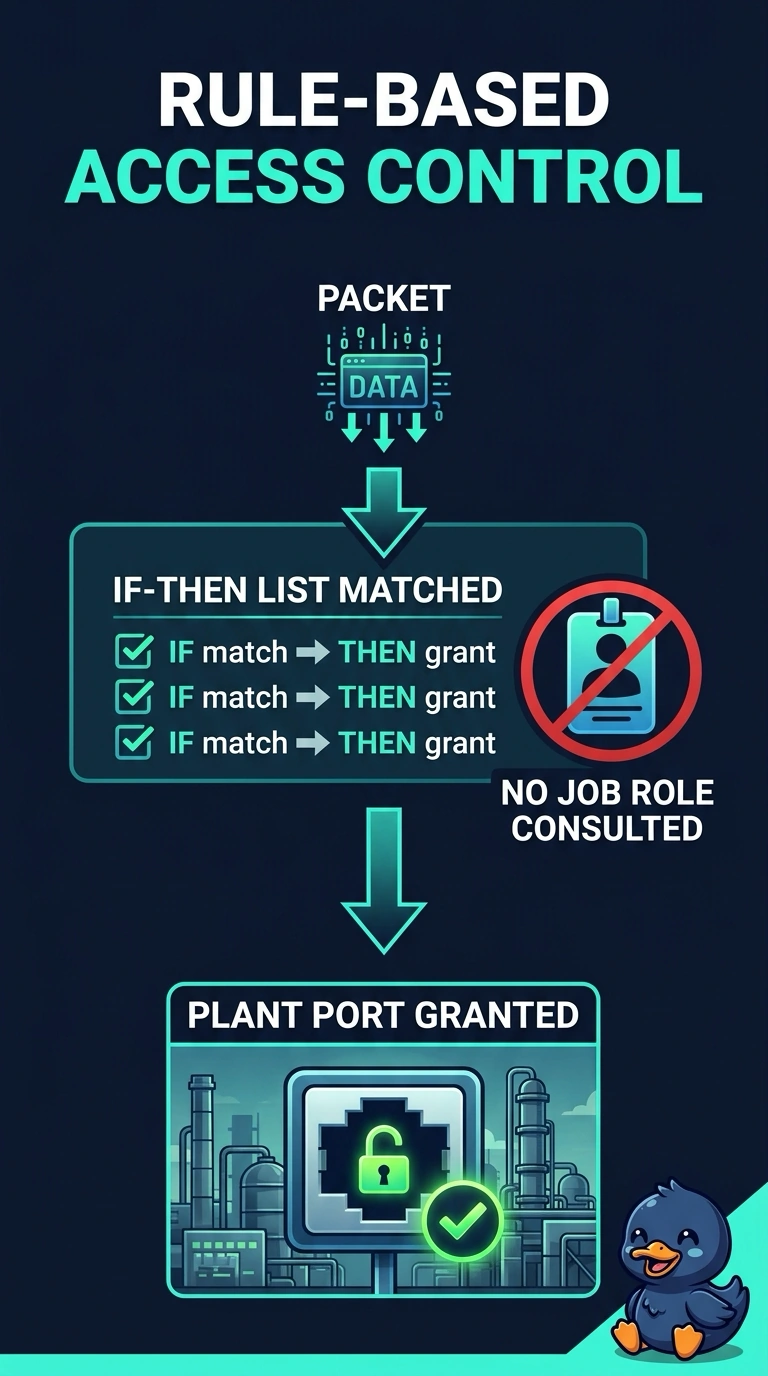
At a manufacturer, the plant firewall permits a host to reach a port only when the packet matches an if-then list, and the decision does not consult a user role. Which access model is this?
Select an answer to reveal the explanation.
Short Explanation
A bouncer with a written if-then card is not checking your job title. You have a plant firewall that allows a port only when the packet matches a list, with no user role in the decision. The trap is hearing the word rule and answering with a job role, a clock, or a document label.
Full Explanation
Rule-based access control decides from a list of conditions, such as an if-then match on the packet, and this plant rule does not look up a job title. The firewall permits the host to reach the port only when the packet matches that list. Rule-based access control granting the plant port only when the packet matches an if-then list and no job role is consulted is the model in front of you. Role-based access control that grants the plant port from the user job title on that account would key off the job, and the scenario excludes a user role. Time-based access control that grants the plant port only inside the published shift window would key off the clock, and the scenario keys off a packet match. Mandatory access control that grants the plant port from sensitivity labels on the plant documents would key off labels, and the firewall list is not a document-label decision. On the exam, rule-based and role-based are different models even though the names look alike; the split here is a packet list with no job role. In operations, read the firewall entries and confirm they match packet fields such as address and port, not a job title.