
At a retailer, a manager powers off a point-of-sale register before anyone captures its memory. What does that power-off destroy?
Select an answer to reveal the explanation.
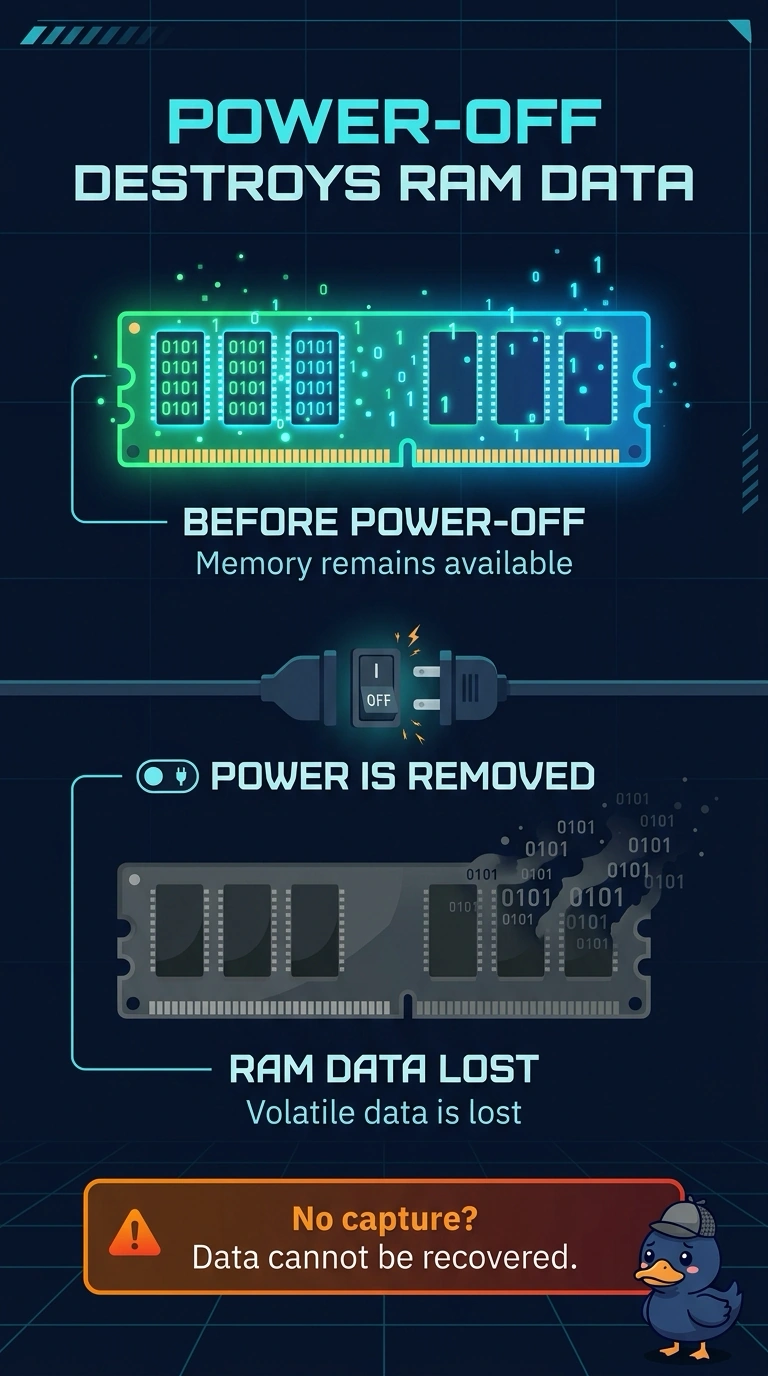
Short Explanation
Switching off a lamp kills the picture on the screen and leaves the book on the desk. You lose volatile data that lived only in RAM. The trap is mourning the disk image, the asset tag, or the public website.
Full Explanation
The right selection is "Volatile data that existed only in RAM and is gone after the register power is removed". NIST SP 800-86 treats memory, running processes, and live connections as volatile, and those contents are gone once power is removed. The statement "The on-disk image of the register, as though cutting power had wiped the stored files" is the wrong loss: files stored on disk remain, and an image of that disk can still be taken after the register is off. The statement "The metal asset tag attached to the register case for the store inventory system" is a physical inventory label and does not depend on the register being powered. The statement "The retailer's public website that shoppers browse, hosted apart from this one register" is hosted elsewhere, so this register's power state does not take the website down. Exam caveat: processes and live connections are part of the same volatile loss as raw memory, and the disk is the part that survives. Operational check: if a register is still on during a case, capture memory before removing power; if it is already off, image the disk and record that memory was not available.