
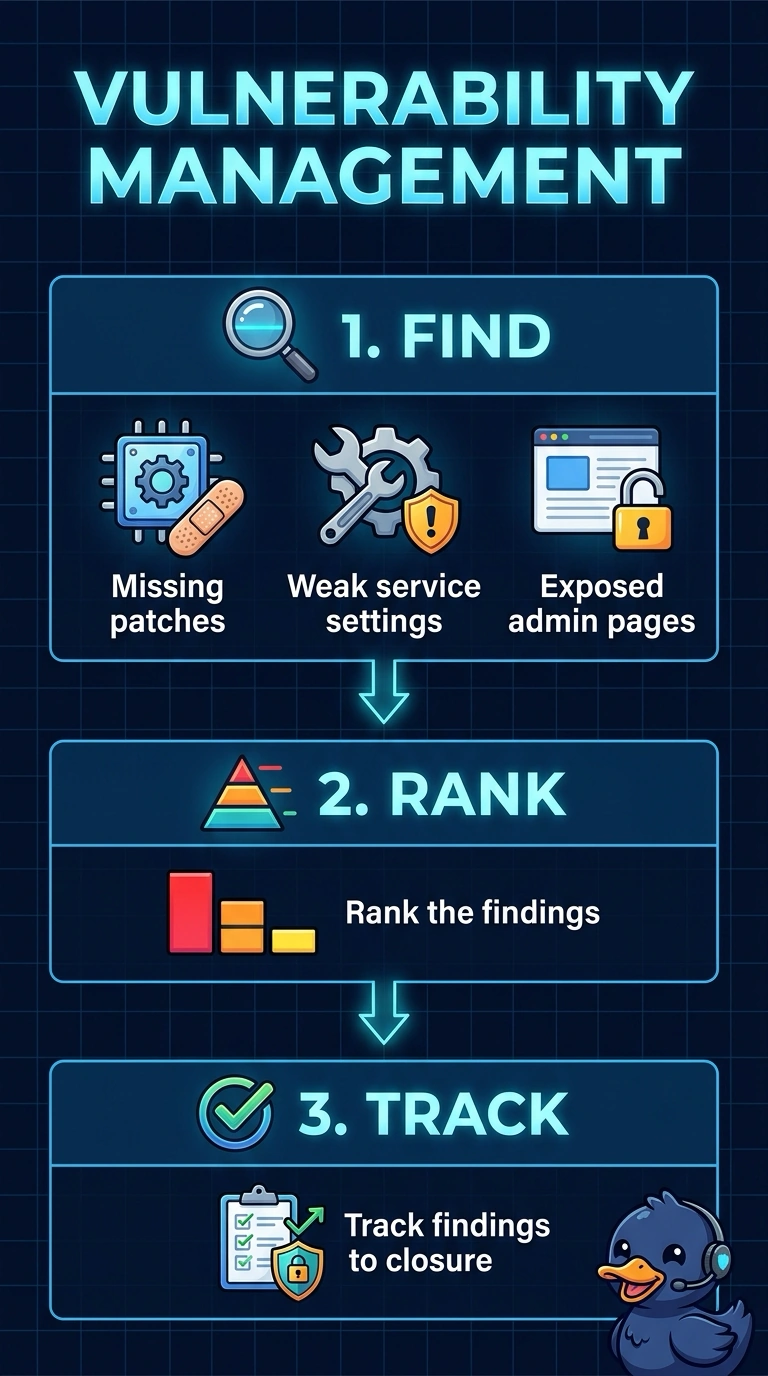
A university team finds missing patches, weak service settings, and exposed admin pages, then ranks the findings and tracks them to closure. Which practice is that full effort?
Select an answer to reveal the explanation.
Short Explanation
Filling prescriptions is only part of running the clinic. When you rank missing patches, weak service settings, and exposed admin pages together, you are doing vulnerability management at the university. Patching alone, surplus disposal, or one firewall rule leaves most of that list untouched.
Full Explanation
Vulnerability management finds weaknesses, ranks them, and tracks them until they are fixed, accepted, or otherwise closed. Missing patches are one class of finding. Weak service settings and exposed administration pages are others, and this team is ranking and tracking all three. That full effort is: Vulnerability management that finds and ranks missing patches, weak service settings, and exposed admin pages. Installing updates is narrower. Patch management limited to installing vendor fixes on a schedule, with no ranking of weak settings or exposed pages would not produce the configuration and exposure items this team is tracking. Retiring hardware is a lifecycle task. Asset disposal that retires old lab machines only after the university surplus process is finished removes assets and does not rank service settings. A single filter is one control, not a program. One firewall rule that blocks a single inbound port on the campus edge router and stops there might reduce one exposure and still leaves the inventory, the ranking, and the tracking undone. Exam caveat: patching feeds vulnerability management and does not replace it. When the stem includes misconfiguration and exposed services plus ranking, the practice is the wider program. Operational check: open the tracking system and confirm it contains weak-setting and exposed-page items, not only missing-patch rows, each with an owner and a state.