
At a hotel, a capture shows ICMP type 8 sent to the gateway and ICMP type 0 returned to the sender. Which exchange do those two ICMP types form?
Select an answer to reveal the explanation.
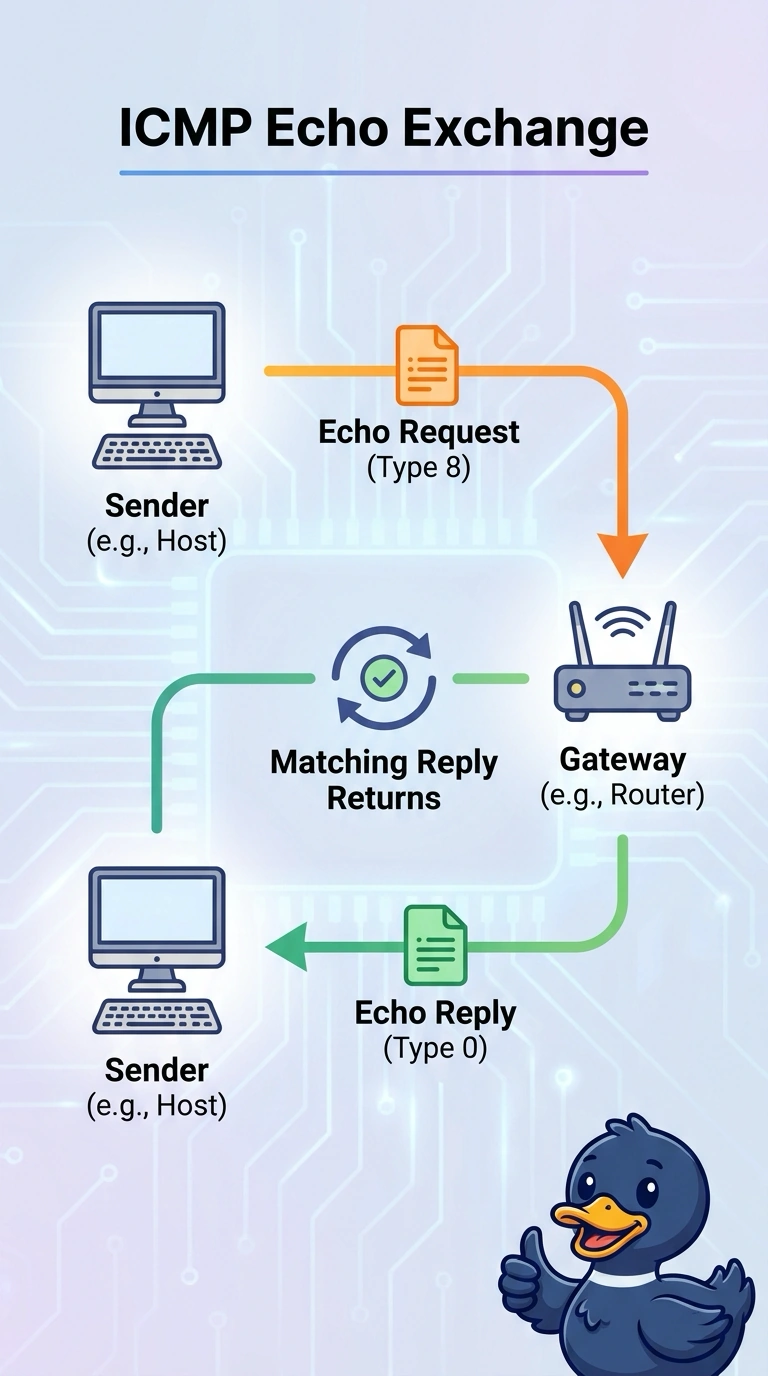
Short Explanation
Think of a sonar ping and the echo that comes back, not an error siren from the dock. You sent ICMP type 8 and got type 0 back, which is an echo request and its echo reply. The trap is reading those types as an unreachable notice, a hop-limit failure, or a TCP reset.
Full Explanation
ICMP echo request is type 8 and echo reply is type 0. A type 8 packet toward the gateway followed by type 0 back to the sender is An echo request sent to the gateway and the matching echo reply returned to the sender. A destination-unreachable report from a router that cannot forward the original datagram is a different ICMP type, used when a router or host cannot deliver the original datagram. A time-exceeded report generated after the hop count on the packet fell to zero in transit is the message a router sends when the hop limit is exhausted, not the pair 8 and 0. A TCP reset that aborts a transport session the gateway refused to keep open for the sender is a TCP flag, and this capture is ICMP, so no transport reset is required to explain the pair. Treat type 8 and type 0 as a matched request and reply, not as an error report from a router. Exam caveat: a type 0 reply shows the gateway answered the echo; it does not prove that every path past the gateway is healthy. Operational check: pair the type 8 and type 0 messages by their identifier and sequence values before you call the exchange complete.