
At a university, a captured IPv6 header has a next-header field that indicates TCP. What does that field tell you about the packet?
Select an answer to reveal the explanation.
Short Explanation
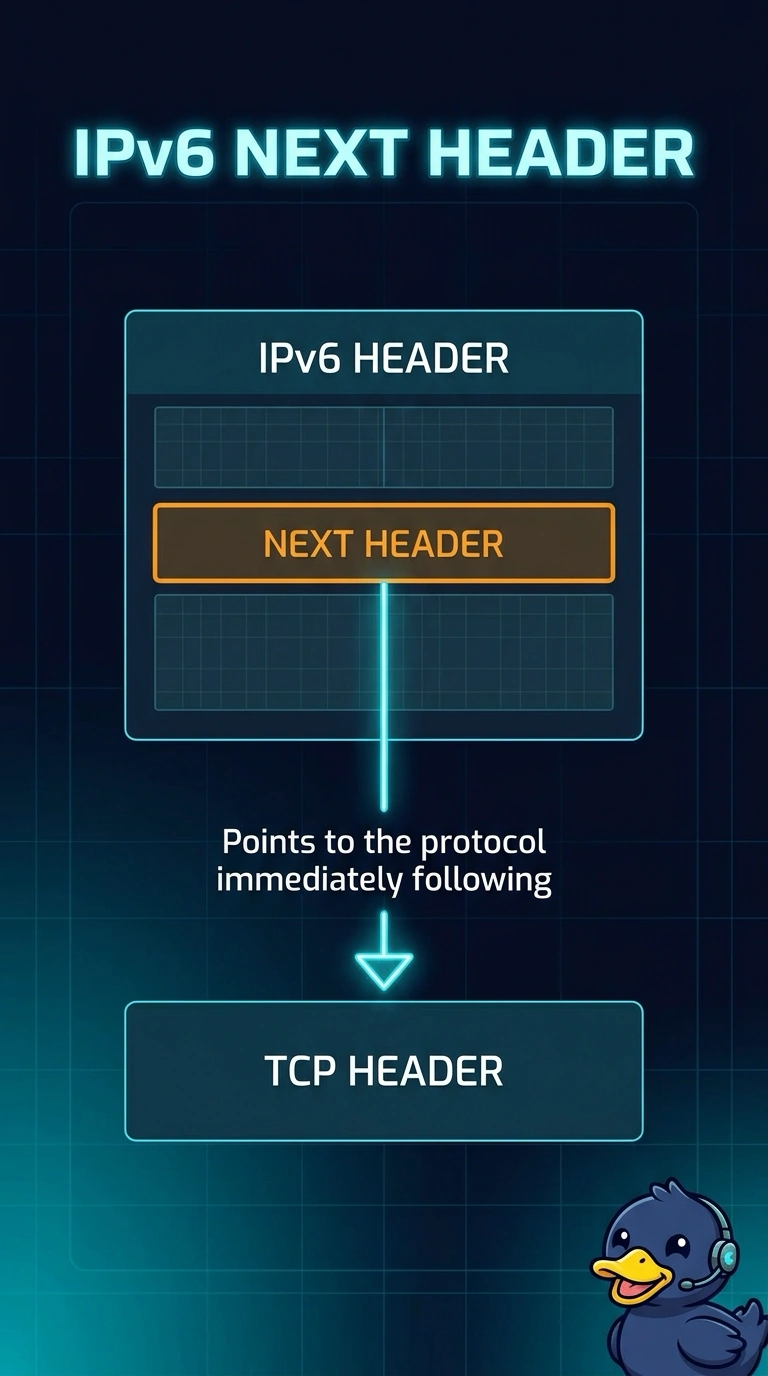
The note on the box tells you what is packed directly underneath the lid. You read the IPv6 next-header field to learn that TCP follows. The trap is treating that field as the hop count, the VLAN tag, or a mail subject.
Full Explanation
The IPv6 next-header field identifies the type of header that follows the IPv6 header. When that field indicates TCP, the header immediately after IPv6 is the TCP header, in the same role the IPv4 protocol field plays for the next protocol. The field tells you "The header or protocol that comes immediately after the IPv6 header, here named as TCP". "Only the remaining hop count before the campus network discards the packet as expired" is the hop-limit field, a different IPv6 field, and next-header does not store how many hops remain. "The Ethernet VLAN identifier that campus switches attached to the frame on the access port" lives in the Ethernet tagging of the frame, below IP, and is not the IPv6 next-header value. "The subject line of a mail message that might be carried later inside the packet payload" would be application data inside a mail message, far above this field, and only if the packet even carries mail. Exam caveat: next-header can also name an extension header that then points onward, but a value that indicates TCP means TCP follows immediately. Operational check: in the decode, read the next-header value, confirm the following bytes are a TCP header, and do not take the hop limit or the VLAN tag from that same field.