
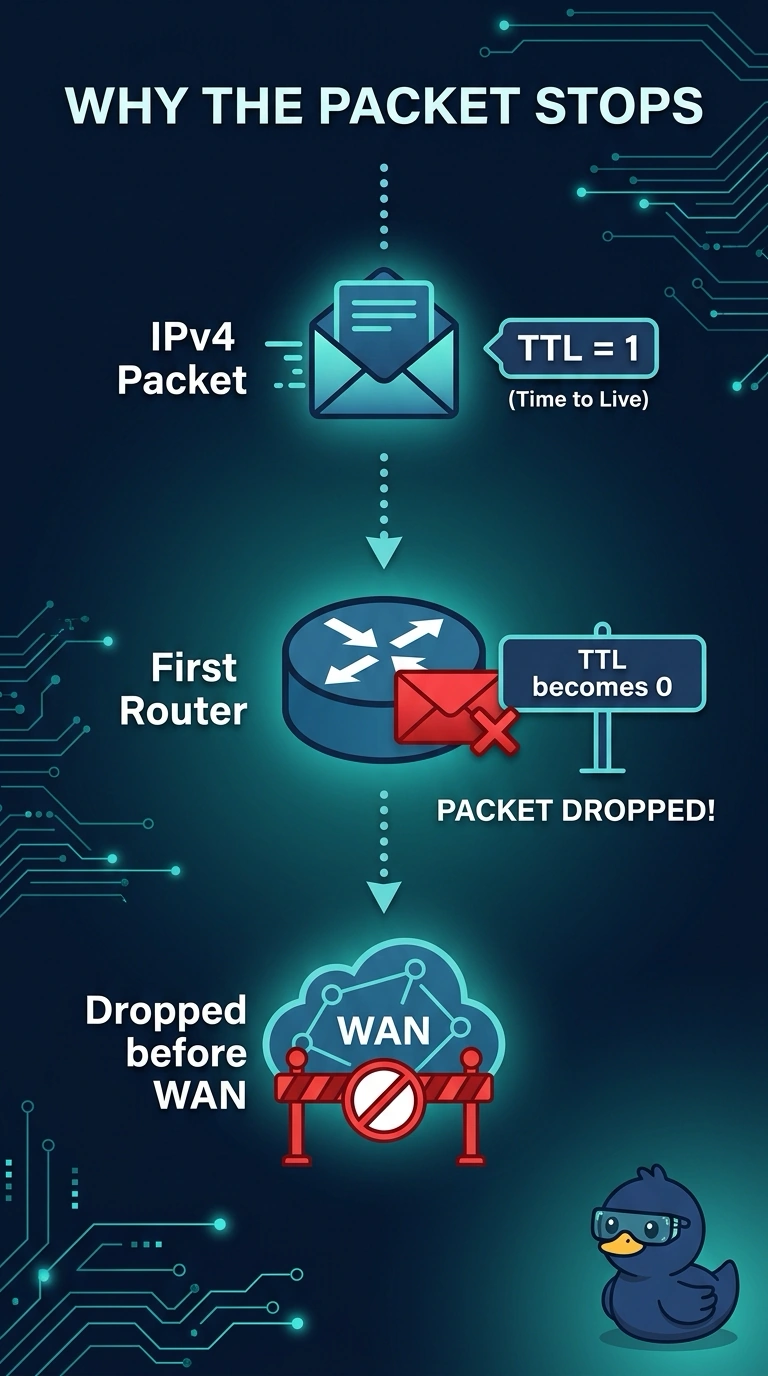
At a retailer, an IPv4 packet that should cross the store WAN reaches the first router with a TTL of 1 and dies there. What does that TTL value explain?
Select an answer to reveal the explanation.
Short Explanation
A parking ticket with one punch left will not get you through the next gate. You are watching an IPv4 hop limit of 1 die at the first router instead of crossing the WAN. The trap is blaming a closed port, a certificate, or an empty NAT pool for a TTL drop.
Full Explanation
IPv4 time to live is a hop limit. A router that forwards a packet decrements that value, and it discards the packet rather than forwarding it onward when the value cannot survive another hop. A packet that arrives with a TTL of 1 and is meant to cross the store WAN therefore dies at the first router because the hop limit was too low to reach the destination. That explanation is "The IPv4 hop limit was already one, so the first router dropped the packet before the WAN". "The destination TCP port is closed, so the store router refused the session during forwarding" would show up as a transport refusal, and the scenario gives the drop as the TTL of 1, not as a port state. "The store certificate is expired, so the first router dropped the packet during inspection" would be a certificate validity failure, and the header fact in front of you is TTL rather than a certificate. "The store NAT pool is empty, so the first router could not translate the packet toward the WAN" would be an address-translation shortage, which this header does not show. Exam caveat: a TTL of 1 explains why the packet was not forwarded, and it is not by itself proof of an attack. Operational check: confirm the router drop reason is TTL expiry on that packet, and compare the sender's initial TTL with the number of hops on the path to the WAN destination.