
A manufacturer detonates a sample known to check for a sandbox, and the report shows no network connections and no new files. How should the analyst read that quiet result?
Select an answer to reveal the explanation.
Short Explanation
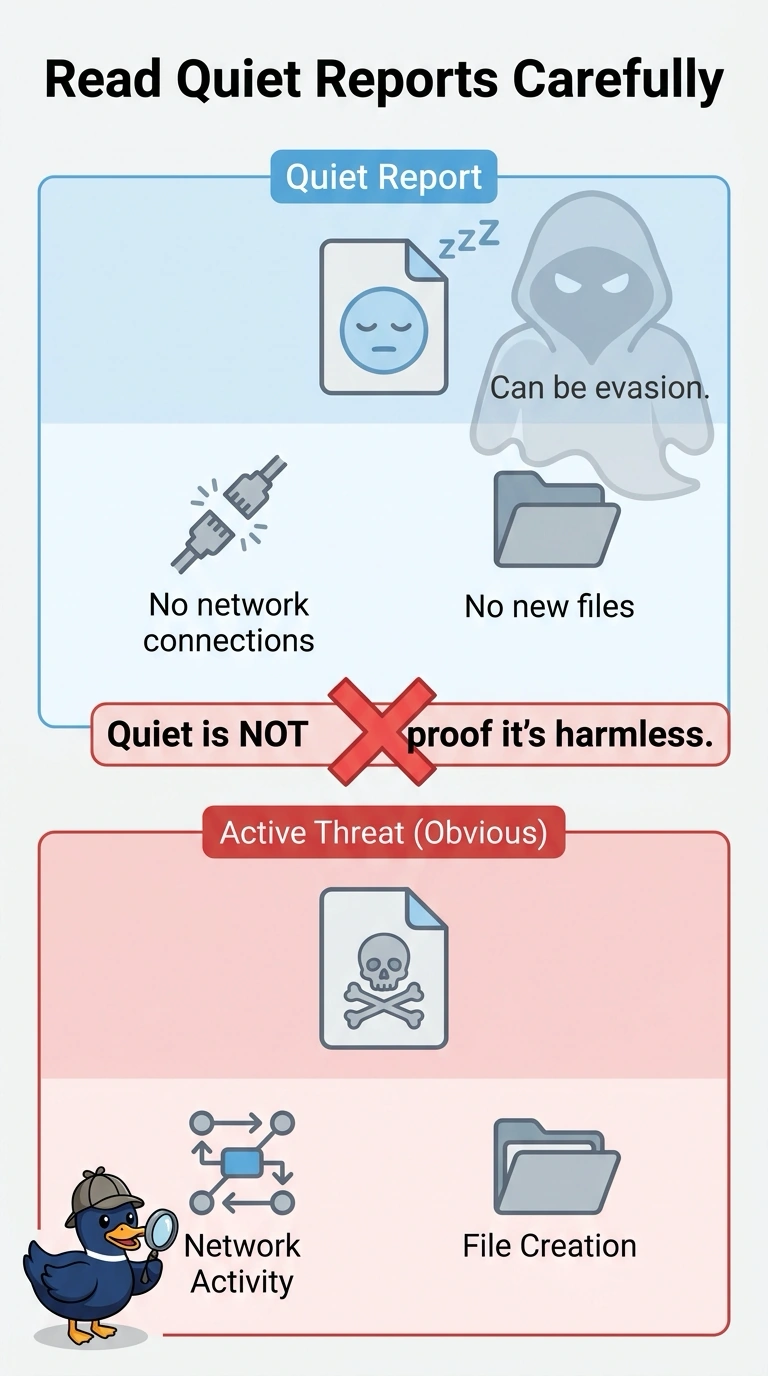
A suspect who goes silent the moment the camera turns on is not proven innocent. You should read a quiet detonation as possible evasion when the sample is known to check for a sandbox. The trap is treating silence as safety, a benign hash, or proof the plant private key was never exposed.
Full Explanation
The sample is known to check for a sandbox, and this detonation shows no network connections and no new files. A sample that detects the lab can stay quiet on purpose. Silence is therefore not a clean bill of health. The reading is "A quiet report can be evasion, and it is not proof that the file is harmless". A quiet run can be either evasion or a harmless file, so it does not prove the file is safe and "A quiet sandbox proves the file is safe to place on systems in the plant" fails. The hash still identifies the file. Quiet behavior does not reclassify that hash as benign, so "The file hash is benign, so the lack of activity means the sample can be ignored" fails. Whether a private key left the plant is a different question. This report does not answer it, so "The private key was not exposed, so the plant is clean and the sample can be closed" fails. Exam caveat: do not close the sample as safe on silence alone when it is known to look for a sandbox. Operational check: note the sandbox check in the case file and, if lab procedure allows, detonate again in an environment that does not present the cues the sample looks for.