
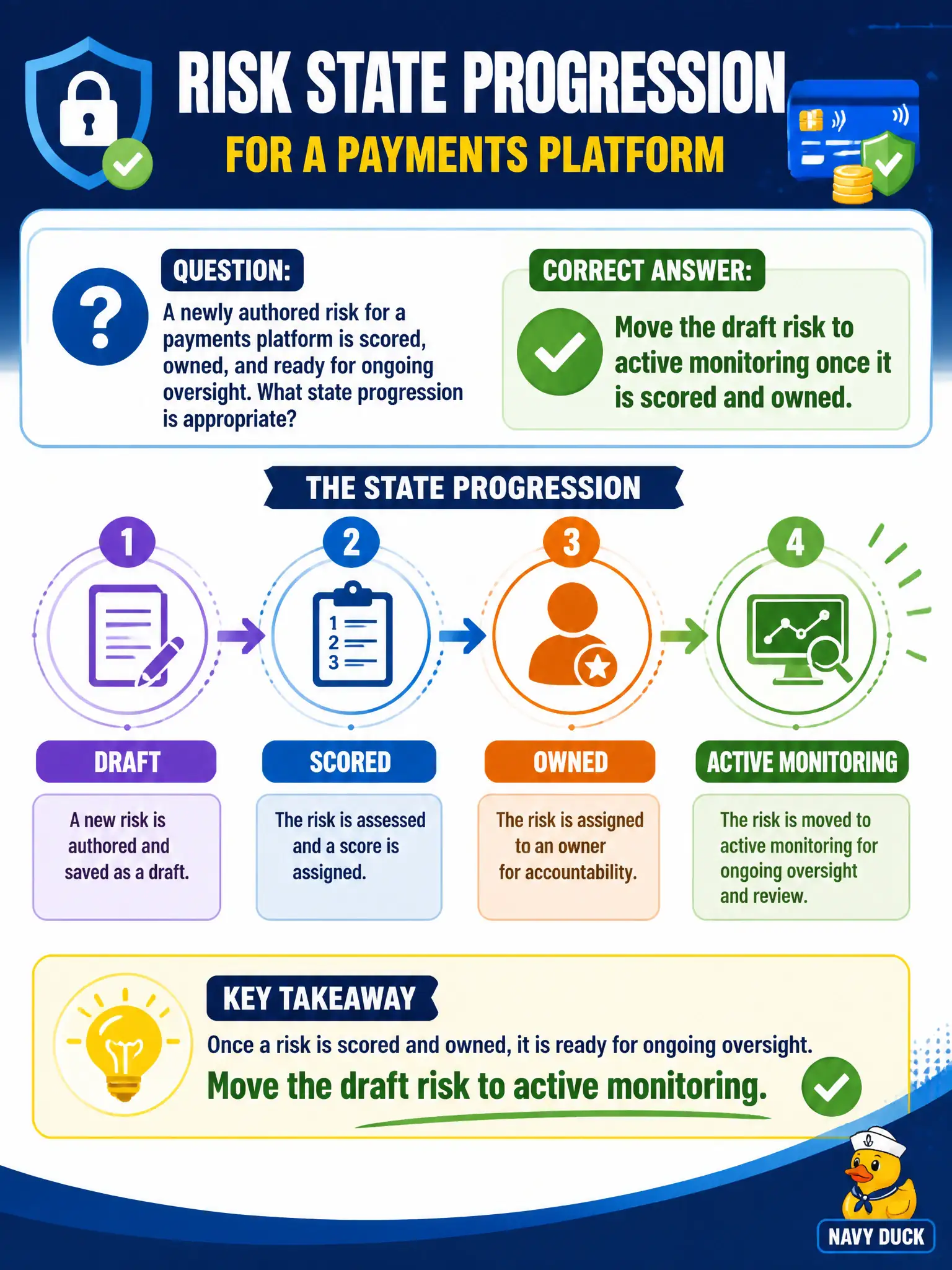
A newly authored risk for a payments platform is scored, owned, and ready for ongoing oversight. What state progression is appropriate?
Select an answer to reveal the explanation.
Short Explanation
Draft is the parking lot; scored and owned means you drive it onto the road. Flip it to active monitoring so it is actually managed.
Full Explanation
A newly authored risk for a payments platform that is scored and owned should move from draft to active monitoring once ready for ongoing oversight. Activation places the civic payments risk under the operating lifecycle. Leaving it in draft indefinitely after scoring and ownership fails by concept because draft status withholds the risk from monitoring and treatment workflows. Moving it directly to retired because scoring finished fails by concept because retirement ends monitoring; scoring completion starts it. Deleting and recreating the risk monthly to simulate lifecycle fails by concept because churn destroys history and continuity. Exam caveat: CIS-RC advances scored, owned draft risks into active monitoring rather than draft limbo or premature retirement. Operational check: after scoring and assigning ownership on the payments-platform risk, transition it to active, verify it appears on monitoring dashboards and indicator relationships, and confirm draft no longer hides it from oversight. In civic IRM programs, retain configuration and decision evidence so examiners can reconstruct why this design supports public services. In civic IRM programs, retain configuration and decision evidence so examiners can reconstruct why this design supports public services.