
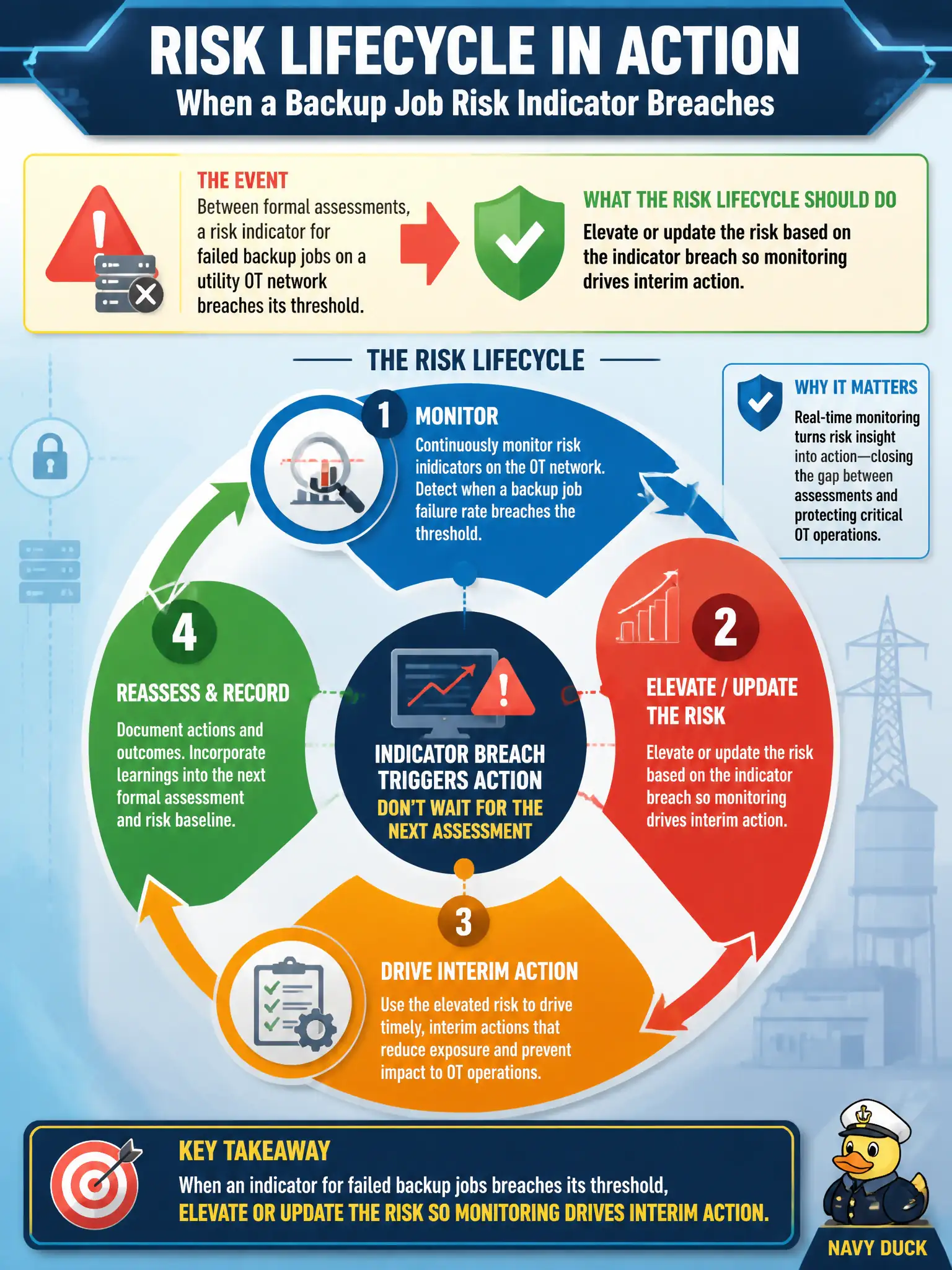
Between formal assessments, a risk indicator for failed backup jobs on a utility OT network breaches its threshold. What should the risk lifecycle do?
Select an answer to reveal the explanation.
Short Explanation
Indicators are the dashboard lights between pit stops. When backup failures redline, elevate the risk now — do not wait for next year's workshop.
Full Explanation
Between formal assessments, when a risk indicator for failed backup jobs on a utility OT network breaches threshold, elevate or update the risk based on the indicator breach so monitoring drives interim action. Indicators protect continuous awareness for infrastructure that serves the public. Ignoring the indicator until the next annual workshop fails by concept because annual cadence is too slow for breached backup signals. Disabling all indicators so only qualitative workshops can change risk state fails by concept because that removes continuous monitoring by design. Automatically accepting every breached risk without owner review fails by concept because acceptance is a governed decision, not an automatic reaction to a signal. Exam caveat: CIS-RC uses indicator breaches to update or elevate risks between formal assessments. Operational check: configure the failed-backup indicator on the OT scope, force a breach in a test, confirm the related risk updates or elevates with owner notification, and record interim treatment actions. In civic IRM programs, retain configuration and decision evidence so examiners can reconstruct why this design supports public services. In civic IRM programs, retain configuration and decision evidence so examiners can reconstruct why this design supports public services.