
A tech lead asks what item generation refers to in ServiceNow IRM. Which definition is correct?
Select an answer to reveal the explanation.
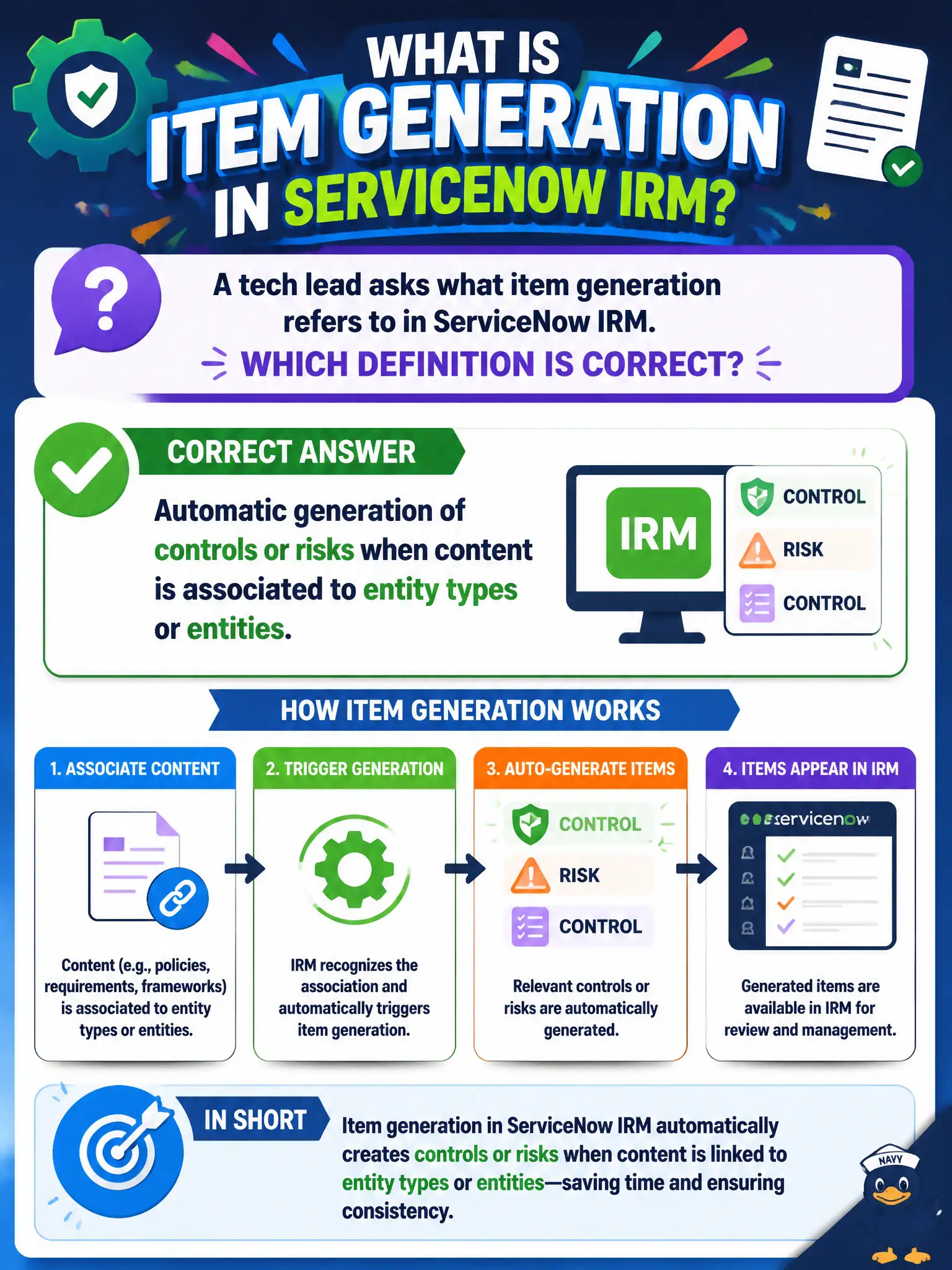
Short Explanation
Item generation is the assembly line: associate the right content to an entity type or entity, and the platform spins up the matching controls or risks. Nobody should be hand-typing every instance if the model is set up. That is how scoped content becomes real work items.
Full Explanation
Item generation in ServiceNow IRM is the automatic generation of controls or risks when content is associated to entity types or entities. It is the assembly line that turns scoped library content into real work items so municipal teams do not hand-type every instance for every application or facility. When associations and entity populations are designed well, generation operationalizes the framework at scale and keeps instances aligned as populations refresh. Skipping generation after association leaves libraries unused and owners with empty queues. Defining item generation as manual creation of PowerPoint slides whenever a policy PDF is uploaded confuses presentation work with GRC record creation. Calling it automatic cloning of every ITSM incident into a risk record overnight invents a dangerous blanket transform unrelated to content association. Describing it as a one-time CMDB export into a flat file for external GRC tools abandons in-platform generation entirely. Exam caveat: item generation follows content-to-entity association inside IRM, not slide making, ITSM cloning, or external flat-file extracts. Operational check for the tech lead: associate a control objective to an entity type with a tight filter, run generation, and verify control records appear only for matching entities with expected ownership fields populated or ready for assignment.