
A department head asks what an entity is in ServiceNow IRM. Which definition is correct?
Select an answer to reveal the explanation.
Short Explanation
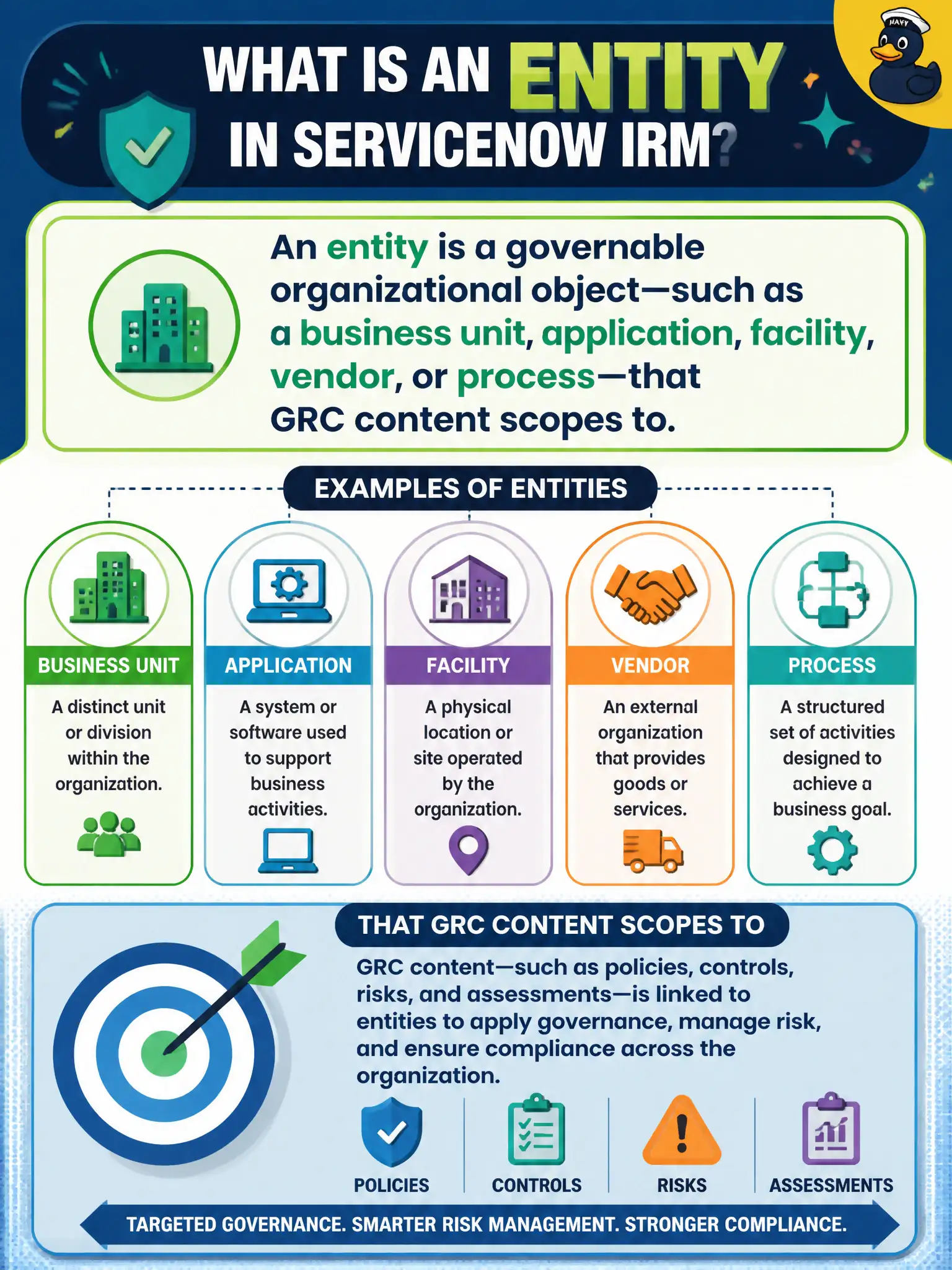
An entity is a named piece of the organization you can actually govern—a clinic, a billing app, a plant, a vendor. It is not a ticket number or a personal dashboard filter setting.
Full Explanation
In ServiceNow IRM, an entity is a governable organizational object—such as a business unit, application, facility, vendor, or process—that GRC content scopes to. A department head should picture a named clinic, billing application, plant, or vendor that policies, risks, controls, indicators, and audits can attach to—not a ticket number or a personal dashboard filter. Entities are the shared map that makes test-once/report-many possible across civic programs and keeps risk, compliance, and assurance talking about the same objects. Without durable entities, libraries of controls and risk statements float unattached to real operations. Defining an entity as only a user preference record for dashboard filters confuses UI personalization with the GRC data model. Calling an entity a Pearson VUE exam registration object invents certification logistics nonsense unrelated to IRM. Equating an entity with an ITSM incident number collapses organizational scope into ephemeral service tickets that close and disappear. Exam caveat: entity is foundational vocabulary for nearly every CIS-RC domain that follows the overview. Operational check for the department head: list three objects the department must govern, confirm each can be represented as an IRM entity with an owner, and attach a sample control or risk to one of them in a documented design or subprod path before wider rollout.