
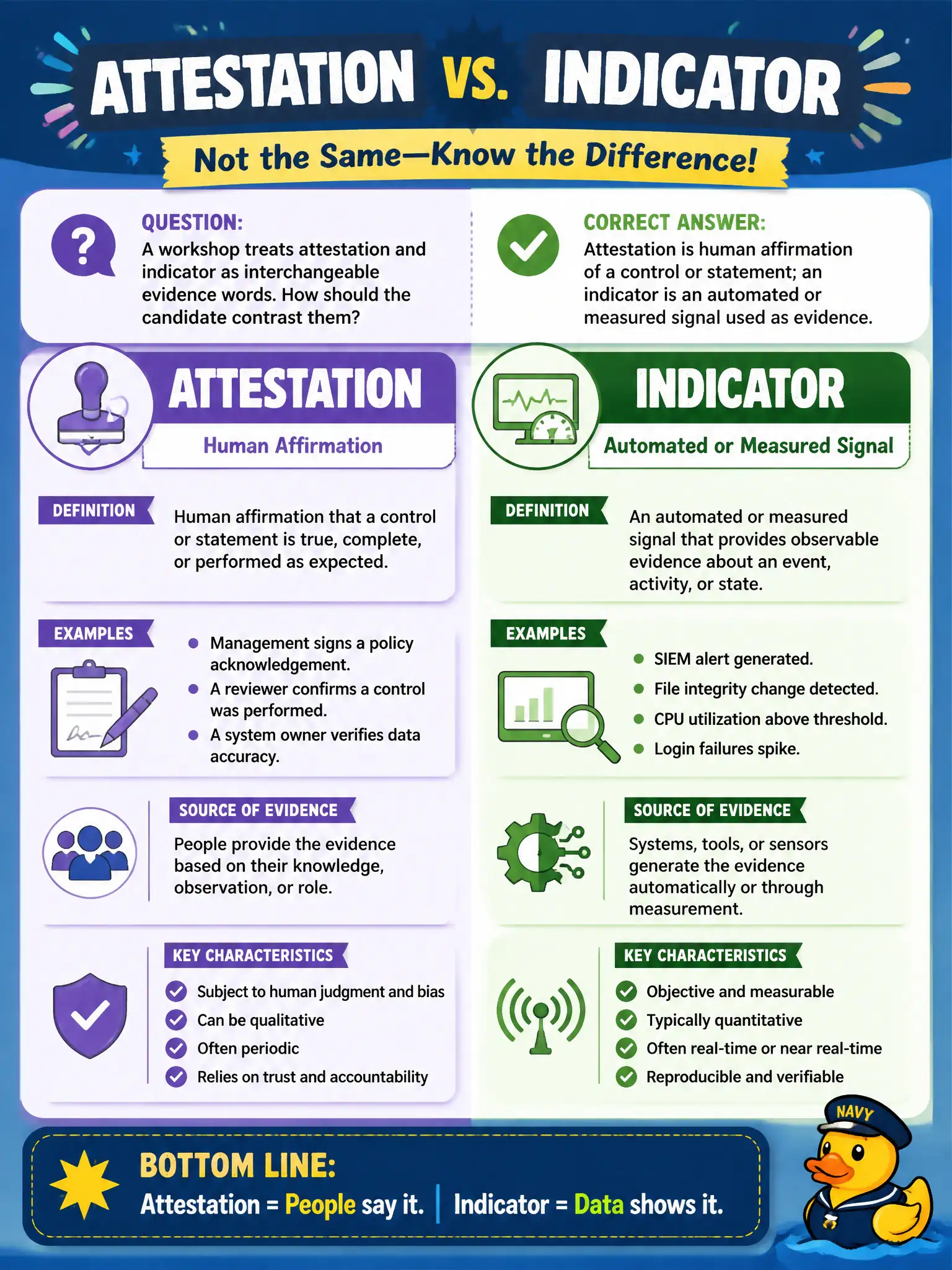
A workshop treats attestation and indicator as interchangeable evidence words. How should the candidate contrast them?
Select an answer to reveal the explanation.
Short Explanation
Attestation is a person putting their name on it; an indicator is a meter reading. One is human confirmation, the other is measured signal—both can be evidence, but they are not twins.
Full Explanation
Attestation is human affirmation of a control or statement; an indicator is an automated or measured signal used as evidence. Workshops that treat the words as interchangeable lose the difference between a person putting their name on a control’s operating effectiveness and a meter reading from continuous monitoring. Both can support compliance and risk decisions in a city program, but they are collected, owned, and interpreted differently in IRM. Attestations create accountability trails; indicators scale measurement where telemetry or queries exist. Saying attestations are always machine telemetry while indicators are always wet-ink signatures reverses the concepts. Claiming both terms mean the same continuous-monitoring script on a MID Server collapses human confirmation into automation alone. Saying attestations replace authority documents and indicators replace citations confuses evidence mechanisms with the mandate content hierarchy. Exam caveat: CIS-RC terminology expects a clean attestation-versus-indicator contrast rather than synonym treatment. Operational check for the workshop: for one control on a civic application entity, schedule a human attestation for the control owner and, where feasible, configure an indicator on a measurable condition; show leadership both evidence types on the same control without merging record types.