
A regulated insurer compares a classic standalone GRC suite to ServiceNow IRM at overview depth. Which ServiceNow positioning point should the candidate emphasize?
Select an answer to reveal the explanation.
Short Explanation
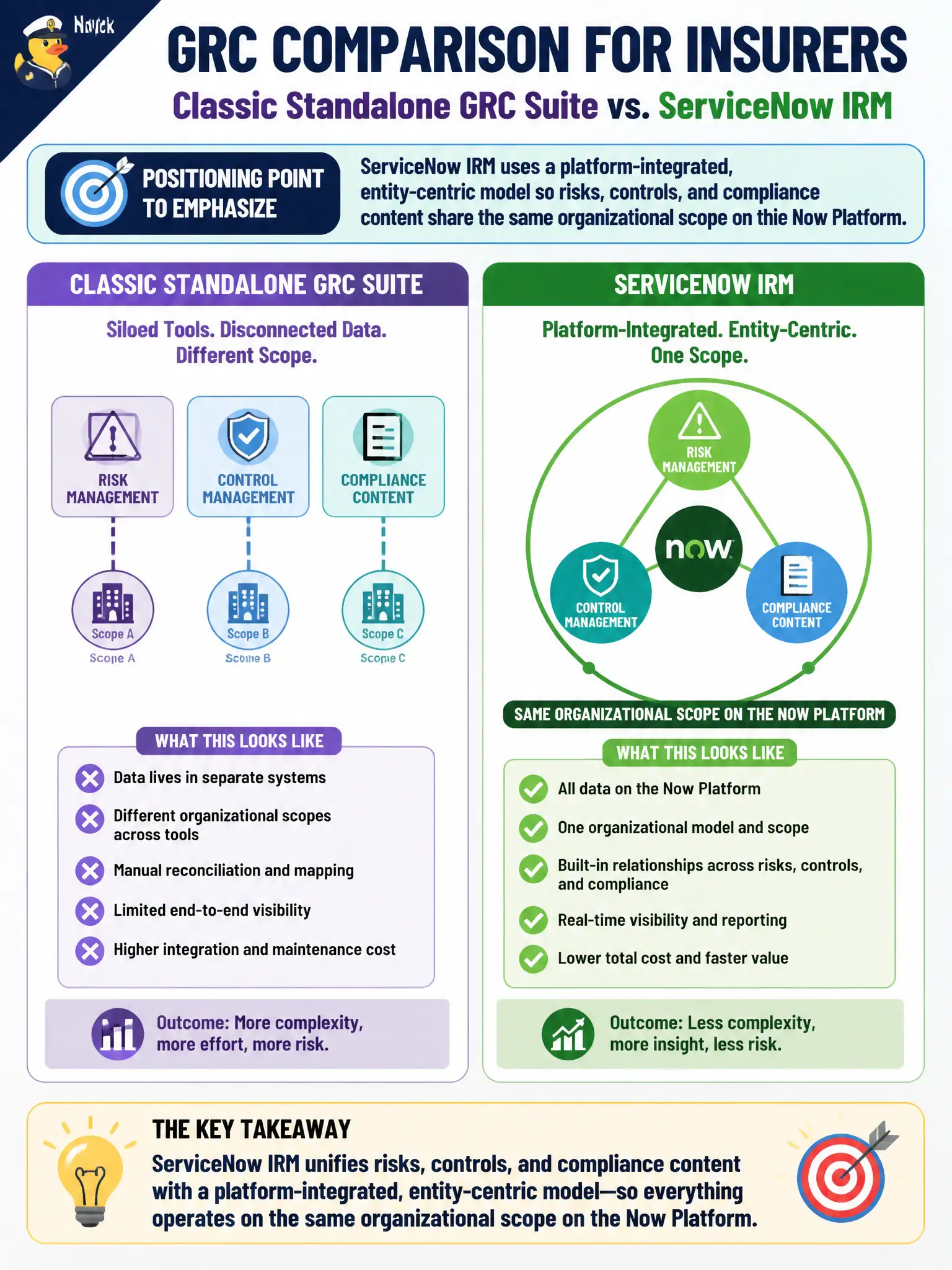
Skip the feature bake-off. The story is one Now Platform neighborhood: entities at the center, with risk, control, and compliance content pointing at the same places the business actually runs.
Full Explanation
At CIS-RC overview depth, ServiceNow IRM is positioned as a platform-integrated, entity-centric model so risks, controls, and compliance content share the same organizational scope on the Now Platform. A regulated insurer comparing a classic standalone GRC suite should hear that story: one neighborhood of entities with GRC apps attached, not a disconnected appliance or a feature-checkbox bake-off. That shared scope is what enables test-once/report-many behavior and alignment with CMDB and org data already on the platform. Winning mainly by listing more checkbox features than any competitor is a marketing distraction, not the architectural point CIS-RC emphasizes. Saying IRM is only useful if the insurer abandons the Now Platform for a separate GRC appliance contradicts platform integration. Limiting IRM to ITSM ticket dashboards with no entity framework erases the core scoping model. Exam caveat: comparison questions reward entity-centric platform positioning over competitor feature wars or ITSM-only caricatures. Operational check for the insurer: demonstrate one application entity sourced from platform data with a linked risk, control, and compliance item in the same instance, and contrast that with how a standalone suite would require a parallel inventory of the same object.