
A city auditor asks how IRM changes assurance work compared with a parallel paper universe of checklists. What benefit should be highlighted?
Select an answer to reveal the explanation.
Short Explanation
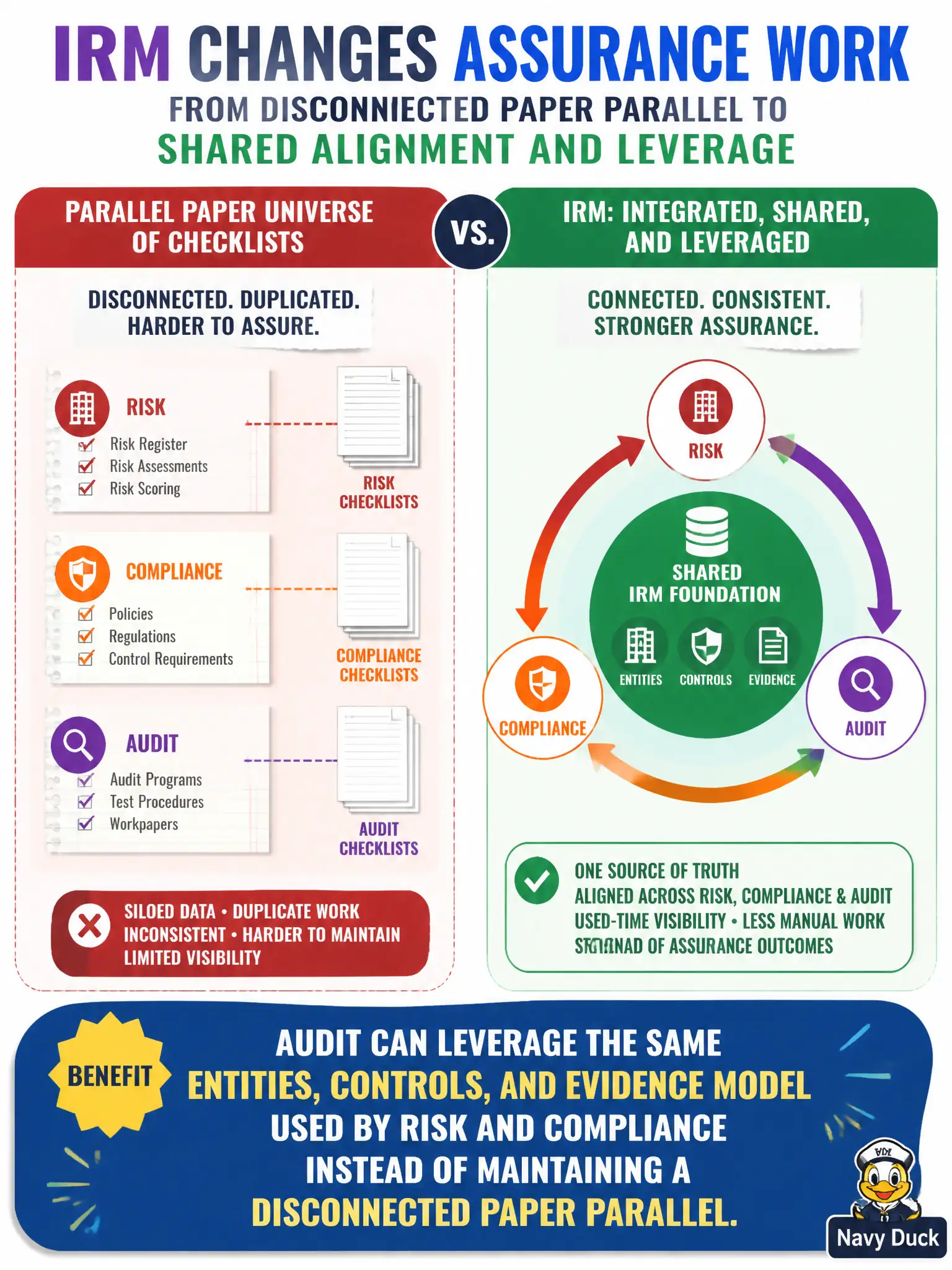
Auditors stop living in a second galaxy of binders. When entities and controls already exist in IRM, assurance can reuse that scope and evidence trail instead of reinventing the city from scratch.
Full Explanation
Integrated assurance means audit can leverage the same entities, controls, and evidence model that risk and compliance already maintain, instead of a disconnected paper parallel of checklists and Word binders. For a city auditor, that shared framework reduces duplicate testing and keeps engagement planning tied to living organizational objects. IRM supports audit work by making scope and proof reusable; it does not abolish internal audit or redefine assurance as vulnerability scanning. Requiring audit to ignore platform controls and always rebuild evidence only in Word recreates the shadow universe the platform is meant to retire. Claiming IRM replaces internal audit with automated vulnerability scans collapses third-line independence into CIS-VR activity. Saying assurance value appears only after Software Asset Management is fully reconciled makes license reconciliation a false gate for audit readiness. Exam caveat: overview themes stress shared entity and evidence models across policy, risk, and audit—not product substitution. Operational check for the city: for one engagement, select controls already scoped to IRM entities, reuse existing test or attestation evidence where appropriate, and document residual procedures that still require auditor fieldwork rather than reinventing the entire control inventory in offline files.