
A public-health department frames GRC only as passing the next external audit. How should the IRM lead expand that positioning?
Select an answer to reveal the explanation.
Short Explanation
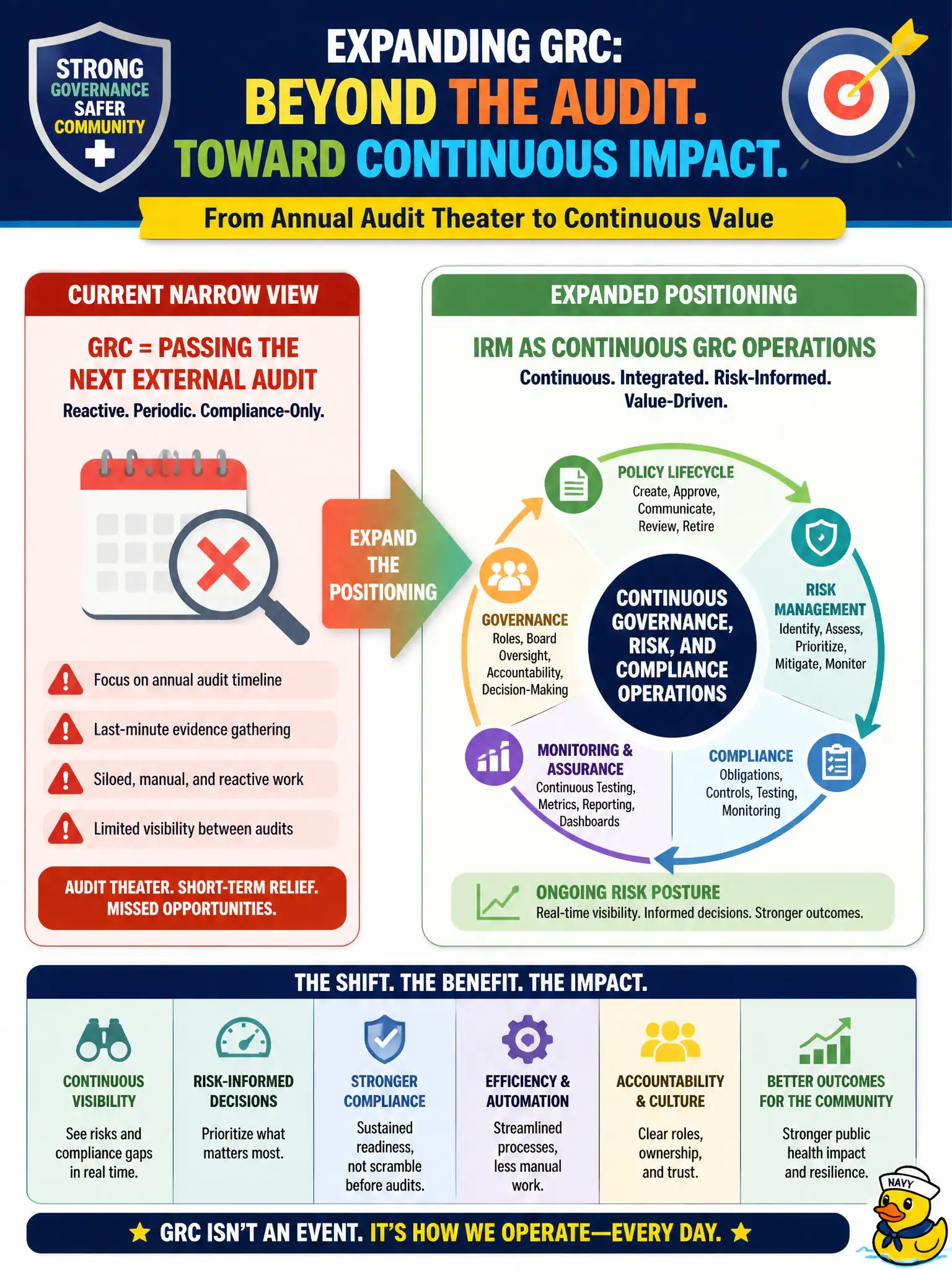
Audits are checkpoints, not the whole highway. IRM keeps policies alive, risks scored, and controls tested year-round so the audit week is a snapshot of ongoing work—not a scramble to invent evidence.
Full Explanation
IRM should be positioned as continuous governance, risk, and compliance operations—including policy lifecycle and ongoing risk posture—not as annual audit theater alone. A public-health department that frames GRC only as passing the next external audit underuses the product: audits become snapshots of year-round control health rather than a once-a-year binder scramble. Correct positioning keeps policies alive, risks scored, issues remediated, and evidence current so audit week validates an operating model. Confirming IRM is used once a year to assemble a binder and then shut down institutionalizes the anti-pattern. Limiting the program to security incident closure metrics for audit week confuses CIS-SIR operational metrics with compliance posture. Treating GRC as a SAM true-up timed to the auditor’s visit again substitutes license reconciliation for obligation management. Exam caveat: overview items contrast continuous IRM operations with audit-week-only framing. Operational check for the department: establish a quarterly cadence of control attestations or indicator reviews on in-scope entities, retain results in the instance, and show sponsors how those records feed the next external audit request without a net-new evidence hunt.