
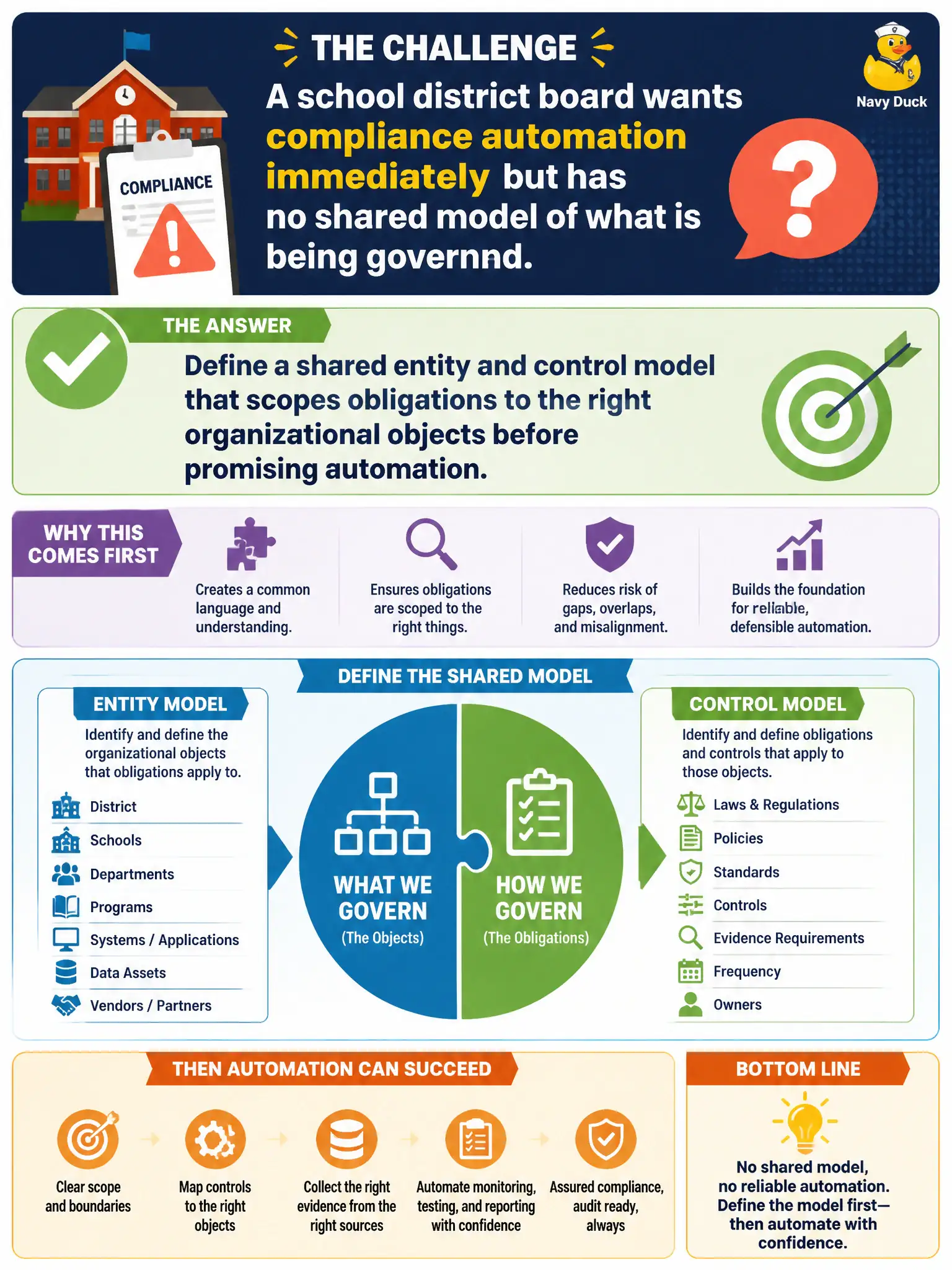
A school district board wants compliance automation immediately but has no shared model of what is being governed. What prerequisite should the IRM lead insist on first?
Select an answer to reveal the explanation.
Short Explanation
Automation without a map just speeds up confusion. First agree what counts as an entity and which controls sit on it—then indicators and workflows have something real to hang on.
Full Explanation
Meaningful compliance automation in IRM depends first on a shared entity and control model that scopes obligations to the right organizational objects. A school district board demanding automation with no map of what is governed will only accelerate confusion: indicators and workflows need durable targets. The IRM lead should insist on defining entities and the controls that sit on them before promising continuous monitoring or mass attestations. Enabling every continuous-monitoring indicator on day one with no entity design produces orphaned signals and noisy false confidence. Standing up SIR playbooks so compliance becomes a queue of security incidents substitutes incident response for obligation management. Importing SAM license counts as authority documents mistakes entitlement data for regulatory or policy mandates. Exam caveat: overview and planning items often test prerequisites—entity scoping before automation theater. Operational check for the district: before turning on indicators, approve a short entity catalog for in-scope applications and schools, associate at least one control objective to that population, generate or assign controls, then add a single indicator or attestation against that scoped set.