
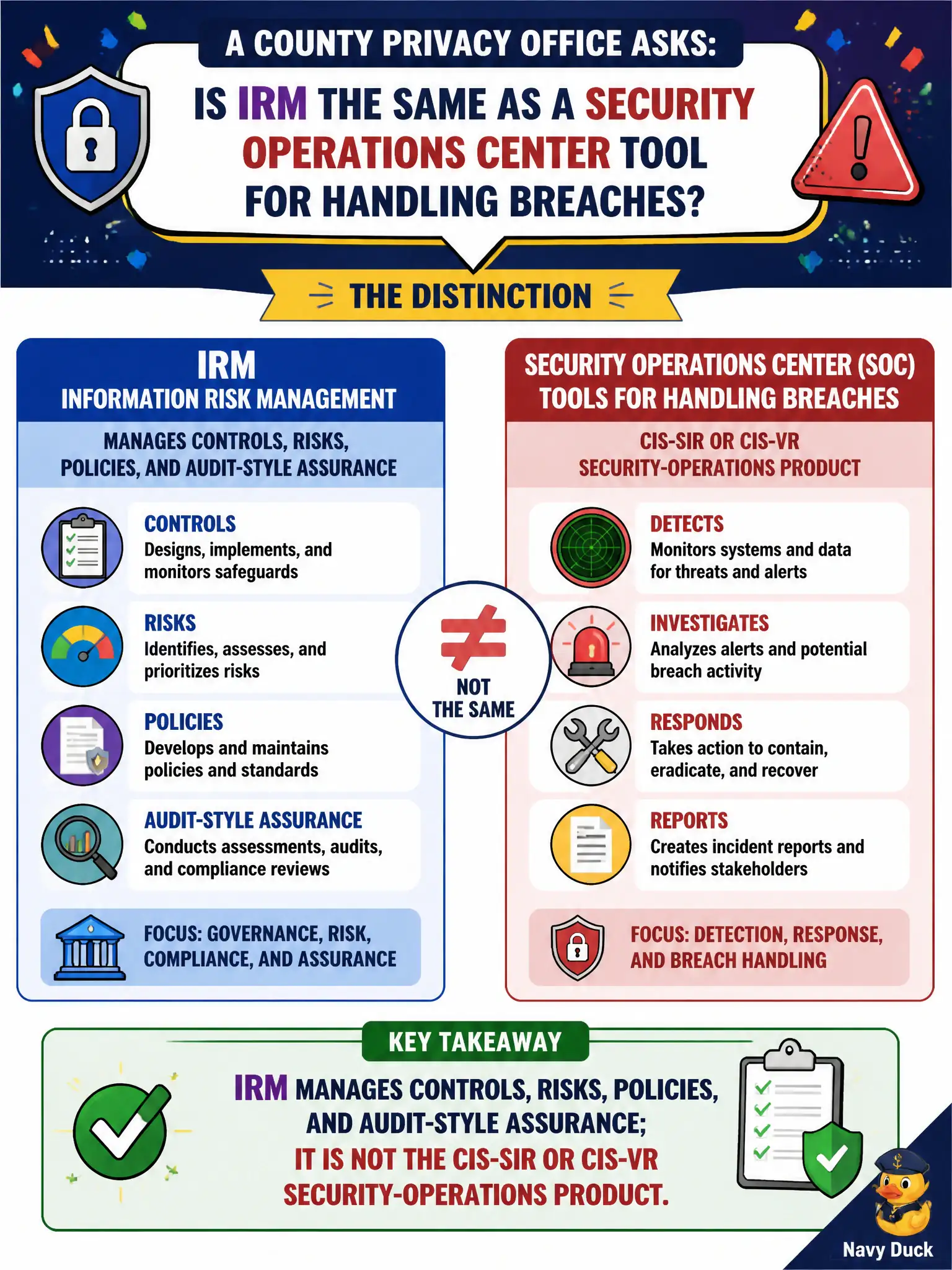
A county privacy office asks whether IRM is the same as a security operations center tool for handling breaches. What distinction should be taught?
Select an answer to reveal the explanation.
Short Explanation
IRM is the control-and-risk ledger, not the firehouse radio. Breach playbooks and vuln queues live in other products; IRM asks whether policies, risks, and evidence still hold for the county’s entities.
Full Explanation
IRM manages controls, risks, policies, and audit-style assurance; it is not the CIS-SIR or CIS-VR security-operations product and is not a SIEM. A county privacy office asking whether IRM is the SOC tool for breaches needs that distinction: breach playbooks and vulnerability queues live elsewhere, while IRM asks whether policies, risks, and evidence still hold for county entities. Correct positioning keeps privacy and compliance work on the Risk and Compliance framework rather than forcing every obligation into a security case type. Describing IRM as primarily Security Incident Response with playbook-driven breach cases mislabels the product family. Calling IRM Vulnerability Response focused on CVE grouping similarly points to CIS-VR, not CIS-RC. Equating IRM with a SIEM that correlates firewall logs in real time invents an operations-monitoring role IRM does not own. Exam caveat: know the neighboring CIS products well enough to reject them when the stem asks for IRM/GRC positioning. Operational check for the county: in architecture diagrams, draw IRM entities, policies, and control tests on one swim lane and SIR/VR case flows on another; confirm a sample privacy control test is recorded in IRM rather than only as a closed security incident.