
Why does the CIS-RC blueprint weight Entity Framework heavily relative to other domains for an IRM implementation?
Select an answer to reveal the explanation.
Short Explanation
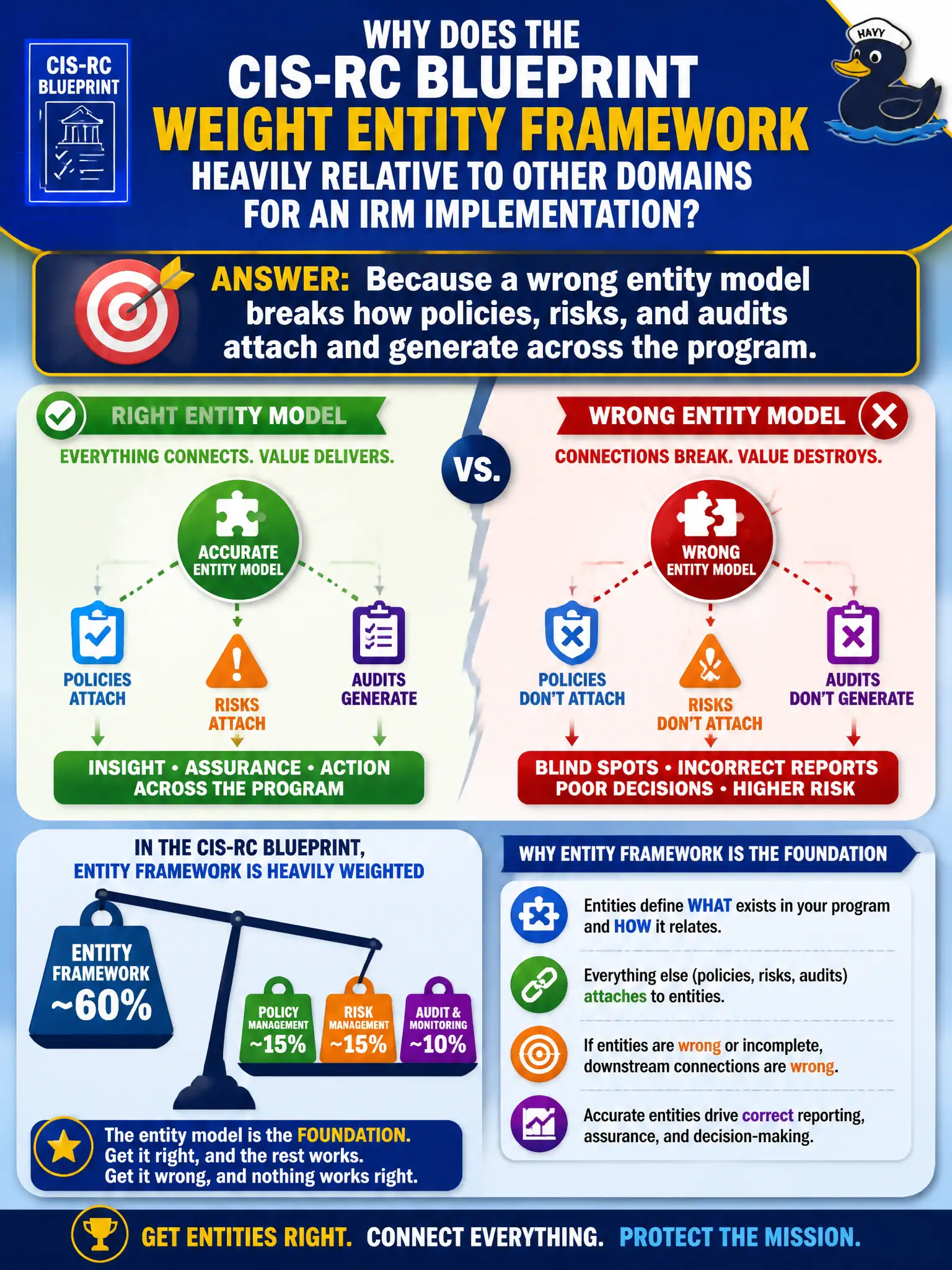
Entity framework is the load-bearing wall. Get the model wrong and policies, risks, and audits have nothing solid to hang on. That’s why this domain carries serious weight—everything else leans on those governable objects.
Full Explanation
Entities are the join points for policy and compliance, risk, and audit content in ServiceNow IRM. The CIS-RC blueprint weights Entity Framework heavily relative to other domains because a wrong entity model breaks how policies, risks, and audits attach and generate across the program. Incorrect types, classes, scoping, ownership, or hierarchy cause misowned work, broken generation, unreliable civic reporting, and expensive rework after content packs land. Entity configuration does not replace the need for any policy or risk content. Entity framework is not cosmetic UI work with no downstream impact. Entities are not used solely by Audit Management and never by Policy and Compliance—those applications share the framework. Exam caveat: heavy blueprint weight means invest design time early; rushing entities to chase content packs usually produces the costliest remediation path in municipal programs. Operational check: complete entity-type, class, hierarchy, ownership, and scope decisions with cross-functional sign-off before mass content association; run a thin vertical slice from entity to generated control and risk; gate further content rollout on that municipal slice succeeding; and reassess entity design when onboarding major new bureaus or mandates.