
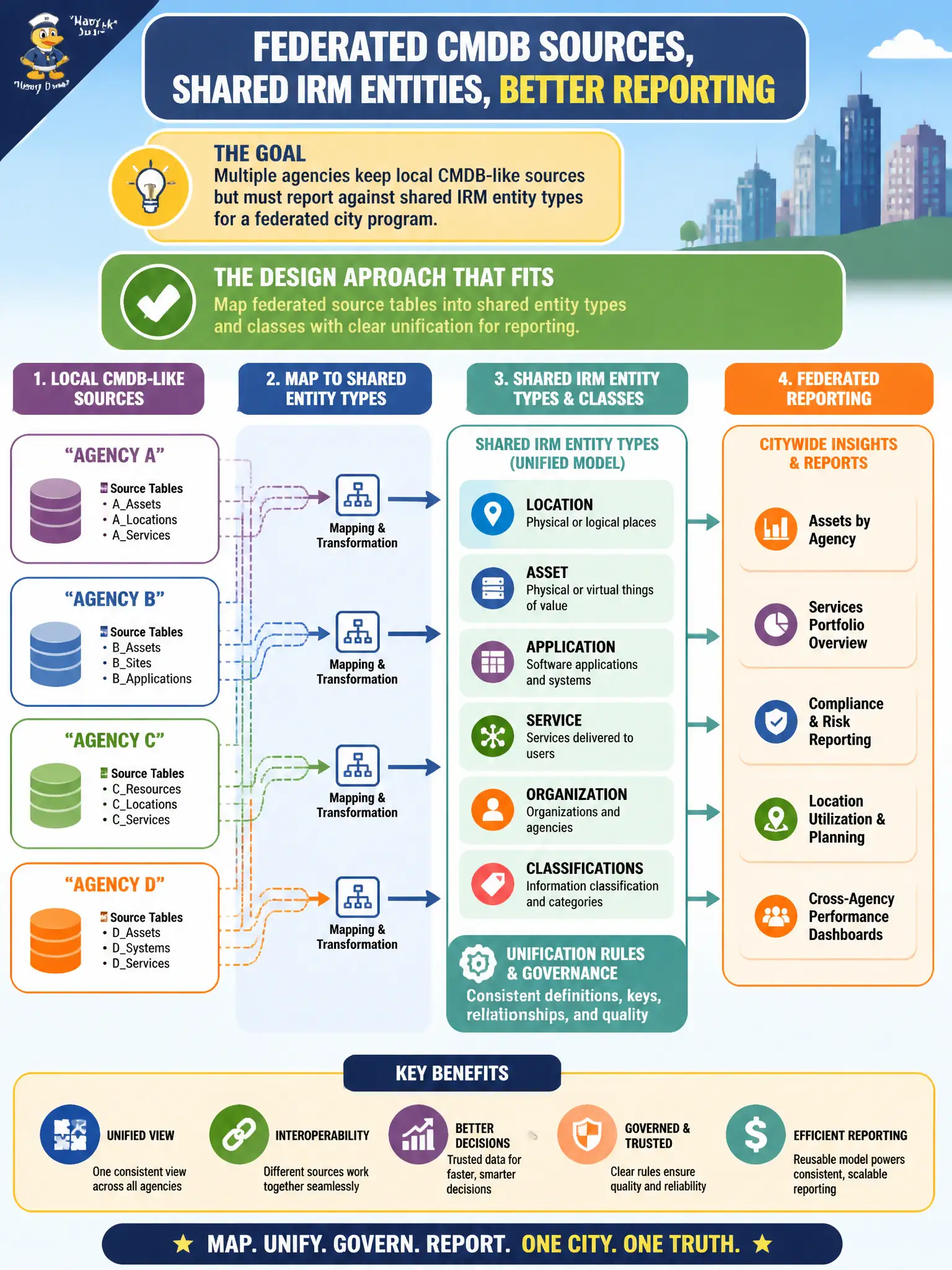
Multiple agencies keep local CMDB-like sources but must report against shared IRM entity types for a federated city program. What design approach fits?
Select an answer to reveal the explanation.
Short Explanation
Federated doesn’t mean chaotic. Agencies can keep feeding from local sources as long as those feeds map into shared entity types and classes. That’s how one citywide compliance view still makes sense.
Full Explanation
A federated model preserves agency source systems while unifying governable objects through shared entity types and classes. When multiple agencies keep local CMDB-like sources but must report against shared IRM entity types for a federated city program, map federated source tables into shared entity types and classes with clear unification for reporting. Forcing every agency to abandon local sources and rekey entities by hand into one spreadsheet does not scale and destroys operational CMDB value agencies still need. Creating unrelated entity definitions per agency with no shared classes or unification rules prevents citywide rollups executives require. Allowing each agency's SharePoint list to remain the only system of record with no IRM entities abandons the shared GRC framework entirely. Exam caveat: unification rules must resolve identity conflicts—the same application known by different names across agencies needs a master identity strategy before reporting can be trusted. Operational check: document source-to-entity mappings per agency, define shared classes, reconcile duplicate candidates, pilot a cross-agency compliance report for city leadership, obtain federation governance approval, and review mapping quality quarterly as agencies evolve local sources and naming.