
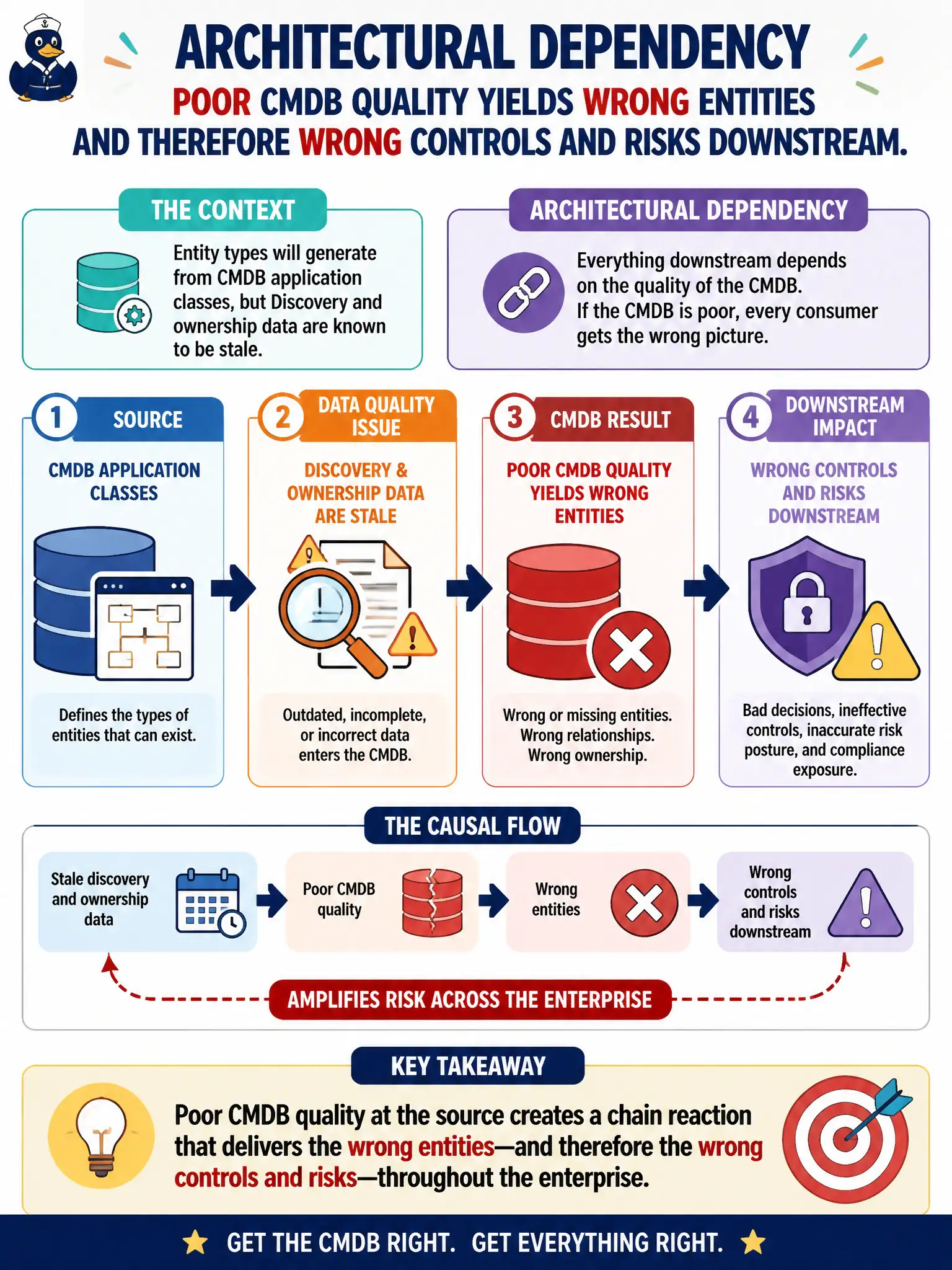
Entity types will generate from CMDB application classes, but Discovery and ownership data are known to be stale. What architectural dependency should be called out?
Select an answer to reveal the explanation.
Short Explanation
Garbage in, entities out. If CMDB criticality and owners are fiction, IRM happily generates fiction-shaped controls and risks. Fix the source of truth before you industrialize generation.
Full Explanation
Entity generation inherits the quality of its source tables. When entity types will generate from CMDB application classes but Discovery and ownership data are known to be stale, the architectural dependency to call out is that poor CMDB quality yields wrong entities and therefore wrong controls and risks downstream. Garbage in, entities out—municipal IRM will industriously generate fiction-shaped obligations if criticality and owners are wrong. Stale CMDB data is not irrelevant because entities ignore source attributes after creation; refresh continues to trust upstream values. GRC content packs do not automatically repair all CMDB identification rules. Only Audit Management reading CMDB is false; Risk and Compliance also depend on CMDB-sourced entities. Exam caveat: IRM cannot outrun CMDB hygiene—treat data quality as a go-live dependency, not a later cleanup after controls already flooded owners. Operational check: score criticality and ownership completeness for in-scope CIs before industrializing generation, remediate gaps with CMDB stewards, pilot entity refresh on a bureau, and gate go-live on agreed data-quality thresholds for the city's critical applications. Re-check metrics when expanding entity types or onboarding another agency into the shared framework.