
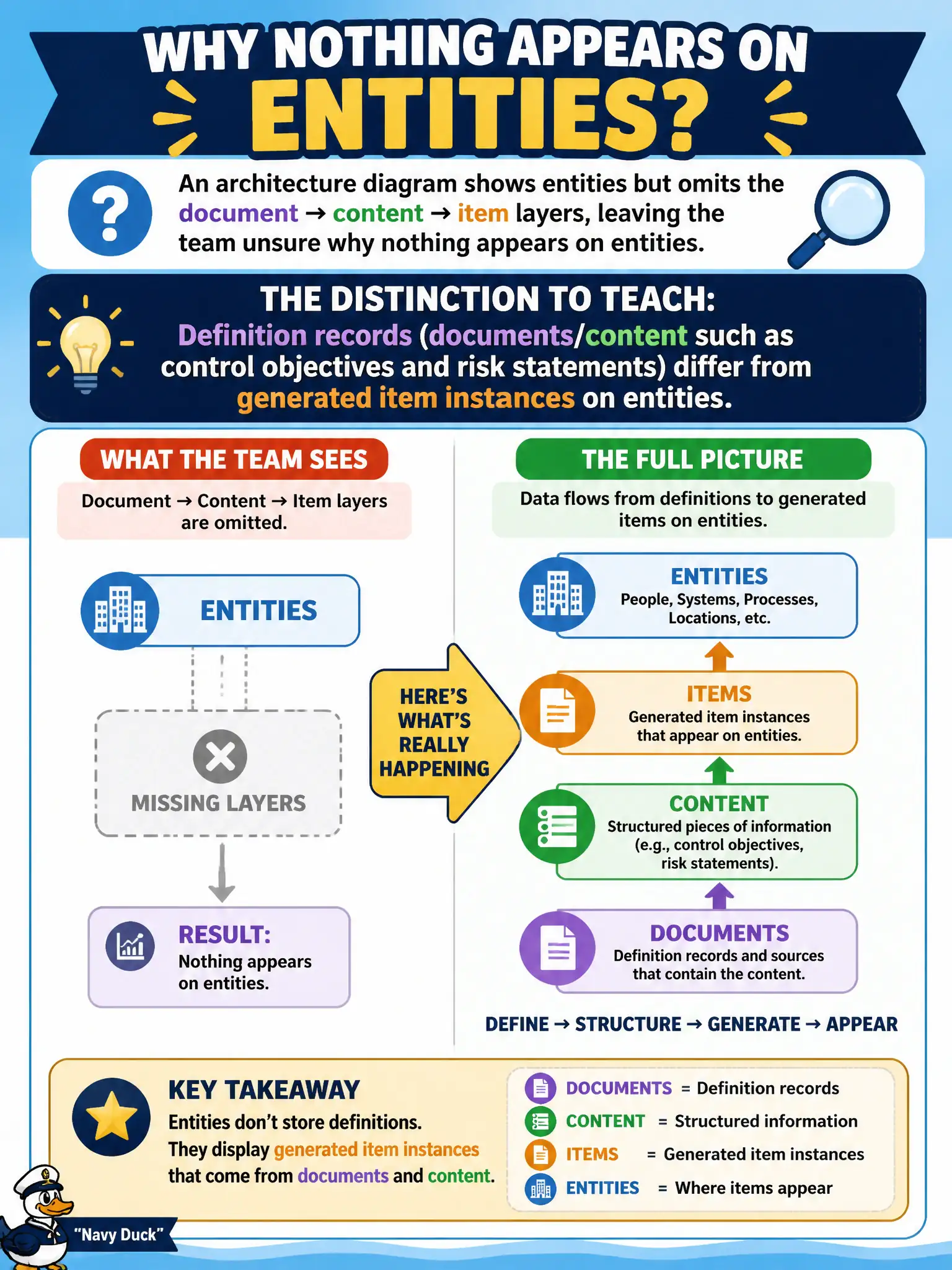
An architecture diagram shows entities but omits the document → content → item layers, leaving the team unsure why nothing appears on entities. What distinction must be taught?
Select an answer to reveal the explanation.
Short Explanation
The cookbook isn't the plated meal. Documents and content definitions are the cookbook; generated controls and risks are what's served on each entity's plate. Draw both layers or the kitchen looks empty.
Full Explanation
IRM architecture separates definitional content—authority documents, citations, control objectives, risk statements—from generated items such as controls and risks on entities. Diagrams that show entities but omit the document → content → item layers leave teams unsure why nothing appears on entities. Teaching that distinction is mandatory for municipal implementations: the cookbook is not the plated meal. It is false that generated items exist only in the CMDB and never in IRM tables, that documents and items are the same record type renamed in the UI, or that item layers are used solely by Software Asset Management entitlements. Without both layers drawn and implemented, city teams keep asking why associated library content never becomes owned work. Exam caveat: fixing the diagram is not enough—teams must also associate content to entity types and run generation with valid ownership. Operational check: redraw the municipal IRM content chain with both layers, walk a single citation through objective to generated control on a pilot entity, capture screenshots for onboarding, and reject architecture reviews that show entities without the upstream definition stack. Re-train after major UI label changes so classic versus workspace naming does not re-confuse definition versus instance.