
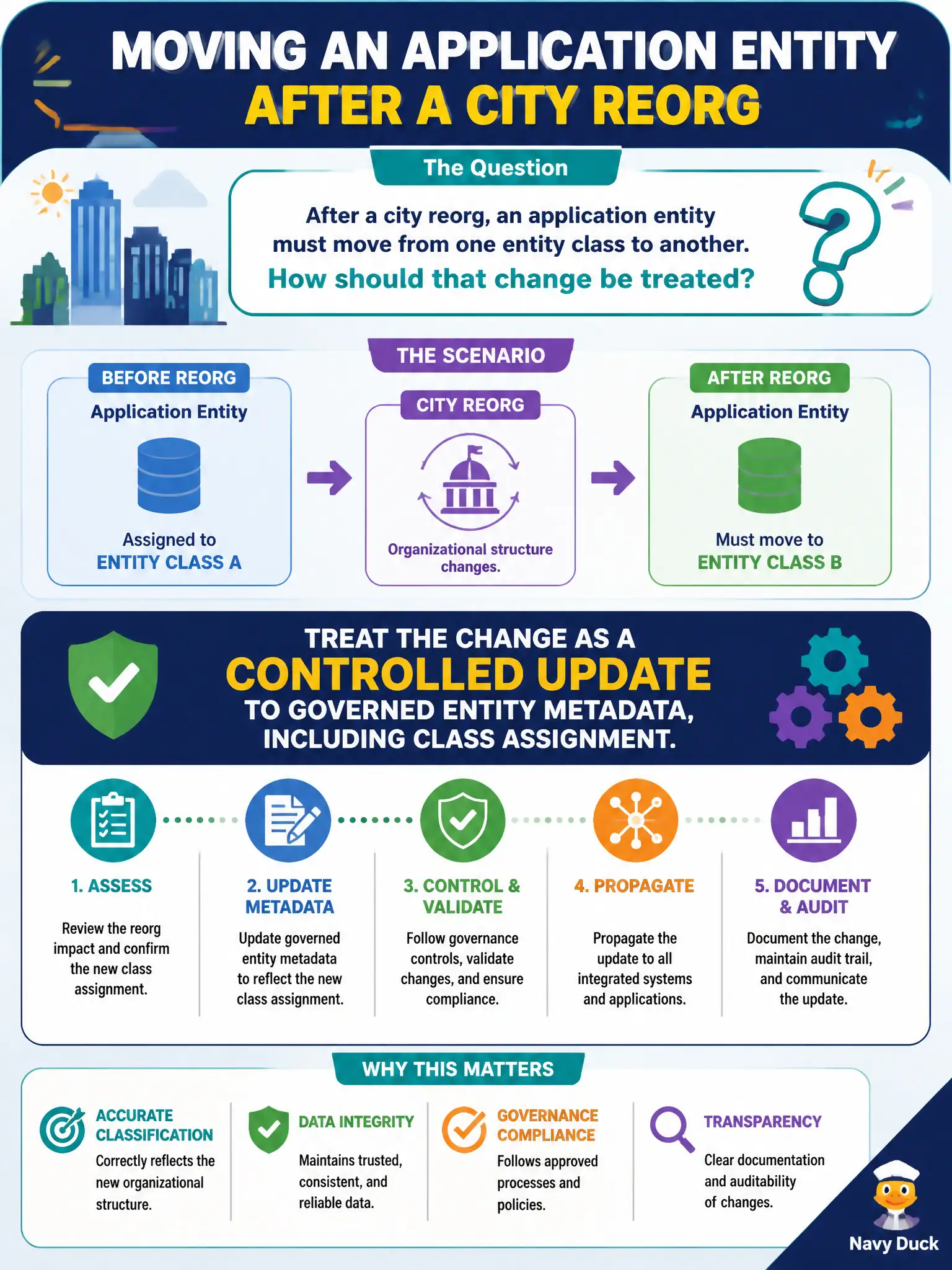
After a city reorg, an application entity must move from one entity class to another. How should that change be treated?
Select an answer to reveal the explanation.
Short Explanation
Class isn't graffiti you scribble overnight. After a reorg, move the entity with the same care you'd use changing an owner—tracked, intentional, governed. Metadata changes deserve a paper trail.
Full Explanation
After a city reorg, moving an application entity from one entity class to another should be treated as a controlled update to governed entity metadata, including class assignment. Class assignment affects hierarchy, reporting rollups, and sometimes scoping behavior, so it belongs in a tracked change with impact review—not an untracked spreadsheet edit. Treating the move as an automatic rename of the CMDB class that silently rewrites all GRC history confuses CMDB classification with IRM entity-class metadata and risks uncontrolled historical distortion. Cloning the entire IRM application for the new department multiplies instances instead of updating metadata on the shared civic system of record. Exam caveat: changing class does not by itself fix ownership or regenerate controls; assess whether hierarchy, cascading scope, and dashboards still behave as intended after the move. Operational check: raise a change that documents before/after class, impacted reports, and owner notifications; update the entity class in IRM; verify municipal dashboards and parent/child navigation; and confirm no unintended orphaning of generated items. Retain the change record so auditors can see why the application moved classes during the reorg.