
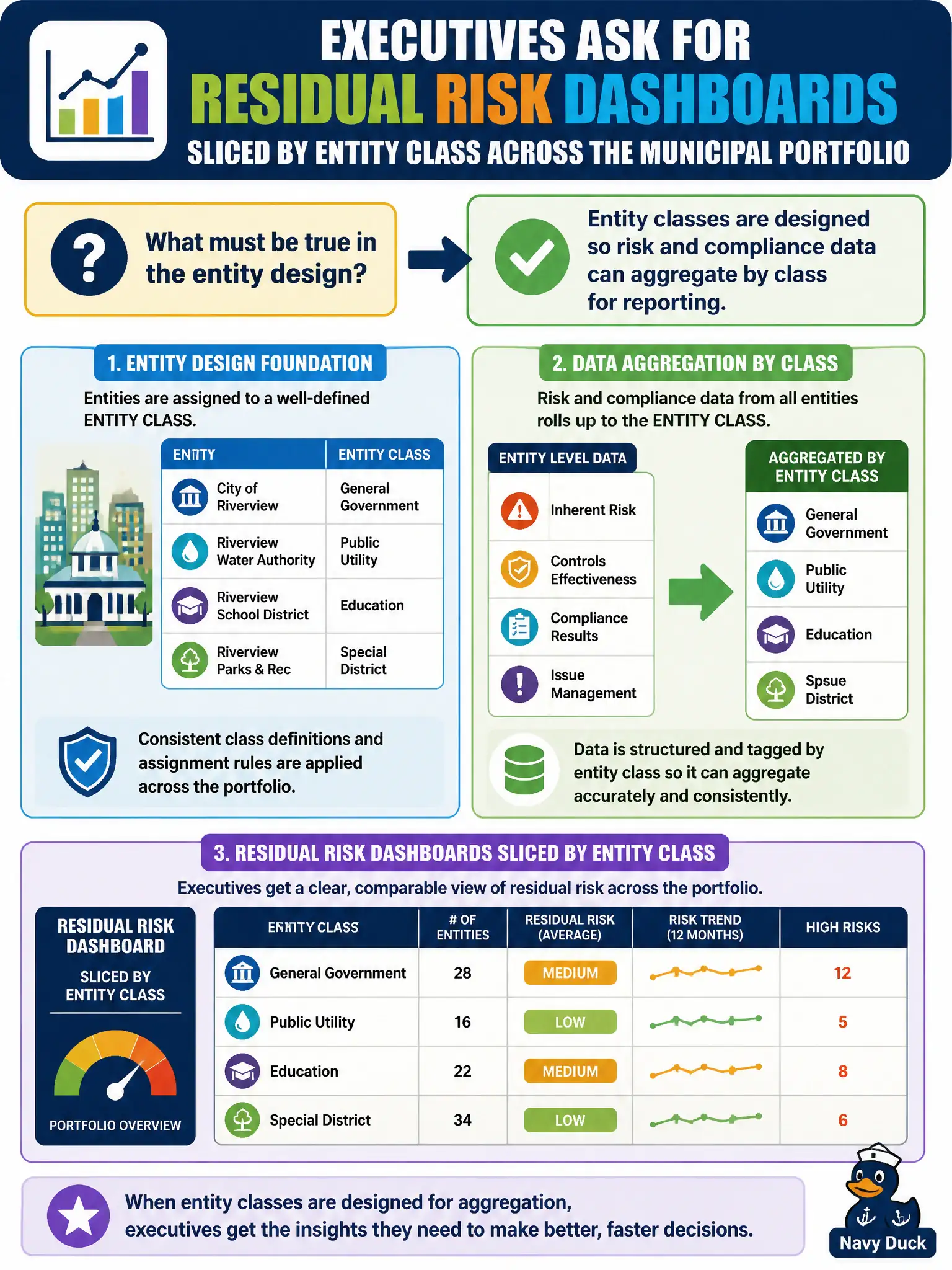
Executives ask for residual risk dashboards sliced by entity class across the municipal portfolio. What must be true in the entity design?
Select an answer to reveal the explanation.
Short Explanation
Executives want pie slices, not a spaghetti bowl. Classes give the slices—Technology here, Organization there—so residual risk can roll up cleanly. Design the classes for the story the dashboard has to tell.
Full Explanation
For residual risk dashboards sliced by entity class across the municipal portfolio, entity classes must be designed so risk and compliance data can aggregate by class for reporting. Classes provide the executive slices—Technology, Organization, Third Party—so residual risk rolls up cleanly for city leadership reviews. Forcing all entities into a single class named Executive collapses the slices executives asked for and hides concentration of risk. Storing risk scores only in spreadsheet exports outside the instance abandons IRM as the system of record and invites version drift. Deleting entity classes before any risk indicator can run is backwards and breaks aggregation pathways. Exam caveat: aggregation quality still depends on consistent scoring methodologies, ownership, and entity membership—classes organize the cut; they do not invent accurate residual scores. Operational check: assign types to reporting classes, ensure risks are linked to entities in those classes, build a residual-risk widget by class for city leadership, validate totals against a known sample of entities, and reconcile differences with risk owners before the next council or executive risk committee. Re-check after taxonomy changes that dashboard filters still align to the approved class set used by the civic program.