
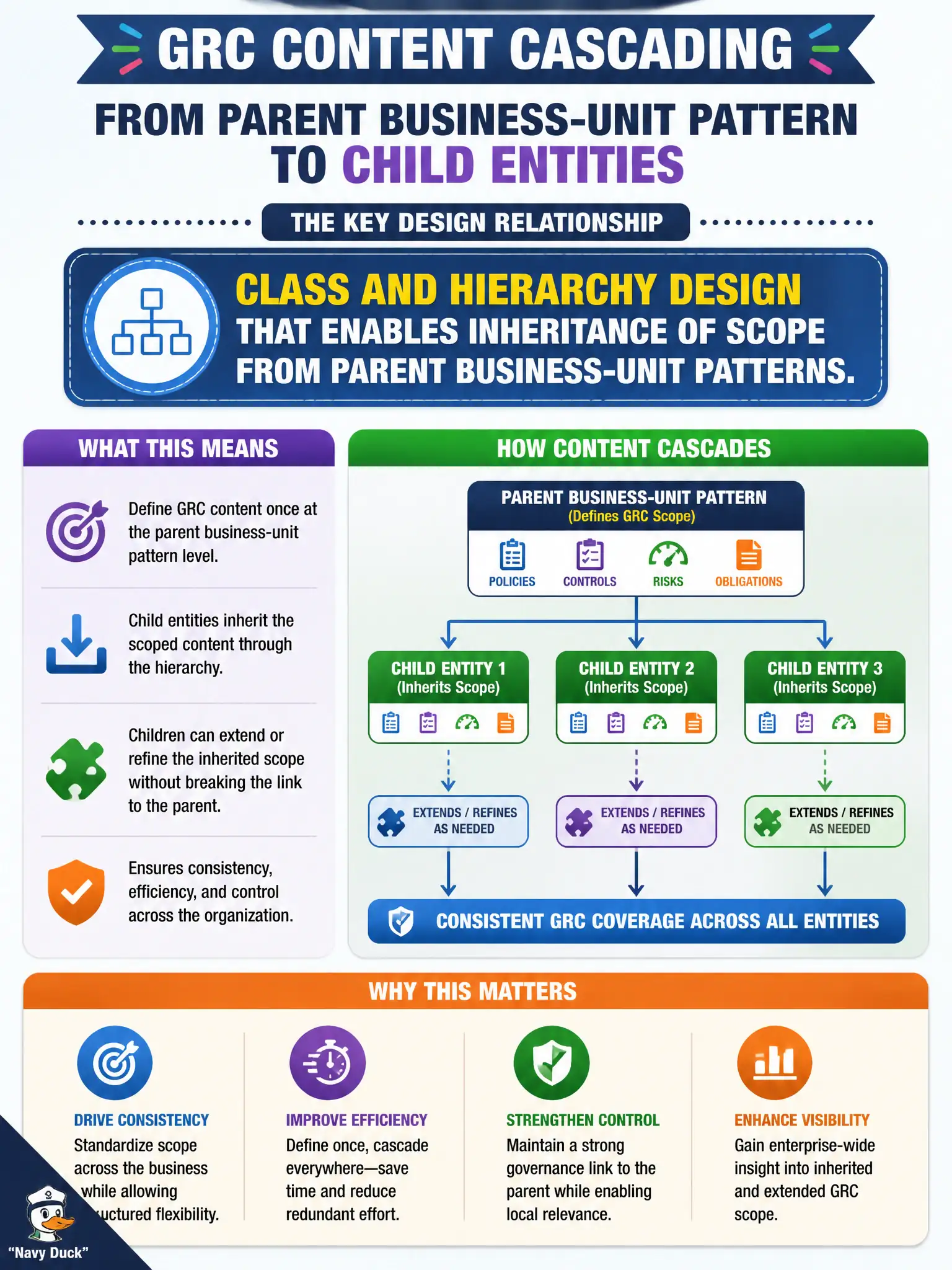
A utility wants scoped GRC content from a parent business-unit pattern to cascade toward child entities. What design relationship should the workshop emphasize?
Select an answer to reveal the explanation.
Short Explanation
Parents set the house rules; kids inherit the curfew unless you redesign the whole block. Class-aware hierarchy is how scoped content can cascade. Flat, unrelated classes break that story.
Full Explanation
When a utility wants scoped GRC content from a parent business-unit pattern to cascade toward child entities, workshops should emphasize class and hierarchy design that enables inheritance of scope from parent business-unit patterns. IRM entity architecture uses hierarchical relationships and class-aware patterns so content associated at a parent can inform children where cascade is supported. Deleting parent entities after children are created removes the structural source of inherited scope and ownership context. Storing cascade rules exclusively in email distribution lists creates an unmanaged shadow process outside IRM. Pointing every child at a different unrelated class with no hierarchy breaks the inheritance story and fragments reporting. Exam caveat: cascade behavior is design- and configuration-dependent—hierarchy alone does not magically copy every control; verify which scoped content patterns the instance actually supports. Operational check: model parent business-unit and child system entities with correct class relationships, associate scoped content at the parent, verify expected child visibility or generation behavior in a pilot, and document cascade assumptions in the utility's IRM design decision register. Re-test cascade after major IRM upgrades so municipal inheritance behavior remains understood.