
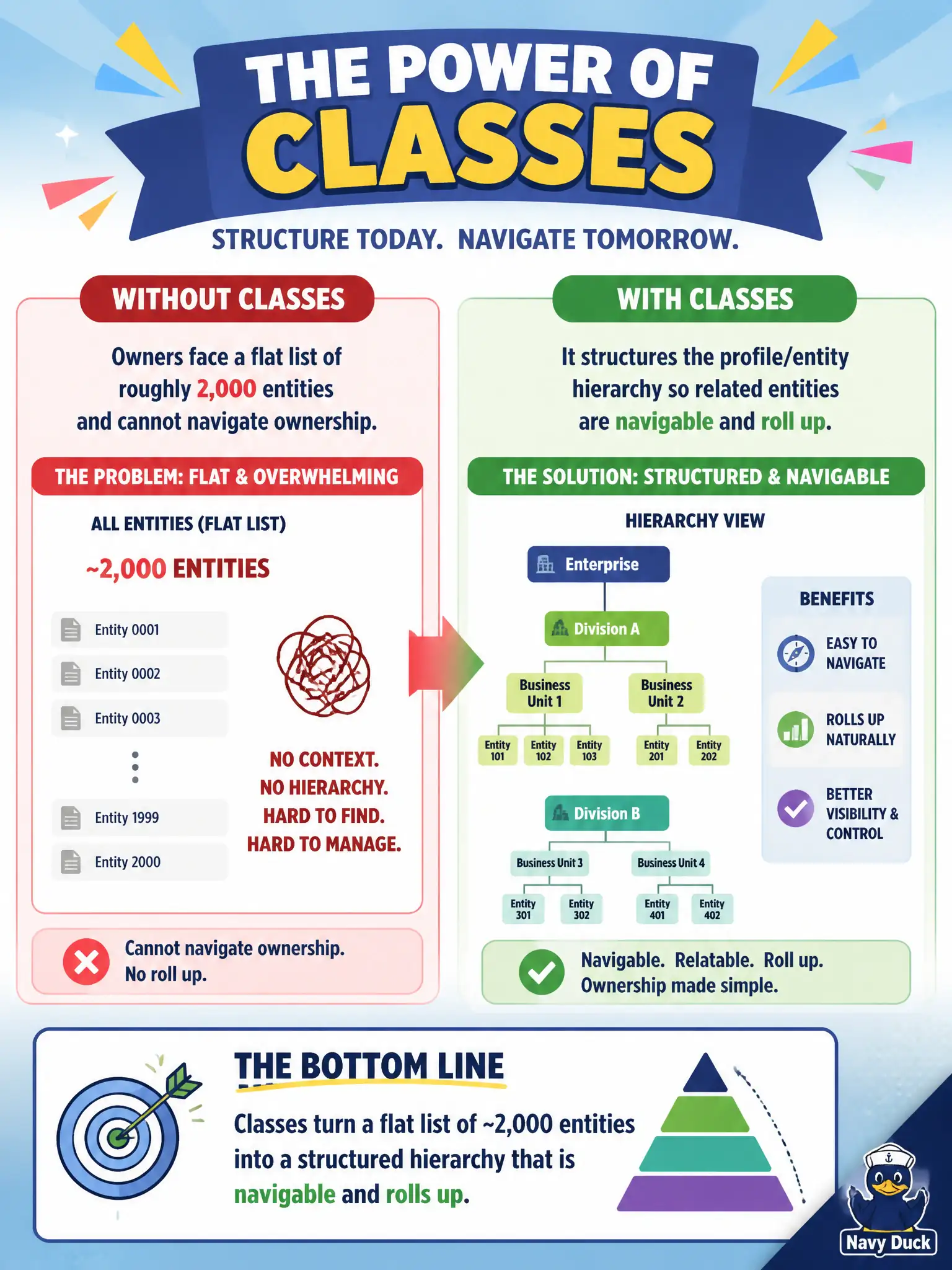
Without entity classes, owners face a flat list of roughly 2,000 entities and cannot navigate ownership. What problem does introducing classes primarily solve?
Select an answer to reveal the explanation.
Short Explanation
Two thousand names in one endless scroll is a phone book without sections. Classes put dividers in the book so owners find their neighborhood. Hierarchy is sanity, not decoration.
Full Explanation
Introducing entity classes primarily structures the profile/entity hierarchy so related entities are navigable and roll up, solving the problem of owners facing a flat list of roughly 2,000 entities. Classes put durable dividers into a large civic inventory so owners find their neighborhood of applications, organizations, or vendors and so reporting can aggregate across the municipal portfolio. Without classes, stewards waste time scrolling undifferentiated lists and executives cannot slice posture by meaningful categories. Classes do not replace the need for control objectives, nor do they automatically remediate open issues overnight. Converting every entity into an incident for ITSM routing confuses GRC scoping objects with operational tickets and invents noisy work that does not improve compliance design. Exam caveat: classes improve navigation and rollup; they do not by themselves assign owners or generate controls—those remain type, content, and ownership concerns. Operational check: assign existing entity types to a small set of stable classes, validate that workspace and classic navigation show hierarchical groupings instead of one endless list, pilot an owner walkthrough with a department steward, and measure time-to-find for a known entity before and after classification. Capture the municipal navigation requirement in UAT scripts so flat-list regressions are caught after upgrades, and record class assignments in the IRM architecture register for auditors.