
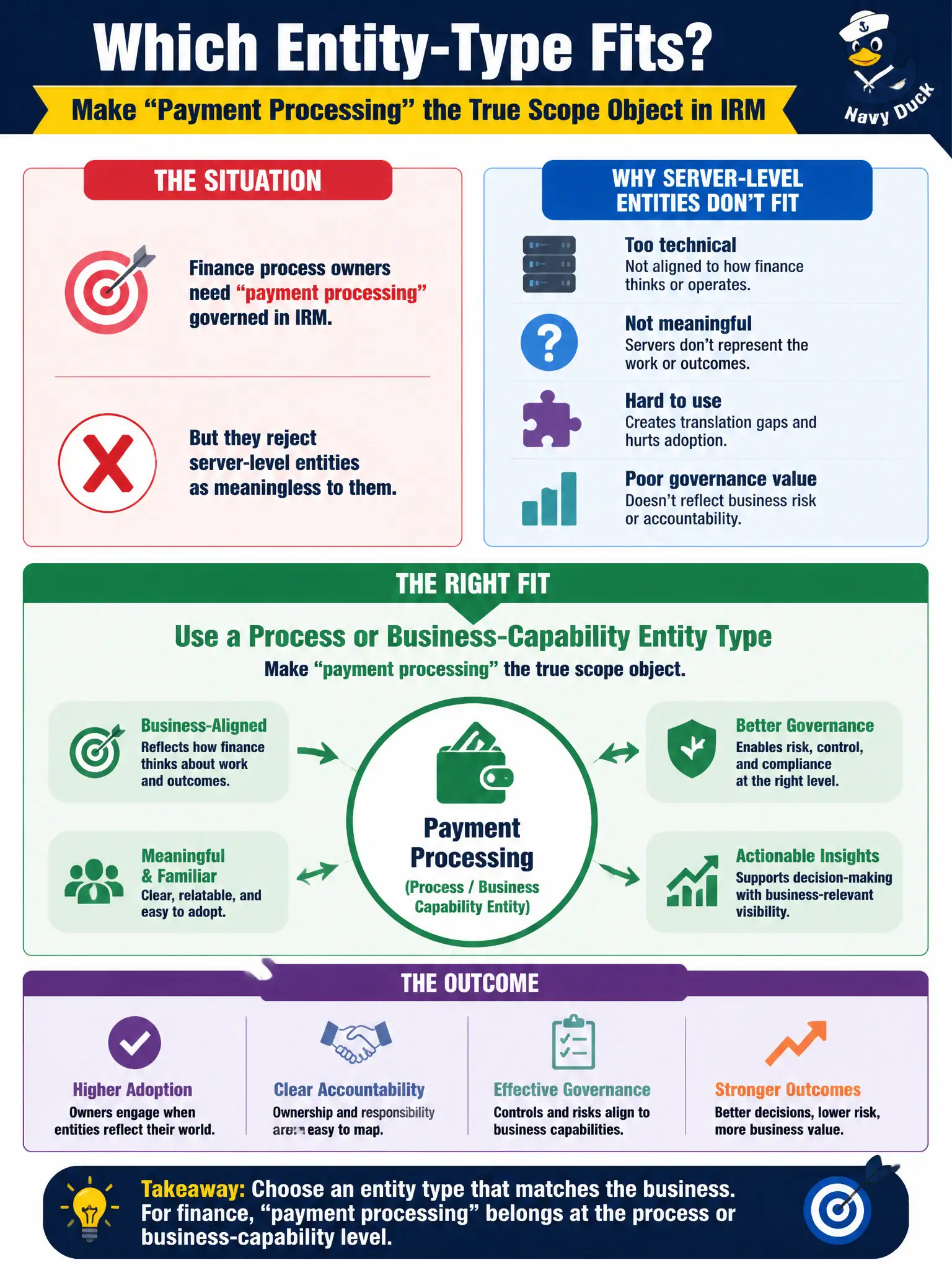
Finance process owners need 'payment processing' governed in IRM, but they reject server-level entities as meaningless to them. What entity-type approach fits?
Select an answer to reveal the explanation.
Short Explanation
If the thing owners care about is the payment process—not a blade in the rack—then the entity should be that process. GRC sticks to what people can attest to. Capability and process entities keep non-technical owners in the game.
Full Explanation
When finance process owners need payment processing governed in IRM but reject server-level entities as meaningless, the fitting approach is a process or business-capability entity type where payment processing is the true scope object. IRM entity design is not limited to infrastructure CIs; process and capability entities let non-IT owners attest in their own vocabulary while still joining controls and risks to durable records. Forcing all payment controls onto data-center rack CIs teaches CMDB jargon instead of enabling accountable compliance and typically yields empty or rubber-stamp attestations. Creating only user entities for every accounts-payable clerk fragments process-level obligations into personal tasks and misses the shared process control environment. Storing payment processing only as a free-text tag on unrelated application entities provides no first-class generation, ownership, or reporting object. Exam caveat: process entities still need clear ownership, filters, and scope—naming a capability does not replace control objectives or item generation. Operational check: workshop with finance to confirm payment processing as the governable object, define a process/capability entity type with stable identity and owner, associate relevant control objectives, generate a pilot control set, and verify owners can complete attestation without server CI knowledge. Capture the civic framing in the design decision log so auditors see why process scope was chosen over infrastructure-only entities.