
A water utility must govern treatment plants and depots as well as IT applications. How should entity types be structured?
Select an answer to reveal the explanation.
Short Explanation
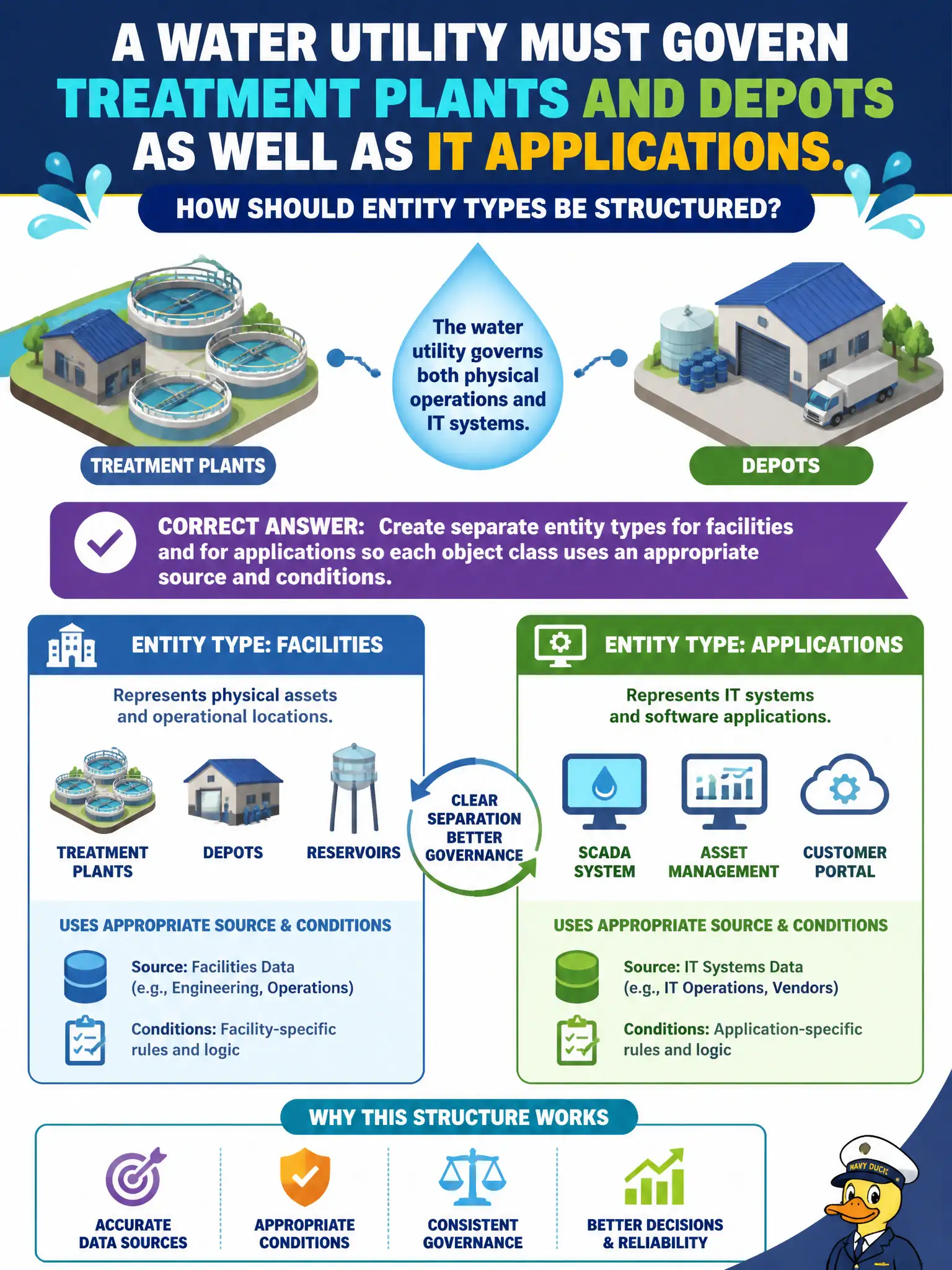
A treatment plant is not an application CI wearing a hard hat. Give facilities their own entity type and keep apps on an application type. Different object classes need different sources and filters—or you end up with nonsense records.
Full Explanation
A water utility governing treatment plants and depots as well as IT applications should create separate entity types for facilities and for applications so each object class uses an appropriate source and conditions. A treatment plant is not an application CI wearing a hard hat; different classes differ in tables, attributes, and ownership models. Separate types preserve clean filters and reporting while reflecting real-world object diversity. Forcing facilities into the application CI entity type by mislabeling plants as apps produces nonsense records. Governing facilities only through free-text risk descriptions with no entities abandons scoping discipline. Allowing only one entity type per instance regardless of object class is a false limitation that harms design. Exam caveat: Entity Framework supports multiple types for different governed object classes. Operational check for the utility: define a facilities entity type on the appropriate facility or location source and an applications type on application CIs, generate both, and confirm plant entities are not forced through the application class filters. Keep civic stakeholders aligned on the operating model, and verify platform records after each change before reporting posture to leadership. Revisit the design when CMDB classes, org structures, or program charters change.