
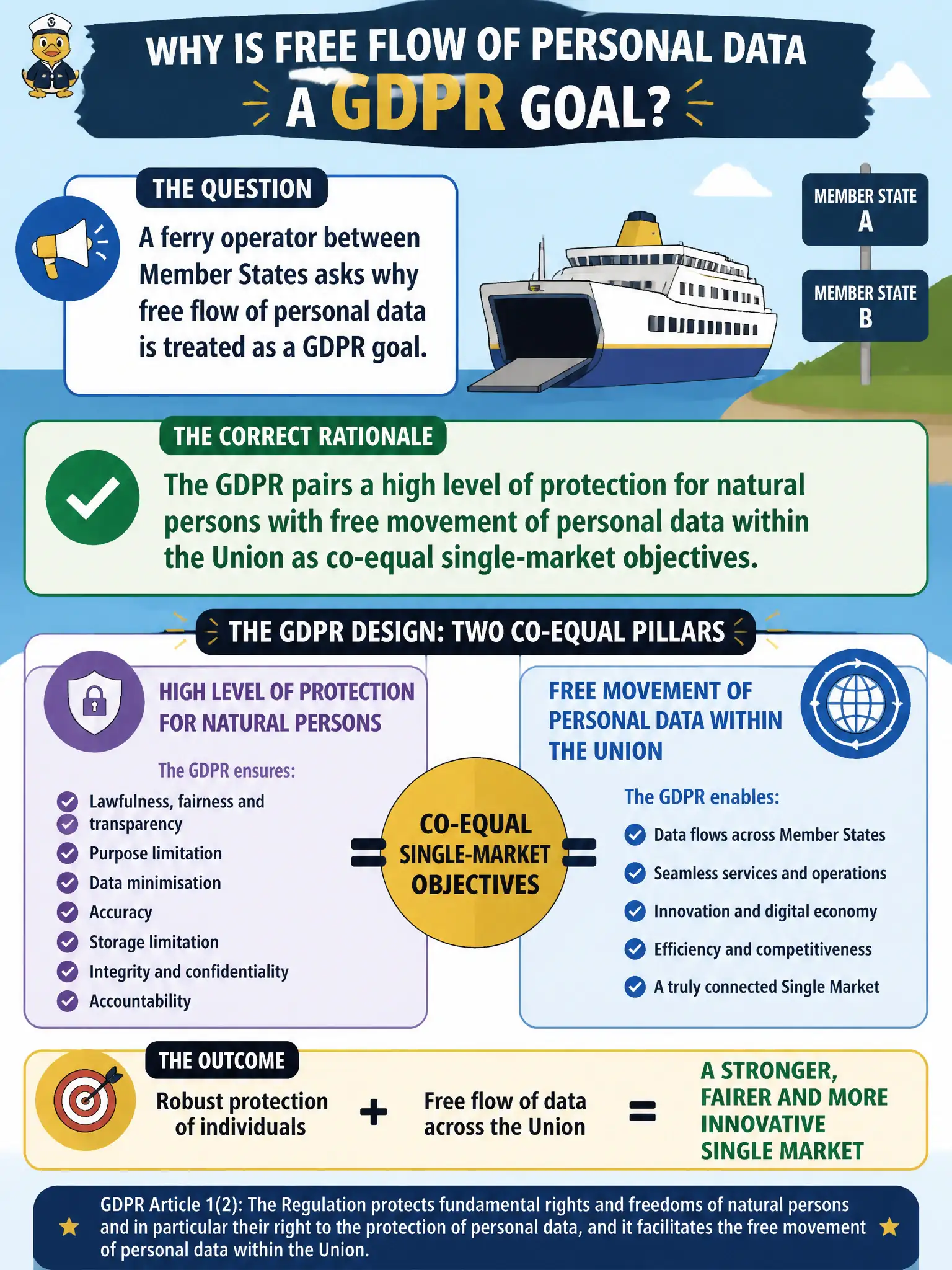
A ferry operator between Member States asks why free flow of personal data is treated as a GDPR goal. Which rationale matches the Regulation’s design?
Select an answer to reveal the explanation.
Short Explanation
The GDPR is not a moat that traps data at every Member State border. Protection of people and free circulation of personal data inside the Union are twin goals—like safe roads and open travel between towns. That single-market logic is why a ferry operator’s passenger processing can move with the journey under one EU rulebook.
Full Explanation
The GDPR pairs a high level of protection for natural persons with free movement of personal data within the Union as co-equal single-market objectives. A ferry operator moving passenger data between Member States should understand free flow as a designed goal under shared safeguards, not as a loophole or as a ban. The GDPR’s sole objective is not to ban all cross-border personal-data movement inside the Union. Free flow is not limited to anonymous marketing lists and never to identified passenger records. Free flow is not a CIPP/US concept imported from the CCPA’s sale definition. Exam caveat: Article 1 twin aims—protection plus intra-Union free flow—are frequently tested together. Operational check: when designing cross-border municipal passenger manifests, document how Article 5 principles and security measures enable lawful free flow rather than inventing an absolute localisation rule “because GDPR.” For municipal teams, keep a one-page decision note that states the governing instrument, why competing labels fail, and what evidence would change the conclusion. Document the decision trail so auditors can see how the civic team matched facts to the correct legal category rather than to a slogan.