
A regional DPO asks what a “harmonised European approach” tried to fix when Member States had divergent national data-protection laws. What problem was the drive toward consistent rules mainly addressing?
Select an answer to reveal the explanation.
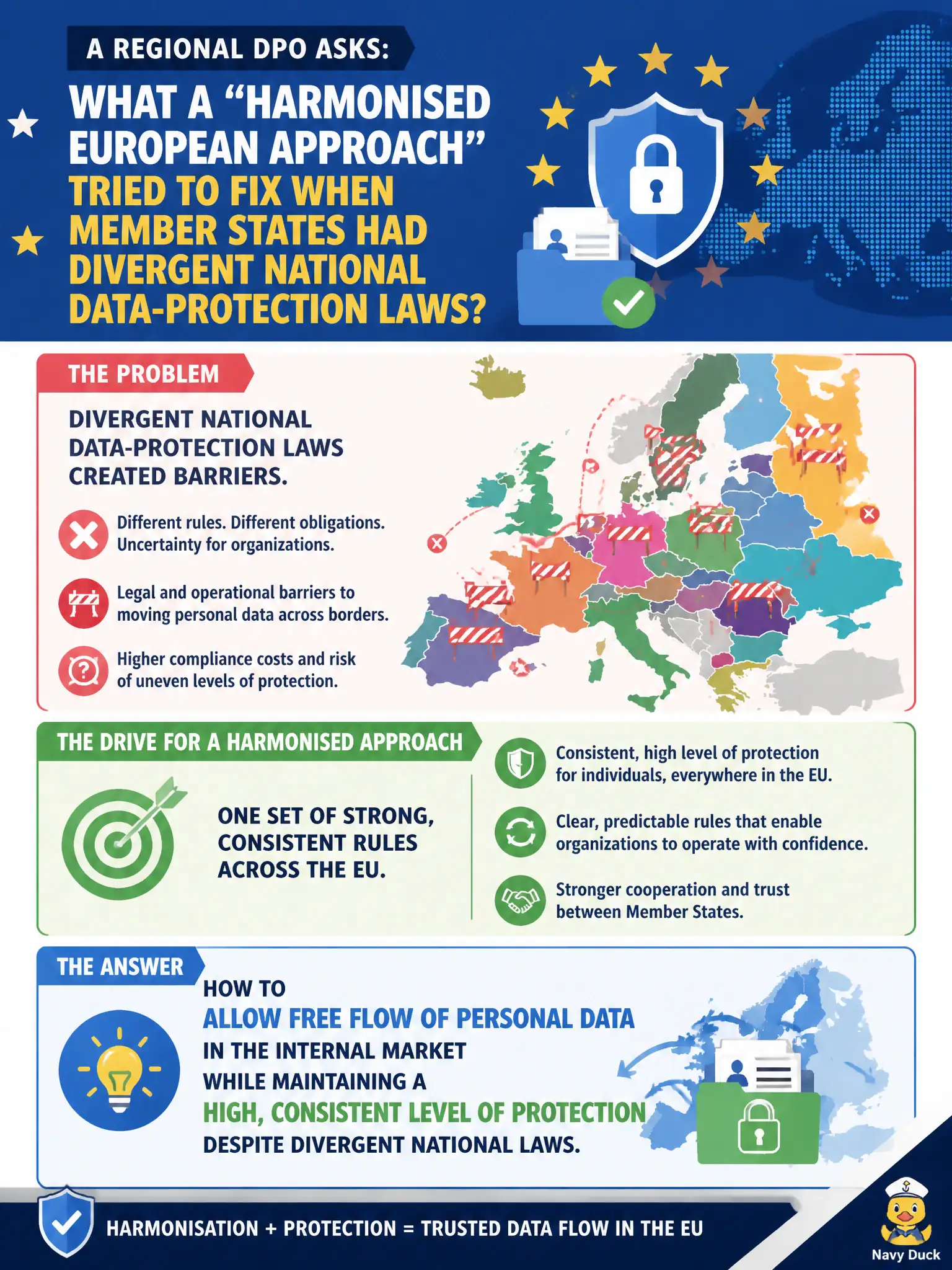
Short Explanation
Divergent national privacy rules were like every city painting different traffic lights — goods and data could not move smoothly, and people got uneven protection. Harmonisation aimed at one clear road code: protect people well and still let personal data circulate in the market. That twin goal is the heart of the story.
Full Explanation
The drive toward a harmonised European approach addressed a dual problem: divergent national data-protection laws threatened both a consistently high level of protection for individuals and the free flow of personal data needed for the internal market. Regional DPOs should frame harmonisation as reconciling free movement of personal data with elevated, more consistent safeguards—not as a branding exercise. Banning all cross-border postal mail containing surnames is neither the historical objective nor a workable market design. Replacing national languages with a single EU privacy vocabulary for contracts confuses linguistic policy with substantive alignment of processing rules. Requiring every municipality to host identical server hardware brands mistakes procurement uniformity for legal harmonisation. Directive 95/46/EC and later the GDPR embody that dual objective of protection plus free flow within the Union. Exam caveat: when stems mention harmonisation, look for the internal-market-plus-high-protection pairing rather than theatrical absolute bans. Operational check: if two Member State interpretations diverge on a municipal data-sharing project, ask whether the friction is exactly the type of barrier harmonised rules were meant to reduce—and escalate consistency questions through the appropriate cooperation channels rather than inventing local hardware mandates.