
A library consortium hears “Convention 108” and assumes it is identical to the GDPR. Which distinction should training emphasise?
Select an answer to reveal the explanation.
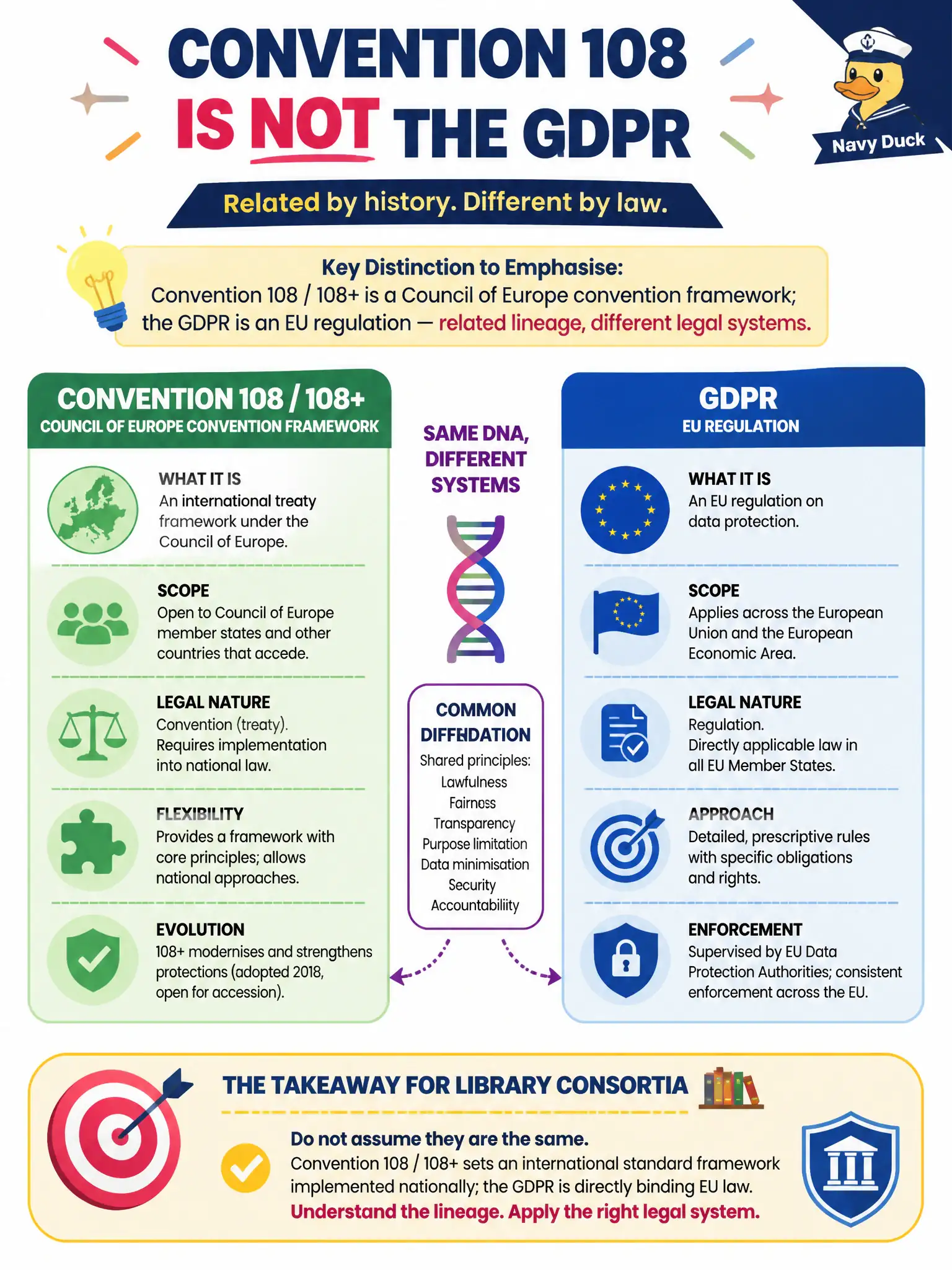
Short Explanation
Convention 108 and the GDPR are cousins, not clones. One lives in the Council of Europe human-rights world; the other is an EU regulation with its own institutions and enforcement. Same privacy family tree, different passports and court systems.
Full Explanation
Convention 108 and its modernised form (108+) are Council of Europe convention instruments on automatic processing of personal data; the GDPR is an EU regulation adopted under Union law. They share conceptual lineage—fairness, safeguards, and protection of individuals—but belong to different legal systems with different parties, supervision models, and remedies. Library consortium training should emphasise that related does not mean identical: a CoE treaty open to a wider set of states is not GDPR by another name. Calling Convention 108 the unofficial nickname for GDPR Article 108 is a numbering fantasy that confuses treaty identity with an EU regulation article. Saying 108 applies only inside the eurozone while the GDPR applies only to paper records misstates both territorial logic and medium neutrality. Claiming Convention 108 repealed the GDPR for libraries in 1981 is chronologically impossible and jurisdictionally confused. Exam caveat: CIPP/E regularly tests CoE versus EU institutional literacy—Convention 108/108+ versus GDPR is a classic pairing. Operational check: in a training slide, put Council of Europe treaty beside 108/108+ and EU regulation / SA + EDPB ecosystem beside the GDPR, and refuse to merge the boxes when staff ask which text to cite for an administrative fine.