
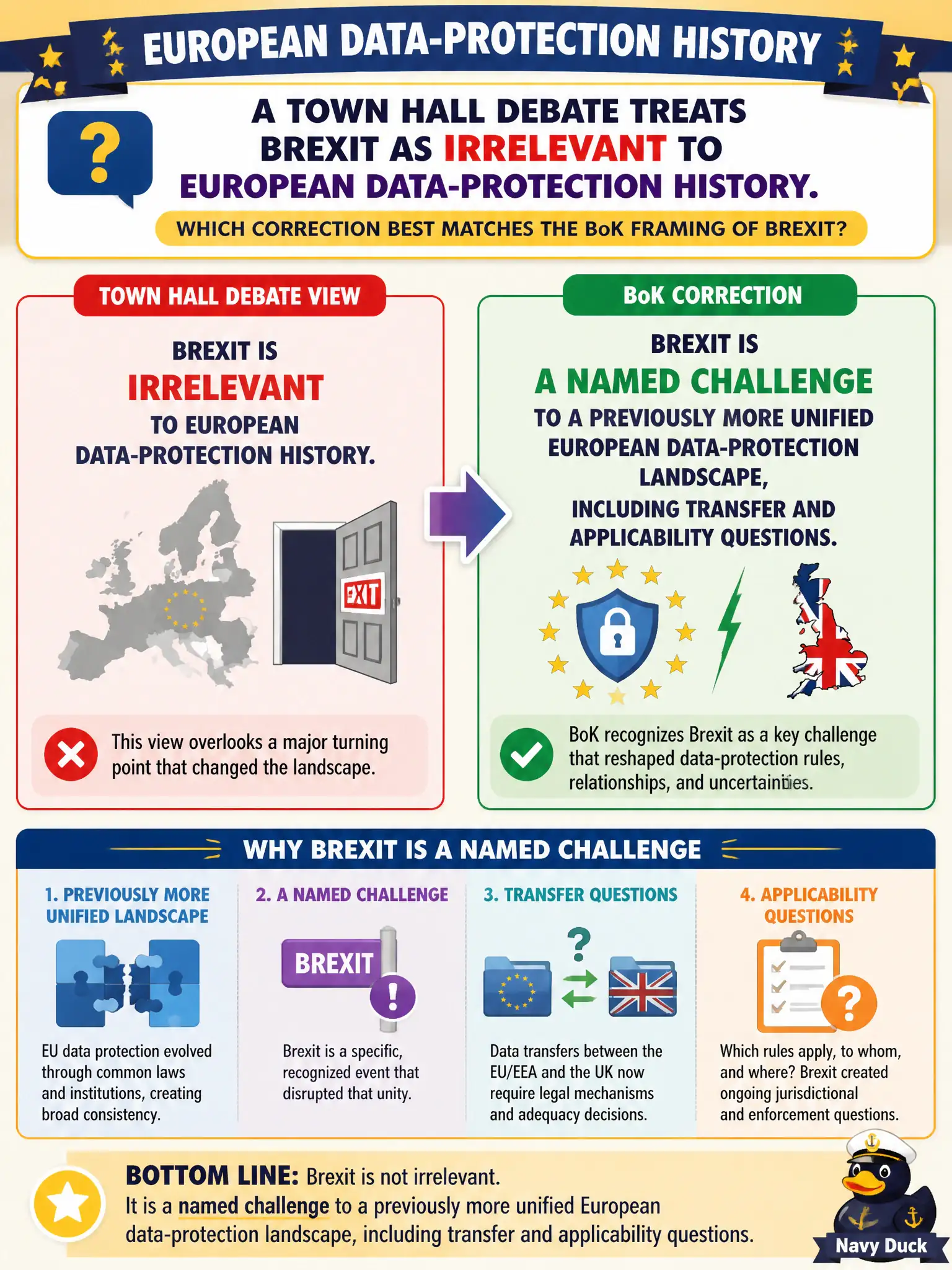
A town hall debate treats Brexit as irrelevant to European data-protection history. Which correction best matches the BoK framing of Brexit?
Select an answer to reveal the explanation.
Short Explanation
Brexit is not a side quest in the European privacy story — it cracked a landscape that used to look more joined-up. When the UK left the EU legal order, questions about which rules apply and how data can keep flowing suddenly got harder. Ignoring that challenge skips a BoK-named piece of the history.
Full Explanation
Within CIPP/E historical framing, Brexit is a named challenge to a previously more unified European data-protection landscape, especially around applicability, supervision pathways, and international transfers involving the United Kingdom. Town-hall briefings that treat Brexit as irrelevant erase that BoK context: withdrawal from the EU legal order changed how UK–EU personal-data flows and regulatory interfaces must be analysed. Brexit did not only affect fishing quotas; personal-data law and transfer mechanisms were squarely in scope for practitioners. It did not immediately repeal the GDPR worldwide on exit day—an overstatement that ignores both territorial scope rules and the UK’s own post-exit regime trajectory. Converting the UK into an EU supervisory authority that leads all EDPB cases reverses institutional reality after withdrawal. Exam caveat: expect Brexit items to test challenge to unity, transfers, and applicability—not apocalyptic worldwide repeal narratives. Operational check: for any civic system still exchanging resident data with UK partners, document the current transfer tool (adequacy or alternative), the roles of the parties, and which supervisory authority is competent—then revisit when adequacy or contractual terms change.