
A county counsel wonders whether the Treaty of Lisbon matters for day-to-day GDPR work. Which link to the modern EU legal order is most accurate?
Select an answer to reveal the explanation.
Short Explanation
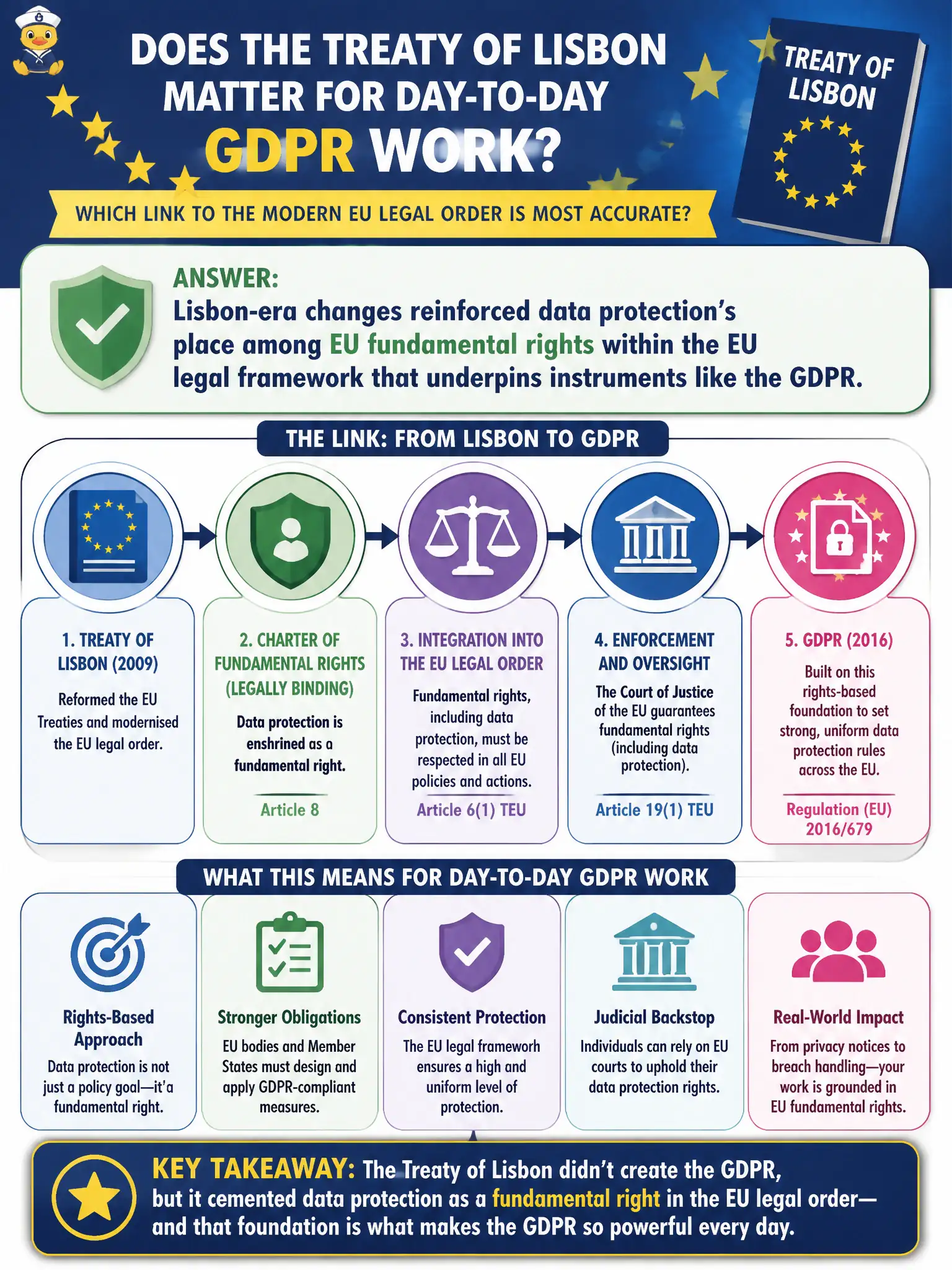
Lisbon is less about renaming committees and more about where data protection sits in the EU’s rights architecture. Once data protection is treated as a fundamental right in that legal order, day-to-day GDPR work rides on firmer constitutional rails. Counsel is right to ask — it is background structure, not trivia.
Full Explanation
The Treaty of Lisbon strengthened the EU’s fundamental-rights architecture, including the binding status of the Charter of Fundamental Rights, which expressly protects personal data. That constitutional embedding is why data protection sits among elevated Union values and helps explain the legal weight of instruments such as the GDPR in day-to-day public-sector work. County counsel should not treat Lisbon as an agricultural renaming exercise with no rights dimension: it matters because it reinforced the rights framework that underpins modern EU data-protection legislation. Lisbon did not make the GDPR optional for municipalities that run open-data portals; direct applicability and material scope still turn on GDPR criteria, not local portal branding. Lisbon did not abolish the Charter; the opposite institutional story is closer to the truth. Framing Lisbon as replacing operational GDPR duties is also wrong—controllers still need lawful bases, notices, DPIAs where required, and cooperation with supervisory authorities. Exam caveat: institutional-history questions often test whether candidates can link Treaty/Charter developments to why GDPR obligations carry fundamental-rights gravity without confusing them for operational exemptions. Operational check: when a civic legal brief asks why GDPR bites so hard, point to Charter Article 8 and Lisbon-era fundamental-rights status, then map the concrete controller duties that follow.