
A municipal privacy officer cites the OECD Guidelines as if they were an EU regulation that can impose administrative fines. How should counsel correct that understanding?
Select an answer to reveal the explanation.
Short Explanation
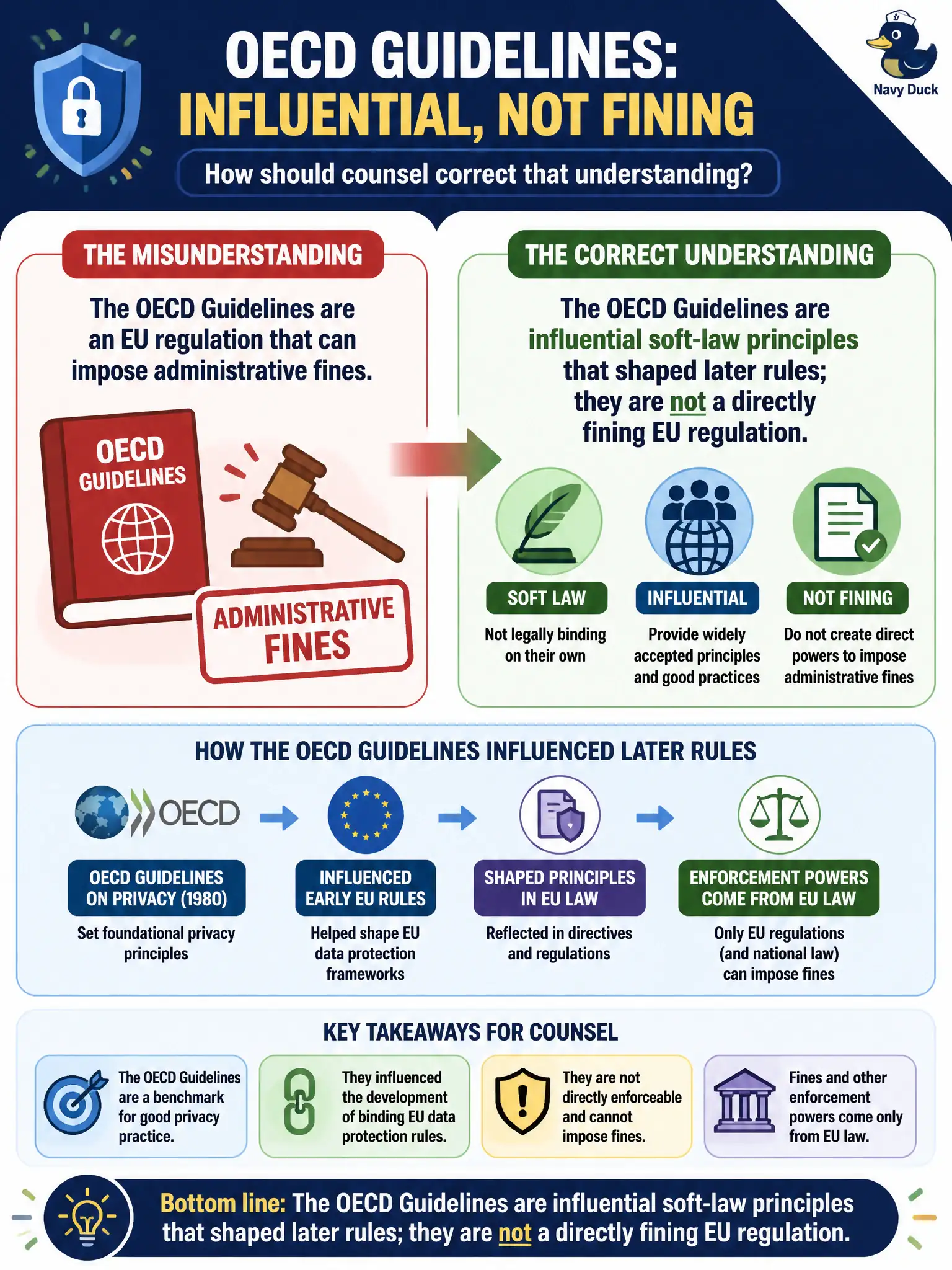
Picture the OECD Guidelines as a really good recipe book that chefs everywhere copied — helpful and influential, but not the health inspector with a fine pad. EU regulations and national laws are what actually bite. Soft law shapes thinking; it does not itself hand out GDPR-style administrative fines.
Full Explanation
The 1980 OECD Guidelines on the Protection of Privacy and Transborder Flows of Personal Data are influential soft-law principles that shaped later European and national rules; they are not an EU regulation with direct effect or GDPR-style administrative fines. Counsel should tell the municipal privacy officer that OECD guidance can inform policy design and comparative analysis, but enforcement posture, fining powers, and one-stop-shop mechanics come from binding Union and Member State law—today primarily the GDPR and national supervisory frameworks. Soft law persuades and converges practice; it does not itself open an administrative-fine file against a city for a census transfer. Claiming the Guidelines automatically fine non-OECD cities invents a sanction mechanism the OECD instrument does not confer. Saying they repealed the GDPR and replaced supervisory authorities reverses hierarchy: the GDPR is binding EU law, and OECD texts did not displace it. Limiting the Guidelines to paper archives ignores their explicit engagement with electronic personal-data flows and their historical influence on electronic processing rules. Exam caveat: distinguish soft-law pedigree from directly applicable EU regulations when a stem name-drops OECD, CoE, or EU instruments together. Operational check: before citing OECD text in a compliance memo, ask whether the obligation you need is enforceable under the GDPR or national law—and cite that binding source for fines and remediation.