
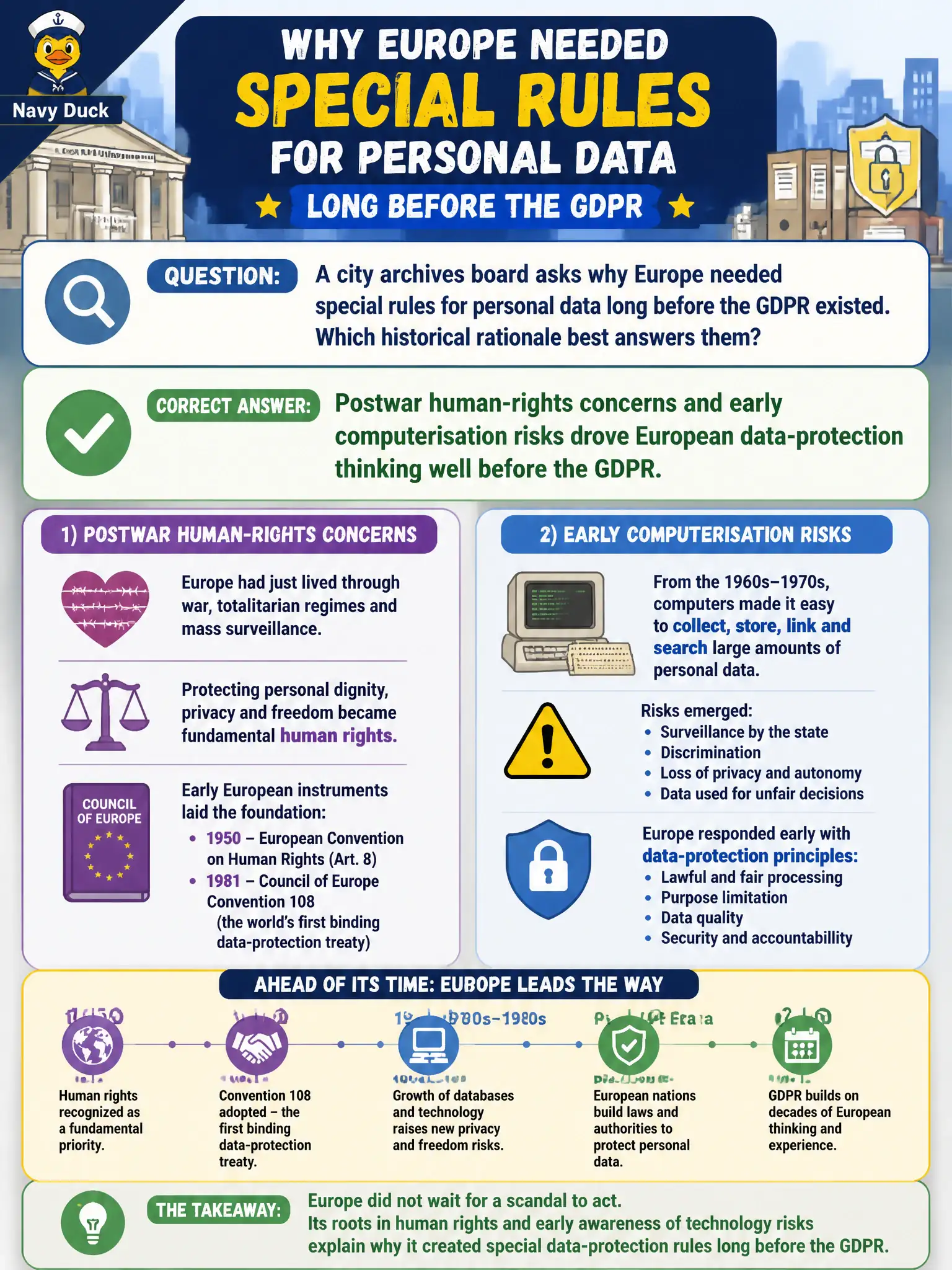
A city archives board asks why Europe needed special rules for personal data long before the GDPR existed. Which historical rationale best answers them?
Select an answer to reveal the explanation.
Short Explanation
Think of Europe's privacy tradition like a house built decades before a fancy remodel. Human dignity and early computers already made people nervous about filing systems that could track citizens at scale — the GDPR is the remodel, not the foundation. So the board is really asking about that older story, not a 2018 invention myth.
Full Explanation
European data-protection thinking long predates the GDPR because postwar human-rights concerns about dignity and autonomy collided with early computerisation risks as automated filing systems spread across public administrations. Instruments such as the OECD Guidelines and Council of Europe Convention 108 already framed principles for fair processing, purpose limitation, and safeguards decades before Regulation (EU) 2016/679. For a city archives board, that lineage explains why municipal record systems were never a privacy vacuum waiting for social media: Europe treated personal-data rules as a human-rights and automated-processing problem first. Claiming privacy rules appeared only after 2018 invents a false origin story and ignores those earlier instruments. Treating data protection as a customs-union tariff code for punched cards confuses trade administration with rights-based processing rules. Asserting that Member States banned filing cabinets in the 1950s so that only digital privacy remained is historically false and wrongly implies paper records fell outside concern. Exam caveat: CIPP/E historical items reward recognising continuity from human rights and early DP law into the GDPR, not treating 2018 as Year Zero. Operational check: when briefing civic leadership, name at least one pre-GDPR European instrument and the dual drivers of human rights plus automated-processing risk before discussing current Article obligations.