
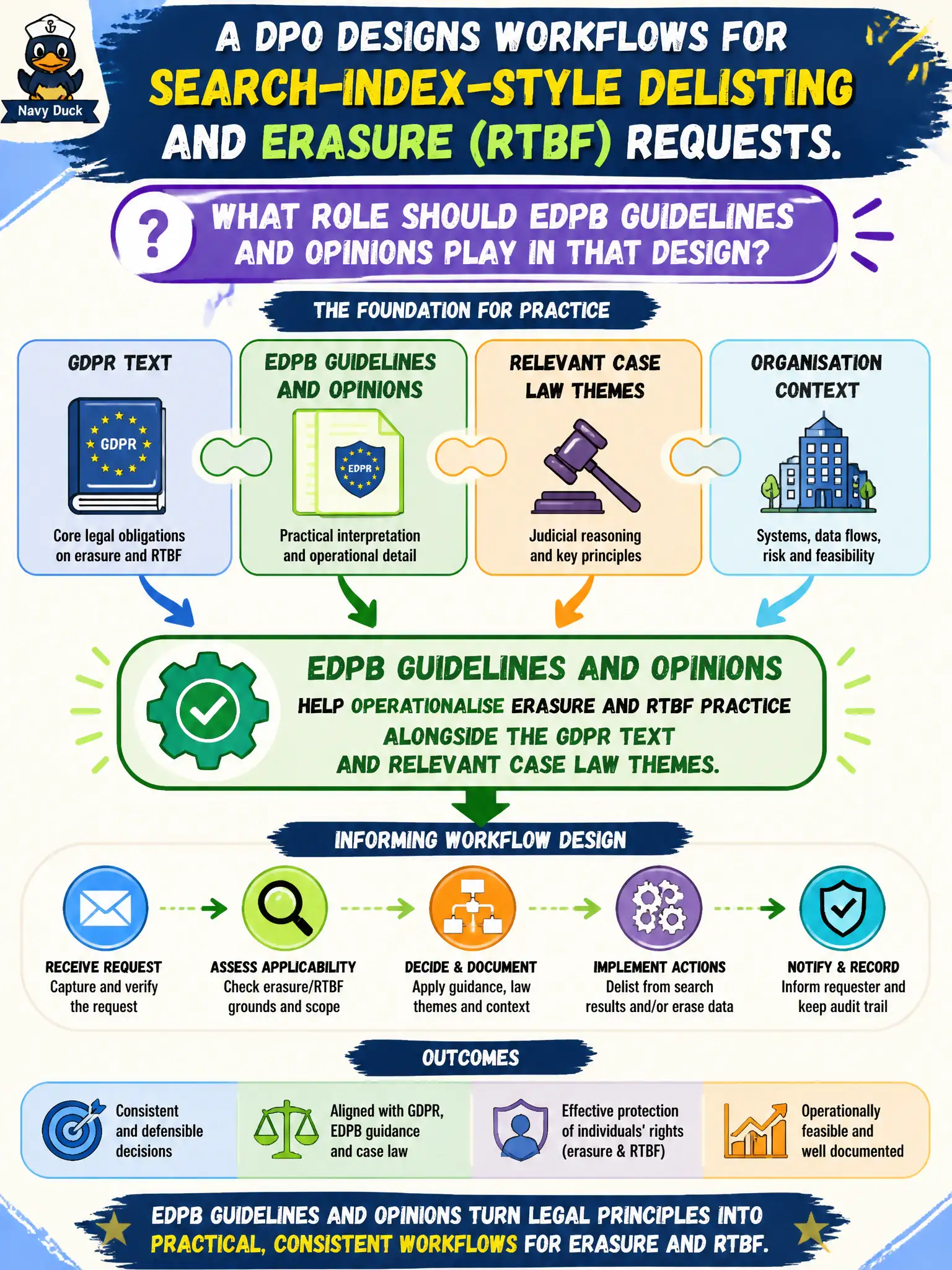
A DPO designs workflows for search-index-style delisting and erasure (RTBF) requests. What role should EDPB guidelines and opinions play in that design?
Select an answer to reveal the explanation.
Short Explanation
When you build an RTBF/delisting playbook, the GDPR is the statute—and EDPB guidelines are the field manual that helps teams apply it consistently. Ignoring that guidance is like tossing the map while navigating a maze. Good DPOs use both the law and the interpretive aids.
Full Explanation
EDPB guidelines and opinions help operationalise erasure and right-to-be-forgotten practice alongside the GDPR text and relevant case-law themes such as search-index delisting. A DPO designing workflows for delisting and erasure should use that soft-law guidance to build consistent criteria, timelines, balancing steps, and reviewer checklists—without treating EDPB materials as a replacement for the Regulation itself or for national supervisory practice that applies to the organisation.
EDPB materials do not replace the GDPR or make national supervisory guidance irrelevant. Delisting workflows must not ignore EDPB guidance in favour of marketing-department preference about what stays online. EDPB opinions and guidelines are not limited to processors; controller erasure and delisting procedures are squarely within the guidance ecosystem controllers are expected to consider.
Exam caveat: soft law guides consistent practice; hard law remains the GDPR and applicable case law. Operational check: map EDPB RTBF criteria into playbooks, train reviewers on balancing tests, log reasoned decisions, and align with lead supervisory expectations. Public-facing platforms and civic information services should show that delisting decisions follow reasoned European guidance, not ad-hoc popularity or PR convenience that residents cannot scrutinise.