
A company claims the right to rectification never applies to any recorded opinion about a person. How should that claim be assessed?
Select an answer to reveal the explanation.
Short Explanation
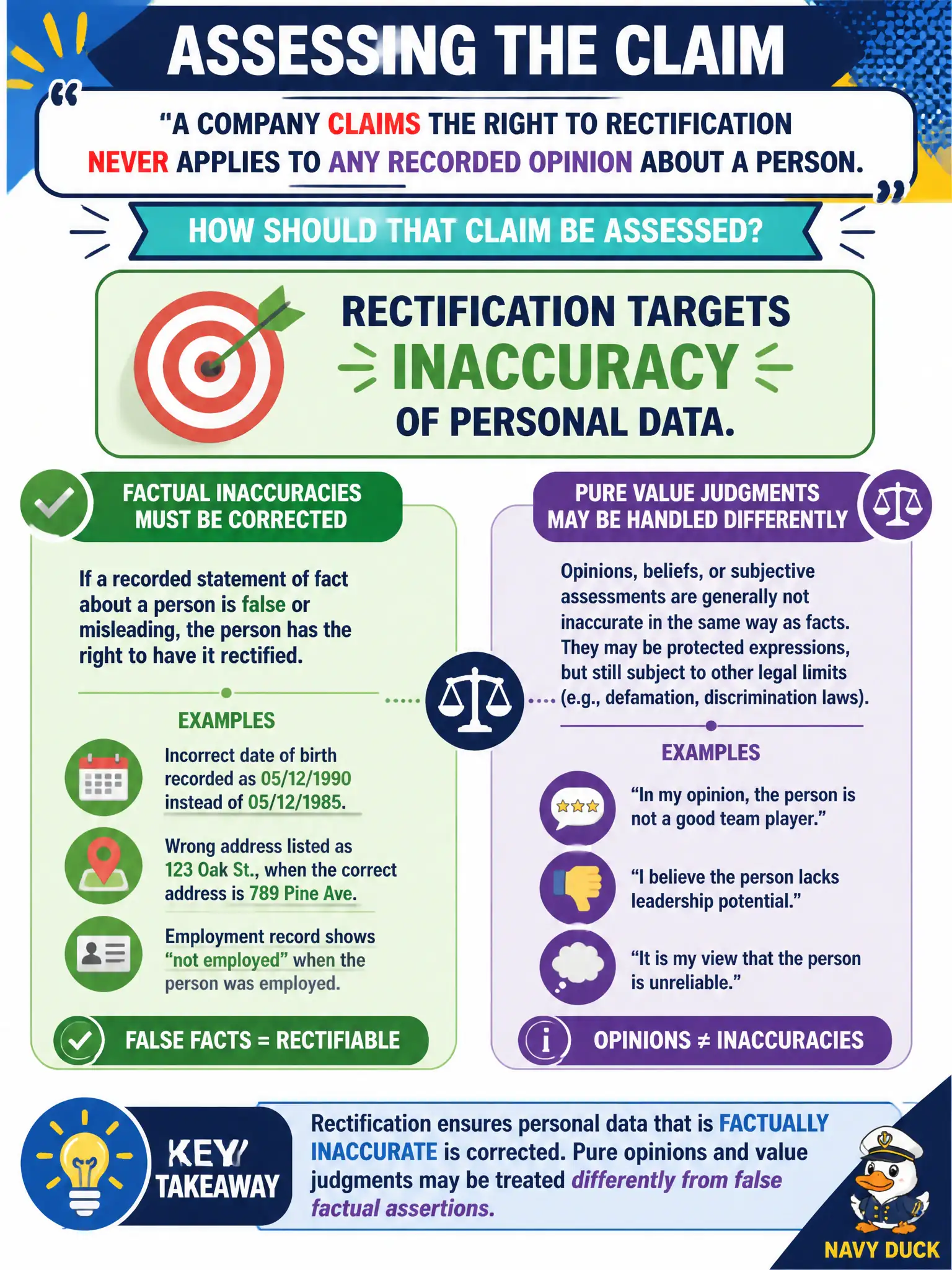
Calling something an opinion does not let you keep a wrong birthday or a made-up address. Facts that are wrong get fixed. True subjective views are a different animal from false statements dressed up as takes.
Full Explanation
Rectification targets inaccuracy of personal data. Factual inaccuracies must be corrected without undue delay; pure value judgments may be handled differently than false factual assertions, sometimes by adding a complementary statement rather than rewriting someone’s opinion wholesale. The claim that rectification never applies to any recorded opinion is too absolute and can be abused to shelter false factual statements merely labelled as “opinion.”
Opinions can still constitute personal data relating to an identified person; rights are not extinguished by the opinion label. Rectification does not always require replacing opinions with the data subject’s preferred wording. Controllers may not store any false facts merely by stamping them as opinions.
Exam caveat: separate false facts from value judgments in rectification analysis—an exam favourite. Operational check: investigate the contested statement, correct false facts, note disputes on opinions where appropriate, propagate corrections to recipients, and communicate the outcome. Public registers and civic case notes should correct wrongful factual entries promptly so residents are not governed by errors dressed up as untouchable opinions, preserving fairness in public decision-making.