
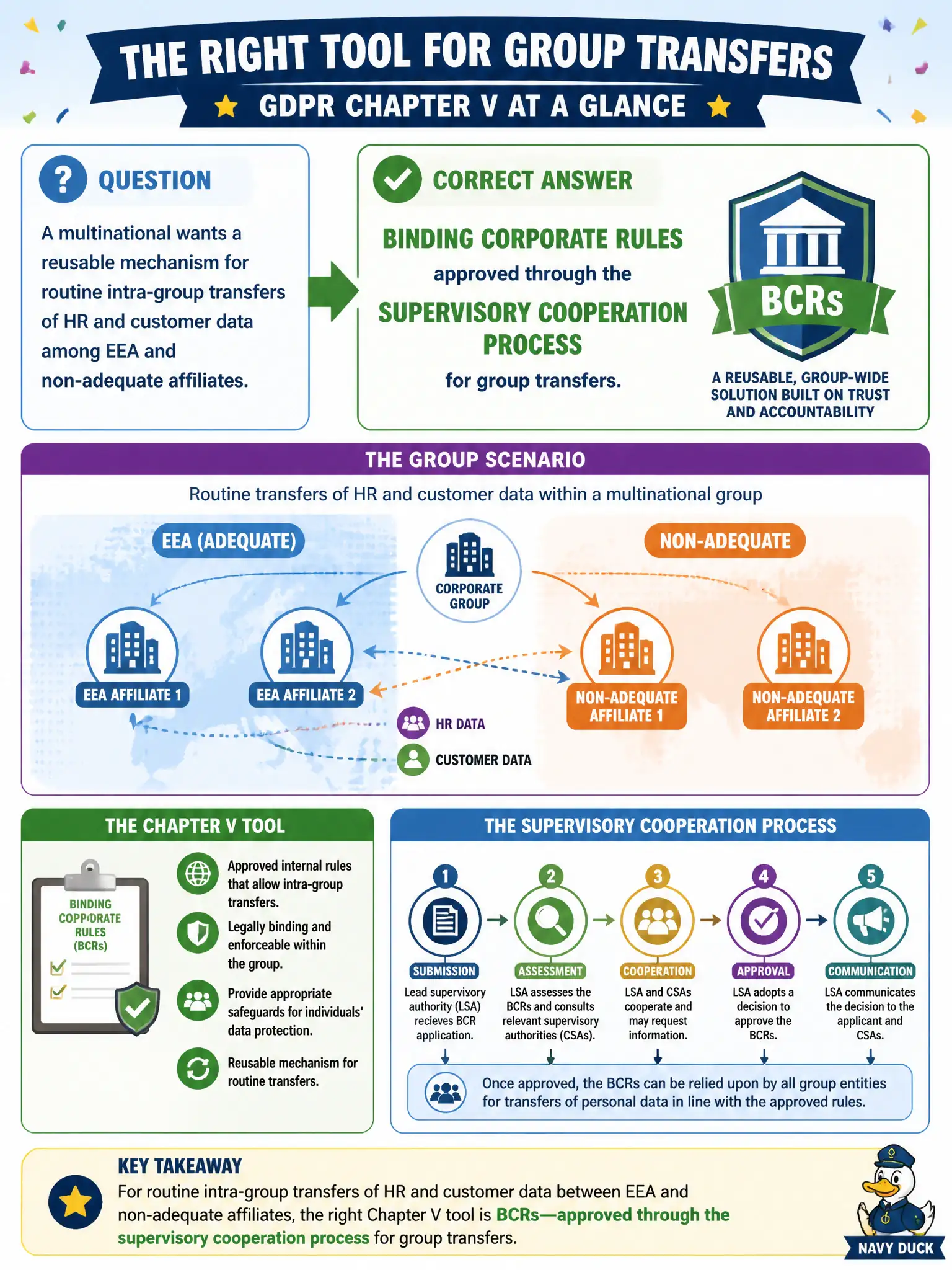
A multinational wants a reusable mechanism for routine intra-group transfers of HR and customer data among EEA and non-adequate affiliates. Which Chapter V tool fits that group scenario at concept level?
Select an answer to reveal the explanation.
Short Explanation
BCRs are the group’s internal rulebook for moving personal data around the corporate family—written to GDPR standards and blessed through the supervisory process. That beats trying to run daily HR syncs on one-off consent or a plain vendor DPA. For systematic intra-group transfers, BCRs are built for the job.
Full Explanation
Binding Corporate Rules are an Article 46 appropriate safeguard designed for multinational groups that routinely transfer personal data among affiliates, including to non-adequate countries. BCRs require a supervisory cooperation approval process and create enforceable intra-group privacy commitments. For reusable HR and customer flows across EEA and non-adequate affiliates, BCRs fit the group architecture far better than one-off exceptions. Public-sector-adjacent corporate groups and private multinationals use them to replace fragmented ad-hoc paper.
Daily Article 49 consent checkboxes are a poor standing design for systematic syncs. A one-page vendor DPA without a supervisory BCR pathway is not BCRs. Public-interest derogations are not meant as the permanent architecture for all affiliate flows.
Exam caveat: BCRs differ from SCCs—BCRs are group policy instruments approved by authorities; SCCs are contractual clauses for specific relationships. Processor BCRs and controller BCRs are distinct flavours.
Operational check: if BCR-bound, verify the approved scope covers the affiliates and data types at issue, train local HR on BCR complaint rights, and avoid parallel ungoverned email exports that bypass the BCR perimeter.