
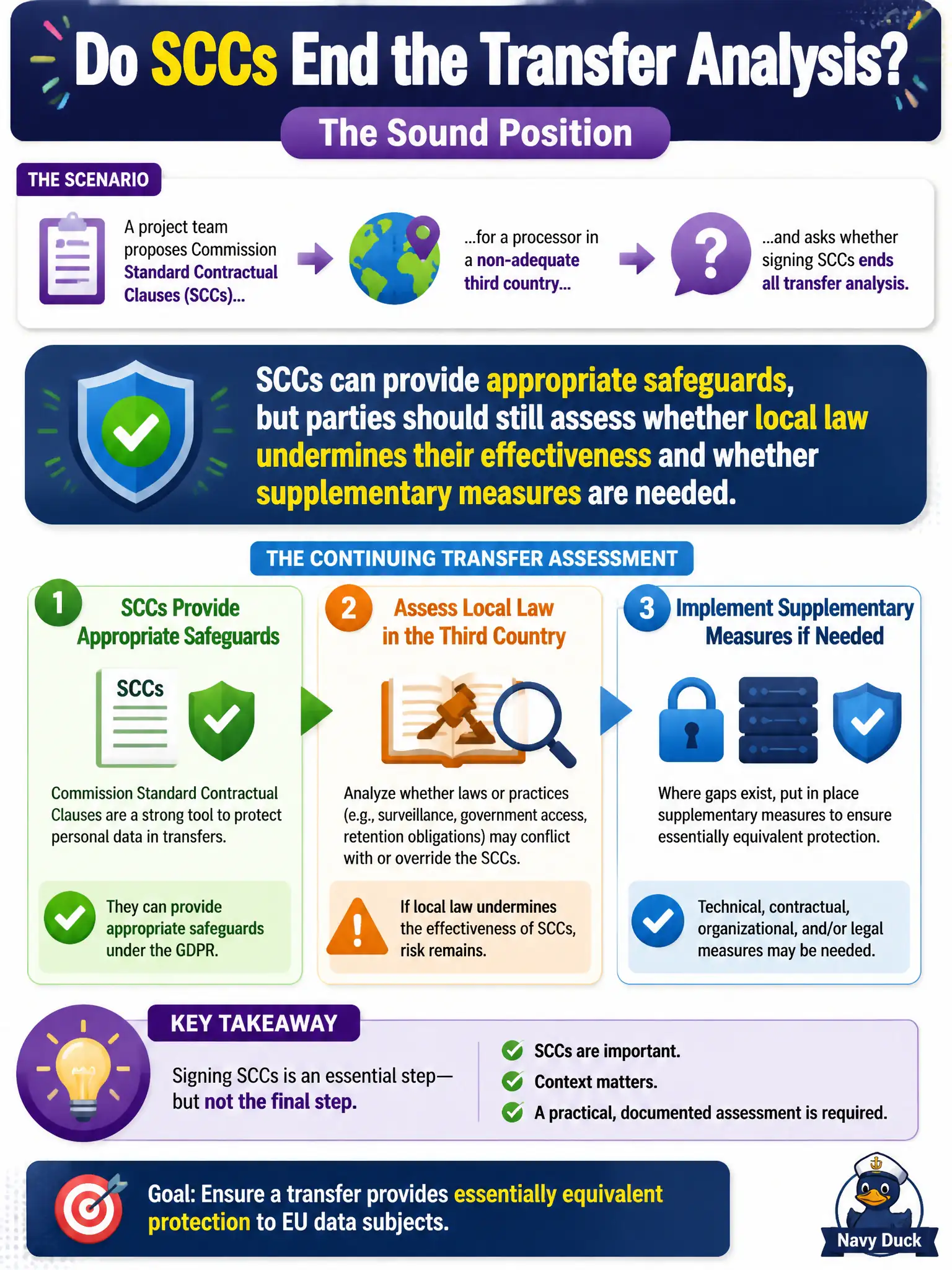
A project team proposes Commission Standard Contractual Clauses for a processor in a non-adequate third country and asks whether signing SCCs ends all transfer analysis. What is the sound position?
Select an answer to reveal the explanation.
Short Explanation
SCCs are a solid contractual seatbelt, but you still check whether the road laws at the destination rip that seatbelt off. Signing the clauses is necessary work—not the end of the journey—when local surveillance or access rules may undercut them. Assess effectiveness and add measures if needed.
Full Explanation
Standard Contractual Clauses adopted by the Commission can provide appropriate safeguards under Article 46, including for transfers to processors in non-adequate third countries when the correct module is used. Signing SCCs does not end all analysis: Schrems II and EDPB guidance expect parties to assess whether third-country law or practices undermine the clauses’ effectiveness and whether supplementary measures are required. Civic and enterprise exporters share that accountability burden.
SCCs are not limited to controller-to-controller transfers; processor modules exist. Transfer impact analysis is not prohibited once SCCs are signed—it is expected where risks warrant. SCCs also do not create an adequacy decision for the destination country; adequacy is a distinct Article 45 instrument.
Exam caveat: use the current Commission SCC sets, pick the right module (C2C, C2P, P2P, P2C), and complete annexes with real transfer descriptions—not blank schedules.
Operational check: execute the correct SCC module, complete a documented transfer impact assessment, implement any supplementary measures (for example strong encryption with key control), and calendar a review when vendor locations or local law change.