
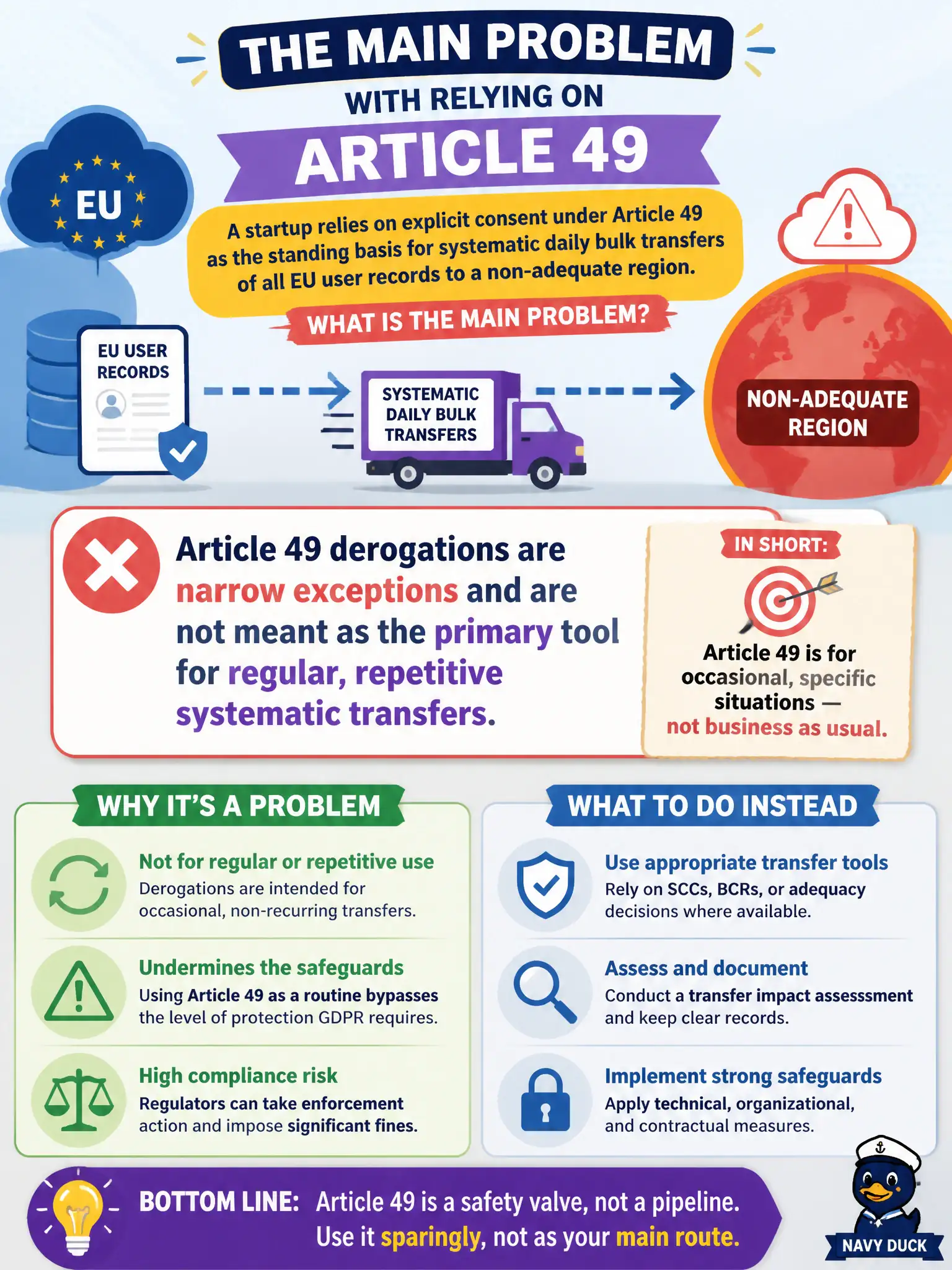
A startup relies on explicit consent under Article 49 as the standing basis for systematic daily bulk transfers of all EU user records to a non-adequate region. What is the main problem?
Select an answer to reveal the explanation.
Short Explanation
Article 49 is the emergency exit, not the main lobby. Using one-off-style consent derogations to feed a daily bulk pipeline turns an exception into business-as-usual. For systematic transfers, build a proper safeguard path instead of living in the derogation.
Full Explanation
Article 49 derogations—including explicit consent for transfers—are narrow exceptions for specific situations. They are not designed as the primary, standing tool for regular, repetitive, systematic bulk exports of all EU user records to a non-adequate region. EDPB guidance emphasises that derogations must be interpreted strictly and that repetitive systematic transfers should normally use Article 45 or 46 mechanisms. Startups serving the public still owe users structural transfer protection, not a daily consent treadmill that papers over missing safeguards.
Article 49 consent is not limited to special-category data. Daily bulk transfers can use SCCs; they do not “always require BCRs.” Consent for transfers is not illegal in all circumstances after Schrems II, but using it as the architecture for continuous bulk export is the misuse.
Exam caveat: occasional, necessary transfers may fit Article 49; “we export the whole production database nightly on consent” is the classic anti-pattern. Freeness and granularity problems also haunt blanket transfer consents.
Operational check: replace standing Article 49 consent for bulk export with adequacy, SCCs, or BCRs; limit any remaining derogations to documented exceptional cases; update notices and stop nightly non-adequate dumps until safeguards exist.