
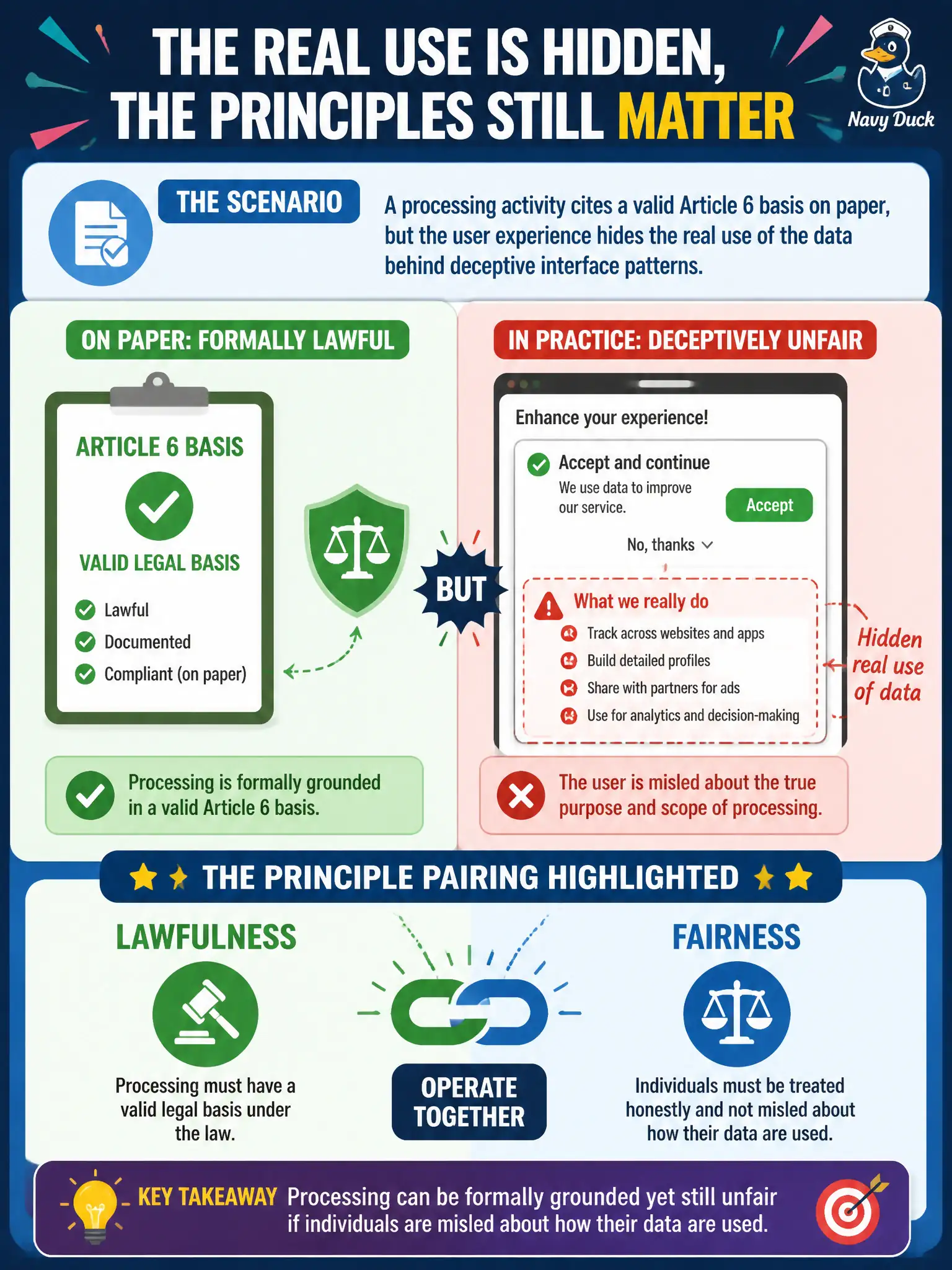
A processing activity cites a valid Article 6 basis on paper, but the user experience hides the real use of the data behind deceptive interface patterns. What principle pairing does this scenario highlight?
Select an answer to reveal the explanation.
Short Explanation
Having a lawful basis on the clipboard does not give a free pass to trick people in the interface. Fairness walks beside lawfulness—if the UX is deceptive, the processing still smells wrong under the principles. Paper compliance without honest dealing is half a job.
Full Explanation
Lawfulness and fairness operate together as Article 5 principles. Processing can cite a valid Article 6 basis on paper yet still be unfair if deceptive interface patterns hide the real use of personal data from individuals. Fairness demands that people are not misled about what happens to their information; dark patterns—hidden defaults, misdirection, and obfuscation—can poison an otherwise formally grounded processing activity and undermine transparency at the same time.
Encryption strength alone does not cure deceptive UX once a lawful basis is named in a policy PDF. Fairness is not optional whenever legitimate interests appear anywhere in the file. Deceptive UX is not exclusively a consumer-marketing issue outside GDPR principles—fairness applies across public and private sectors whenever personal data are processed.
Exam caveat: lawful on paper plus misleading UX can still fail fairness (and transparency) on the exam. Operational check: review interfaces for hidden processing, align notices with actual data uses, ban deceptive toggles and pretexts, and test comprehension with real users. Civic digital services should model honest design so residents understand municipal data uses; stewards should record why dark patterns were rejected as incompatible with public integrity.