
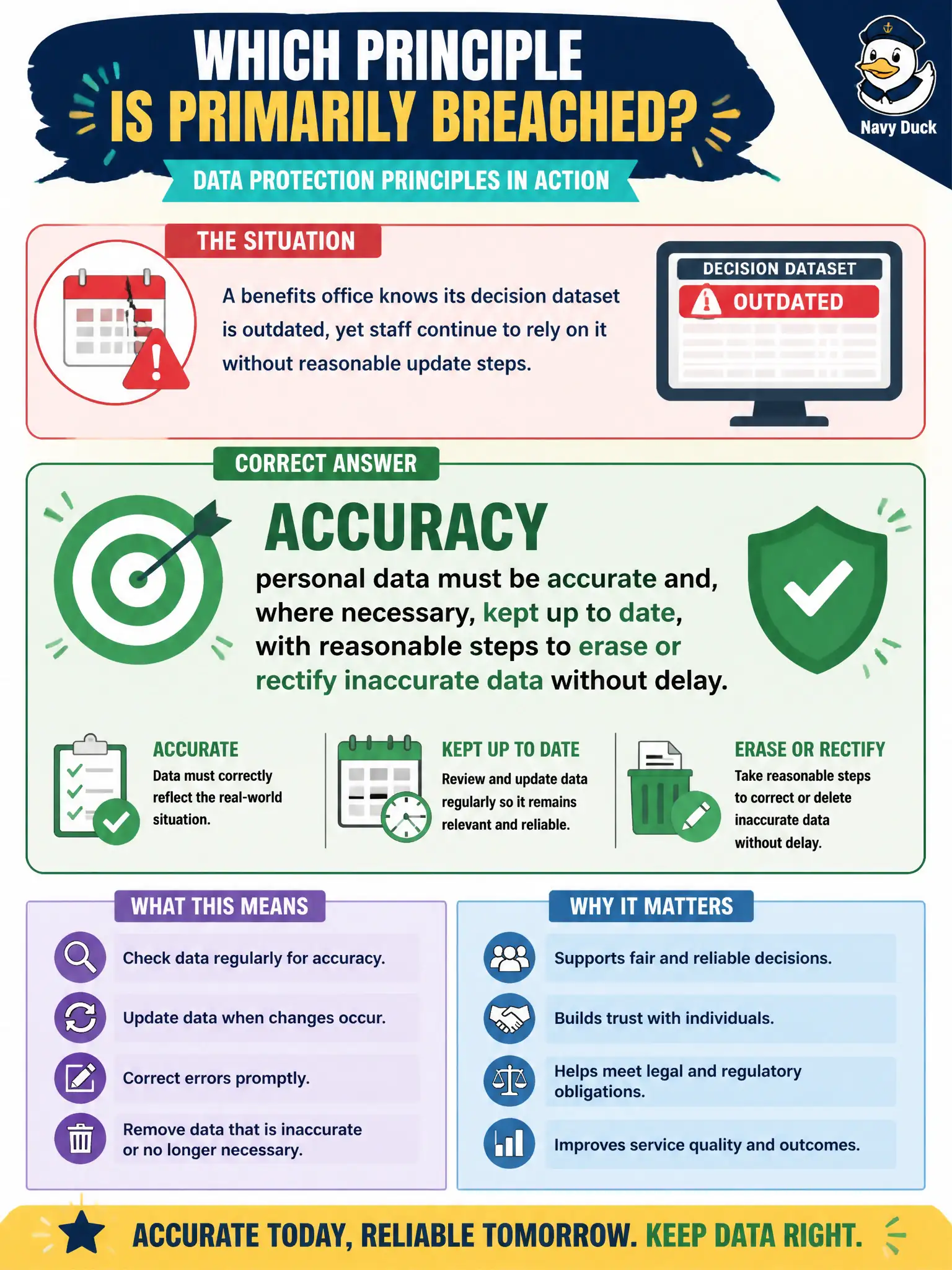
A benefits office knows its decision dataset is outdated, yet staff continue to rely on it without reasonable update steps. Which principle is primarily breached?
Select an answer to reveal the explanation.
Short Explanation
If the map is years out of date and you still navigate by it, wrong turns are on you. Accuracy means take reasonable steps to keep personal data right—especially when decisions about people hang on those fields. Shrugging at known stale benefit data is not good enough.
Full Explanation
Accuracy requires that personal data be accurate and, where necessary, kept up to date, with reasonable steps to erase or rectify inaccurate data without delay. A benefits office that knows its decision dataset is outdated yet continues to rely on it without reasonable update steps primarily breaches accuracy—and risks unfair, wrongful decisions against residents who depend on correct administrative data.
Purpose limitation is not automatically breached merely because data are outdated; outdatedness speaks first to accuracy (though further uses may raise other issues). Data minimisation does not require duplicating every outdated field in a second database. The right to object does not automatically delete inaccurate municipal records overnight; rectification and update processes are the direct tools.
Exam caveat: known stale decision data + continued reliance = accuracy failure. Operational check: schedule data-quality reviews, correct or refresh source fields, suspend automated decisions on known-bad sets, and propagate fixes to downstream systems. Benefits administration is a civic fairness engine; supervisors should treat knowingly outdated datasets as both a compliance defect and a justice defect toward claimants.