
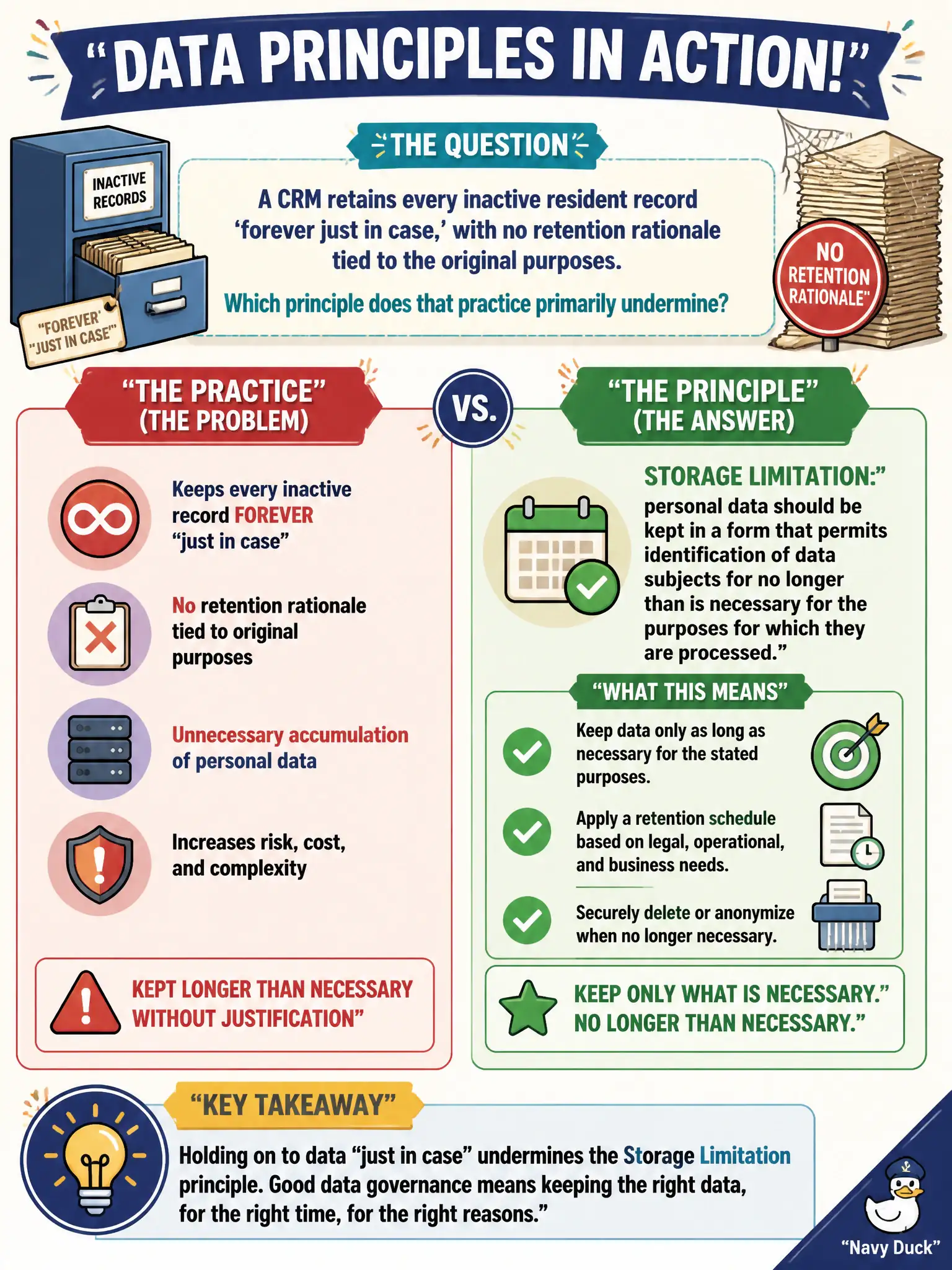
A CRM retains every inactive resident record ‘forever just in case,’ with no retention rationale tied to the original purposes. Which principle does that practice primarily undermine?
Select an answer to reveal the explanation.
Short Explanation
‘Just in case forever’ is the digital equivalent of never taking the holiday decorations down. Storage limitation says keep identifiable data only as long as the purpose still needs them. Parking inactive resident files indefinitely without a retention story breaks that rule.
Full Explanation
Storage limitation requires that personal data be kept in a form permitting identification of data subjects for no longer than necessary for the purposes for which they are processed. A CRM that retains every inactive resident record “forever just in case,” with no retention rationale tied to original purposes, primarily undermines that principle. Indefinite speculative retention turns “just in case” into a permanent identifiable archive without demonstrated necessity for any current municipal purpose.
Lawfulness does not always require indefinite retention of inactive records; keeping everything forever is not a lawful-basis strategy. Accuracy is not improved merely by keeping old records longer; stale contact and status data often become less accurate and more harmful. Transparency is not limited to privacy-notice colour schemes and does not excuse missing retention schedules or unexplained perpetual storage.
Exam caveat: “just in case” is the storage-limitation anti-pattern candidates should recognise instantly. Operational check: define purpose-linked retention schedules, automate deletion or anonymisation of inactive records, justify any long holds with documented need, and purge or crypto-shred backups where feasible. Civic resident databases should earn their longevity with documented need—otherwise cities quietly accumulate dossiers that residents never agreed to warehouse forever.